 HYGO News
 Paul 'Triple H' Levesque: health & wellness sports, Fitness Test; Trump's BBB $1k Baby wealth
Paul “Triple H” Levesque: health & wellness sports, Fitness Test; Trump’s BBB $1k Baby wealth
Two announcements with specific cultural resonance. WWE legend Paul “Triple H” Levesque, joining the President’s Council on Sports, Fitness, and Nutrition: “Since I was 14, this has been such an important part of my life. Health, fitness, sports, nutrition, all of it … I look forward to the opportunity to help make our youth healthy.” Trump confirmed the restoration of the Presidential Fitness Test: “It’s going to be a very big thing from the late 1950s until the 2013 graduate scholars all across our country competed against each other in the Presidential Fitness Test. And it was a big deal. This was a wonderful tradition and we’re bringing it back.” And “not signed with an auto pen. We don’t want auto pens in the White House.” Treasury Secretary Scott Bessent explained the $1,000 Baby Account provision of the One Big Beautiful Bill: a capitalist supplement to Social Security designed to give “every newborn a stake in the system.” And Bessent on NYC: “Caracas on the Hudson.”
Triple H’s Endorsement
Paul “Triple H” Levesque opened by thanking the administration team. “Thank you to President Trump. Thank you for this honor. I’m humbled by it. I’m truly honored to be on this. Vice President Vance, thank you very much, Secretary Kennedy. Truly appreciate all that everybody is doing for the health and wellness of the entire country.”
Levesque’s name is familiar to wrestling fans. As Triple H, he was one of the most iconic professional wrestlers of the 2000s, a 14-time world champion, and currently the Chief Content Officer at WWE. His extensive work with WWE’s fitness programming makes him a natural fit for the President’s Council.
“For me, since I was 14, this has been such an important part of my life. Health, fitness, sports, nutrition, all of it. I think learning that at a young age sets you up for success in life. And without it, you’re at a lesser place for it.”
“Since I was 14.” Levesque’s personal framing. Physical fitness became central to his life as a young teenager. Professional wrestling, for all its theatrical elements, requires genuine athletic preparation. Levesque’s perspective — that early physical-fitness education shapes life trajectories — is informed by decades of personal experience.
“So I look forward to the opportunity to do this. I look forward to the opportunity to help make our youth healthy, help get them engaged in sports, and let them learn what it takes to be successful in life. So thank you very much for the honor. Thank you.”
The specific objective Levesque is committing to: getting American youth “engaged in sports.” That is more concrete than the general “fitness” framing. Sports engagement requires specific infrastructure, programming, and cultural emphasis. Youth sports participation rates have declined in recent decades — Levesque’s platform focus is reversing that decline.
The Presidential Fitness Test
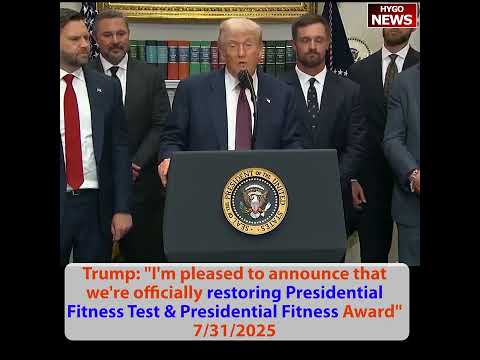
Trump announced the specific policy deliverable. “I’m pleased to announce that we’re officially restoring the Presidential Fitness Test and the Presidential Fitness Award.”
The Presidential Fitness Test is the specific program that ran in American public schools from the late 1950s to 2013. Schools administered standardized physical-fitness assessments — timed runs, push-ups, sit-ups, pull-ups, flexibility tests — with awards for students who achieved specific performance benchmarks.
“And it’s going to be a very big thing from the late 1950s until the 2013 graduate scholars all across our country competed against each other in the Presidential Fitness Test. And it was a big deal.”
Millions of American children took the Presidential Fitness Test during the 55 years it operated. Schools integrated the assessments into physical-education curricula. Results were recorded. Awards were given. For generations of students, the fitness test was a regular part of school life.
“This was a wonderful tradition and we’re bringing it back.”
The Obama administration discontinued the Presidential Fitness Test in 2013, replacing it with a more lenient “Presidential Youth Fitness Program” that emphasized participation over performance benchmarks. Trump is restoring the competitive performance-based approach.
That restoration has cultural as well as policy significance. The shift from performance-based fitness assessment to participation-based programming reflected broader changes in educational philosophy that critics have characterized as lowering expectations. Restoring the performance-based test is restoring the standards.
”Not Signed With an Auto Pen”
“Okay, we got it. We’ll pass that one up, please. That is not signed with an auto pen. We don’t want auto pens in the White House. Okay.”
Trump continuing to make the autopen point. Every signing event is an opportunity to demonstrate that Trump personally signs documents rather than delegating to autopen. The political framing: Biden-era autopen usage is, in Trump’s framing, one of the great scandals of our time. Trump’s visible personal signing is the counter-demonstration.
The $1,000 Baby Account
Treasury Secretary Scott Bessent explained the Trump Accounts (also called Baby Accounts or $1,000 Baby Bonds) provision of the One Big Beautiful Bill. “The $1,000 baby bonds that every American citizen, every newborn is going to get.”
$1,000 at birth. For every American newborn. Deposited into an investment account that grows with compounding returns over decades.
“The Democrats hate this program because it brings capitalism and markets to every American, not just their constituents at the upper end.”
That is the political framing. Democrats, in Bessent’s framing, have oriented their economic policy around government benefits for their voter base. Republicans are orienting around market participation for all Americans. The Trump Account is the concrete embodiment of the Republican approach.
“Over time, the compounding is going to be an incredible supplement to Social Security, not a replacement. It is a compliment. What I said was Social Security will continue as it is. It is intact. Everyone will get their check every month.”
That is the critical framing. The Trump Account is not replacing Social Security. Social Security continues. The Trump Account supplements Social Security.
The Math
“But it’s very exciting to me that there could be a big payout at the end of when people turn 59 or 60 for the first time, Joe.”
The timing: Americans who started their lives with Trump Account deposits in 2025 would be roughly 59-60 years old in 2084-2085. At that age, they would have approximately 60 years of compounded growth on the initial $1,000 (plus potential additional contributions).
At 7% annual compound returns (historical stock-market averages), $1,000 invested for 60 years becomes approximately $57,000. At 10% annual returns, it becomes approximately $304,000. The specific outcome depends on market performance, but the directional scale is significant — a multi-decade compounded investment from $1,000 of federal seed funding becomes meaningful capital by retirement age.
“Because as you know, bottom 50% of households in America do not have financial assets and President Trump is giving them financial assets.”
That is the distributional claim. 50% of American households have minimal or zero financial assets — no stock portfolios, no mutual funds, no retirement accounts beyond Social Security. For those households, the Trump Account is the first financial asset they will own.
”Caracas on the Hudson”
Bessent’s extraordinary characterization of NYC under Mamdani. “I believe that the reason you all have the mess you are about to have in New York, Caracas on the Hudson, is because people have given up on a market-based system.”
“Caracas on the Hudson.” That is the framing. Caracas is the capital of Venezuela — a country transformed over the past two decades from South America’s wealthiest nation to economic catastrophe through socialist policies. The comparison places NYC’s potential trajectory under Mamdani alongside Caracas’s actual trajectory under Chavez and Maduro.
The comparison is political hyperbole. NYC under Mamdani would not fully replicate Venezuela’s destruction. But the structural similarities Bessent is pointing to — government-run grocery stores, rent controls, anti-capital messaging, socialist-coded policies — do have historical precedents in countries that have experienced substantial economic decline.
”A Shareholder in the System”
“Trump administration is going to make every newborn a shareholder, and they are going to have a stake in the system. When you have a stake in the system, you do not want to bring down the system.”
That is the political-economic theory behind the Trump Account. People who own financial assets become invested in the system’s success. They support policies that grow their assets. They resist policies that would destroy the underlying wealth-creation mechanism.
Mass financial-asset ownership, in this framing, is the strongest structural defense against socialist policy drift. If every American is a shareholder, electoral coalitions favoring confiscation or destruction of wealth become politically untenable.
“So the power of compounding could mean a big payout that would be a compliment, not a substitute for Social Security.”
“The power of compounding” is the specific mechanism. Albert Einstein is often quoted as calling compound interest “the most powerful force in the universe.” Sixty years of compounding at stock-market rates produces returns that intuition cannot anticipate. The Trump Account harnesses that power for every American.
The Cultural Work
Triple H joining the Council is cultural work. Pro-wrestling fans include significant numbers of working-class Americans, many of whom are politically unaffiliated or lean conservative. Levesque’s association with MAHA signals that fitness and physical-strength culture is being integrated into the administration’s public-health agenda.
Restoring the Presidential Fitness Test is cultural work. The test represented a specific era of American youth development — Cold War-era emphasis on physical vigor and competitive benchmarking. Its restoration signals return to those values.
The Trump Accounts are political-economic work. Turning every American newborn into a shareholder fundamentally changes the political coalition’s relationship with capital. If the provision holds through multiple administrations, it reshapes American political economy in directions that favor wealth-accumulation and market participation over redistribution and government dependence.
Key Takeaways
- Paul “Triple H” Levesque joined the President’s Council on Sports, Fitness, and Nutrition: “Since I was 14, this has been such an important part of my life … I look forward to the opportunity to help make our youth healthy.”
- Trump announced the restoration of the Presidential Fitness Test: “It’s going to be a very big thing from the late 1950s until the 2013 … And it was a big deal. This was a wonderful tradition and we’re bringing it back.”
- “That is not signed with an auto pen. We don’t want auto pens in the White House” — continuing the autopen critique.
- Treasury Secretary Bessent on the Trump Accounts: “$1,000 baby bonds that every American citizen, every newborn is going to get … an incredible supplement to Social Security, not a replacement.”
- Bessent on NYC under Mamdani: “Caracas on the Hudson … because people have given up on a market-based system. Trump administration is going to make every newborn a shareholder, and they are going to have a stake in the system.”