 HYGO News
 Patriot missile crews to Iran's strikes: oldest 28-yr-old captain, youngest 21-yr-old private 2 yrs
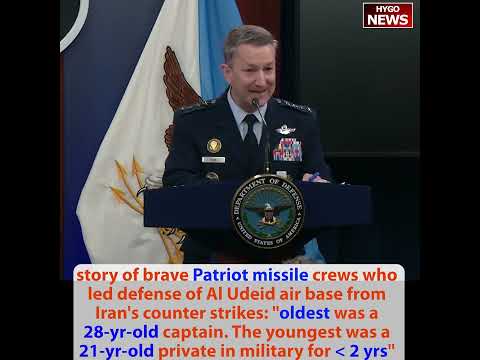
Patriot missile crews to Iran’s strikes: oldest 28-yr-old captain, youngest 21-yr-old private 2 yrs
Joint Chiefs Chairman General Dan “Raizin” Caine delivered one of the most detailed operational accounts of the Iran retaliation response at a Pentagon briefing, walking step by step through the defense of Al Udeid Air Base in Qatar against the Iranian missile barrage that followed the American strikes on Iranian nuclear facilities. The account is notable for its specificity — the 44 American soldiers who remained on base after the security perimeter was extended, the two Patriot batteries operating in minimum-force posture, the youngest defender being a 21-year-old private with less than two years of service. What Caine called “the largest single Patriot engagement in US military history” saw the Iranian missile salvo defeated by air defenders working in coordination with Qatari Patriot crews. The resulting defense is, Caine argued, evidence of the combat capability the administration has been investing in.
”Indications And Warnings”
Caine opened with the pre-attack preparation. “First on Monday, as the president has stated on Monday morning we began to receive indications and warnings that Iran intended to attack US bases in the region.”
“Indications and warnings” is the intelligence community’s term of art for the early signals that precede a specific attack. The American intelligence system produces such indications through multiple collection methods — signals intelligence, human sources, satellite imagery, and open-source analysis. When multiple streams converge on the same threat assessment, the administration has advance warning to prepare.
”Minimum Force Posture”
Caine described the preparatory step. “That morning building on the work that Sentcom commander Eric Karilla had done and on the orders of the president, Al Udeid air base in Qatar and around the region we assumed a minimum force posture. Most folks had moved off the base to extend the security perimeter out away from what we assessed might be a target zone except for a very few army soldiers at Al Udeid.”
“Minimum force posture” is the operational term for the preparation. The base was evacuated of non-essential personnel. Only those required to execute the base defense mission remained. The security perimeter was extended outward, reducing the concentration of potential casualties if the Iranian strikes hit.
The decision to extend personnel away from the base represents good operational judgment. Al Udeid hosts thousands of American personnel under normal conditions. Had all of them remained on base during the Iranian attack, the casualty risk would have been substantial. The minimum force posture limited the exposure to the specific personnel required for defense.
”44 American Soldiers”
Caine provided the specific count. “At that point only two Patriot batteries remained on base, roughly 44 American soldiers responsible for defending the entire base to include Sentcom’s forward headquarters in the Middle East and entire air base and all the US forces there.”
44 American soldiers. Two Patriot batteries. Responsible for defending the United States’ forward headquarters in the entire Middle East theater. The ratio of mission significance to personnel size is striking. These 44 soldiers, operating two Patriot systems, were the difference between a successful defense and a catastrophic loss.
”The Oldest Soldier Was 28”
Caine then humanized the defenders. “The oldest soldier was a 28 year old captain. The youngest was a 21 year old private who’d been in the military for less than two years.”
The age profile captures something important about the American military. The average age of the defenders was far younger than most observers might assume. The soldiers responsible for the most consequential air defense engagement in recent military history were not seasoned veterans with decades of experience. They were young people who had, in many cases, only recently completed their specialized training.
That is the nature of the American armed forces. Young people carry extraordinary responsibilities. Their training, their discipline, their chain of command, and their individual character are what translate that responsibility into mission success.
”Put Ourselves Out There”
Caine then invited the audience into the perspective of a specific defender. “So let’s put ourselves out there for a second. Imagine you’re that young first lieutenant, you’re 25 or 26 years old and you’ve been assigned as the tactical director inside the command and control element. You at that age are the sole person responsible to defend this base.”
The rhetorical move is deliberate. Caine is asking the audience to inhabit the perspective of a young officer facing an imminent attack. Most observers, reading news reports of military operations, experience them abstractly. Caine is forcing the audience to consider what it feels like to be the person making the decisions that determine whether the attack succeeds or fails.
“The sole person responsible to defend this base” is the burden. Not a team. Not a committee. One young officer, supported by colleagues, but ultimately the individual whose decisions will determine the outcome.
”120 Seconds”
Caine described the decision timeline. “Listening next to you is your early warning operator whose job is to notify you of imminent attack. There’s five people inside a vehicle and five people outside of a vehicle around these total of, as I said, 44.”
The specific personnel distribution — five in the vehicle, five outside — captures the operational configuration. Patriot crews operate from command vehicles that coordinate the battery. The crews work together in close proximity. Their coordination has to be instantaneous when an engagement begins.
“You know that you’re going to have approximately two minutes, 120 seconds to either succeed or fail.”
120 seconds. The entire engagement window from detection to intercept. In that window, the defender must identify the threat, acquire it with the Patriot radar, compute an intercept solution, launch the missile, guide it to the target, and confirm the intercept. If any step fails, the incoming missile reaches its target.
”Multiple Extensions”
Caine noted the defender backstory. “By the way, you’ve sat in the Middle East for years deployed over and over again, extended multiple times, always being prepared, but unsure of when that particular day will come that you must execute your mission and not fail at doing it.”
The observation captures the nature of military deployment. Soldiers train for months and years for specific mission profiles. Most deployments do not produce the specific combat moment the training prepares them for. Some deployments do. The soldier never knows in advance which deployment will include the combat moment. They must remain prepared at all times, even during the long periods when the training seems disconnected from the day-to-day experience.
“In this case, these Patriot crews were deployed from Korea and Japan as part of our US forces there to ensure that we had the most capable missiles in the Sentcom area of responsibility.”
The crews had been reassigned from East Asia to the Middle East specifically because of the elevated threat. That reassignment reflects the kind of operational judgment the administration had been making for weeks — moving the most capable forces to the theater where they would be most needed.
The Countdown
Caine walked through the specific moments leading up to the engagement. “As the day continues, you start to hear more and more chatter in the information space about an appending attack. As the sun starts to set in the West, you get orders from your higher headquarters to make sure that your missile batteries are pointed to the north.”
“Pointed to the north” is the specific directional orientation. Iranian missiles would be incoming from Iran. Iran is north of Qatar. The batteries’ radar arrays had to be oriented to detect incoming tracks from that direction.
”It’s Hot, You’re Getting Nervous”
The human detail. “There are just a few other teammates. It’s hot, you’re getting nervous, and you expect an attack. Outside of those Patriot vehicles, your hot crew, which is one NCO and four additional soldiers, turns a key and relinquishes control of those missiles to that young lieutenant inside the vehicle. And you wait.”
The procedural moment — the hot crew turning the key and relinquishing control — captures the military’s carefully designed transfer of authority. The missiles are armed. The young officer in the vehicle has the authority to fire. The surrounding crews have done their pre-engagement work. Everyone waits.
The Attack
Caine described the moment of engagement. “You know that you’re going to have approximately two minutes, 120 seconds to either succeed or fail. And at approximately 12 30 PM on Monday, 7 30 PM in Qatar as the sun sets in the West, Iran attacks as the targets were detected round after round of Patriot missiles are ejected from their canisters by an initial launch charge. Then the main solid rocket motor ignites. You can feel this in your body if you’ve ever been around a Patriot taking a shot and round after round goes out and guides against those missiles coming inbound.”
“You can feel this in your body” is the operational description of what it is like to be near a Patriot launch. The physics of launching a missile at Mach 4 involves enormous acoustic and kinetic energy. Witnesses near a Patriot firing describe it as one of the most physically impressive experiences in modern military operations. Caine is reminding the audience that these young soldiers experienced that intensity repeatedly, round after round, during the engagement.
”The Largest Single Patriot Engagement”
Caine delivered the operational verdict. “We believe that this is the largest single Patriot engagement in US military history.”
Patriot systems have been operational since the 1980s. They have been used in combat in Operation Desert Storm, in Operation Iraqi Freedom, and in various subsequent engagements. The claim that this specific engagement is “the largest single” one in US military history means the Al Udeid defense involved more Patriot launches than any prior engagement. The scale reflects the magnitude of the Iranian missile salvo the defenders faced.
”Qatari Patriot Crews”
Caine acknowledged the alliance dimension. “We were joined in this engagement by the Qatari Patriot crews.”
Qatar, as host country, operates its own Patriot systems. Those systems participated in the defense. The engagement was a combined American-Qatari operation, with both countries’ air defenders contributing to the successful intercept of the Iranian missiles.
The operational coordination between American and Qatari forces required pre-existing training relationships. The fact that the joint engagement was executed without friendly-fire incidents or deconfliction problems reflects the quality of the alliance relationship.
”A Lot Of Metal Flying Around”
Caine described the air environment during the engagement. “I’m not going to tell you how many rounds were shot, but it was a bunch because of classified purposes. And we’re aware that something there’s reports of something getting through. What we do know is there was a lot of metal flying around between attacking missiles being hit by Patriots, boosters from attacking missiles being hit by Patriots. The Patriots themselves flying around in the debris from those Patriots hitting the ground. There was a lot of metal flying around.”
The image of “metal flying around” captures the physical reality. Interceptions at altitude produce debris. That debris falls. Some of the debris is intact missile components. Some is fragmented metal. During the engagement, the airspace over Al Udeid was filled with the kinetic residue of the successful defense.
“Reports of something getting through” is Caine’s honest acknowledgment that the defense was not perfect. Some Iranian missiles may have reached areas beyond Patriot intercept. The administration has not publicly detailed what, if anything, specifically landed where. But Caine’s acknowledgment signals that the defense was, while extraordinarily successful, not without limitations.
”Complex Decisions With Strategic Impact”
Caine summarized the defenders’ work. “And yet our US air defenders had only seconds to make complex decisions with strategic impact. These awesome humans, along with their Qatari brothers and sisters in arms stood between a salvo of Iranian missiles and the safety of Al Udeid. They are the unsung heroes of the 21st century United States Army.”
“Seconds to make complex decisions with strategic impact” is the operational pressure. The defenders could not consult extensive guidance. They could not pause to deliberate. They had to decide, in real time, how to allocate limited interceptors against incoming threats. Their decisions determined whether the strategic outcome was successful defense or catastrophic loss.
”The Unsung Heroes”
The characterization — “unsung heroes” — is significant because much of the coverage has focused on the offensive operation (the B-2 strikes on Iran). The defensive operation at Al Udeid has received far less attention. Caine is correcting that imbalance. The 44 defenders at Al Udeid deserve recognition equal to the B-2 pilots who flew to Iran.
”They Absolutely Crushed It”
Caine’s colloquial close captured the outcome. “And I know a lot of you have seen the videos online and the excitement as those Patriots departed their launchers and went up and guided. This really demonstrates the combat capability and capacity of our Army air defenders. Simply stated, they absolutely crushed it.”
“Absolutely crushed it” is Caine’s informal verdict. Professional military briefings often favor more measured language. Caine’s willingness to use the informal framing captures the pride he wants to communicate about the defenders’ work.
The Strategic Implications
The Al Udeid defense has implications beyond the immediate engagement. Iranian planners attempting to assess the cost of future attacks on American facilities now have to account for the observed Patriot defensive capability. Iranian missiles, even in large salvos, did not overwhelm the American defense. That observation will shape Iranian future decision-making about whether to attempt similar operations.
The defense also demonstrates the quality of the American-Qatari alliance. Qatar’s willingness to host the base, to operate its own defensive systems in coordination with American forces, and to accept the risks of Iranian retaliation against its territory reflects a functional partnership. Future American force posture in the Gulf depends on similar functioning partnerships with host countries.
Key Takeaways
- Caine on the defense profile: “44 American soldiers responsible for defending the entire base to include Sentcom’s forward headquarters in the Middle East.”
- The age range: “The oldest soldier was a 28 year old captain. The youngest was a 21 year old private who’d been in the military for less than two years.”
- The 120-second engagement window: “You know that you’re going to have approximately two minutes, 120 seconds to either succeed or fail.”
- The historical significance: “We believe that this is the largest single Patriot engagement in US military history.”
- Caine’s verdict: “They are the unsung heroes of the 21st century United States Army…Simply stated, they absolutely crushed it.”