 HYGO News
 Part 2: Georgia's new election law Jim Crow in the 21st century?
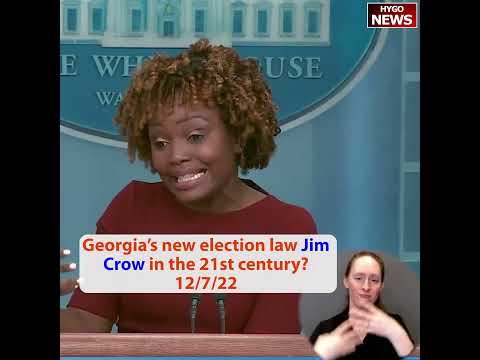
KJP on “Jim Crow” Georgia Claim: Pivots to Biden Agenda Success and “Ultra-MAGA” Republican Attacks — Won’t Reconcile Original Framing With Record Turnout
On 12/8/2022, in a continuation of the exchange about Georgia’s election law, a reporter pressed White House Press Secretary Karine Jean-Pierre again on whether President Biden still viewed Georgia’s SB 202 as “Jim Crow in the 21st century” and a “blatant attack on the Constitution” — given the record turnout in Georgia’s 2022 elections. Rather than answering the question directly, KJP pivoted to defend the administration’s political performance. “The American people spoke very loud and clear. And they did that because of the success that the president has had on his legislative agenda,” KJP said. She then shifted to attacking Republicans for “ultra-maga ideas” and claimed “it was a stunningly bad cycle for Republican senators.” The pivot served to avoid reconciling Biden’s original severe characterization of the law with the fact that turnout under the law had been record-breaking rather than suppressive.
The Context of Continuation
This exchange was the second part of a conversation that began with the reporter noting record turnout in Georgia’s primary, general, and runoff elections. The reporter had asked whether DOJ would drop its lawsuit given the turnout data, and whether Biden still saw the law as “Jim Crow in the 21st century.”
KJP’s initial response had deflected to DOJ matters and asserted that suppression had occurred despite the turnout numbers. The current exchange continued with the direct question about Biden’s specific characterization of the law.
The “Jim Crow” Question Repeated
The reporter asked the specific question again. “The president, though, called it Jim Crow in the 21st century and a blatant attack on the Constitution. So does he still see it that way?” the reporter asked.
The direct repetition was a journalism technique. The first ask had produced deflection. By asking the same question again, the reporter was:
Creating a clear record — Showing that the administration was refusing to engage.
Forcing clearer evasion — If KJP evaded again, the evasion would be obvious.
Maintaining pressure — Signaling to other reporters that this was a question worth pressing.
Testing commitment — If Biden still held the position, KJP could easily say so.
The question was also a test of accountability. Biden had publicly made severe characterizations of the Georgia law. Those characterizations had been based on predictions about what would happen to voter turnout. The predictions had been tested. Either Biden’s original characterizations were accurate (despite the apparent record turnout) or they weren’t. Either he still held them or he didn’t. The administration needed to address this directly.
The Pivot Begins
KJP’s response immediately pivoted. “I’ll say this is something that the American people spoke very loud and clear,” KJP said.
The “American people spoke loud and clear” framing shifted the subject from Georgia’s election law to the election results generally. This was a common rhetorical move:
From specific policy to general political outcome — Shifting the conversation’s level.
From whether Biden was right to claim the administration’s political standing — Moving from accountability to advocacy.
From Georgia specifics to national trends — Broadening to avoid the specific empirical test.
From testable claims to celebrations of results — Moving from vulnerable position to offensive position.
The “spoke very loud and clear” language was also politically interesting. The 2022 midterms had produced mixed results — Democrats held the Senate but lost the House. Turnout had been strong. The “red wave” that many predicted hadn’t materialized. But neither had the results been a clear Democratic triumph. “Loud and clear” was selective interpretation of a genuinely mixed political outcome.
”Success of the President’s Legislative Agenda”
KJP credited the administration’s performance. “And they did that because of the success that the president has had on his legislative agenda, because of what the president has been able to deliver, because of what Democrats has been able to do, and making sure we had a sharp message for the American people to see the contrast,” KJP said.
The credits list included:
President’s legislative agenda — Presumably referring to bills like Infrastructure, CHIPS, and IRA.
What the president has delivered — General accomplishments framing.
What Democrats have done — Party contributions.
Sharp message for contrast — Political messaging.
But this enumeration had no obvious connection to Georgia’s election law or the “Jim Crow” characterization. The reporter had asked about Biden’s specific description of SB 202. KJP was answering with talking points about the general 2022 electoral performance. The answer didn’t even attempt to address what the reporter had asked.
The “sharp message for the American people to see the contrast” line was particularly revealing. It framed the 2022 election as a political success story rather than as a legitimate test of voter suppression predictions. By celebrating political success, KJP was implicitly dismissing the factual question about whether suppression had occurred.
The Republican Attack
KJP extended the pivot to attacking Republicans. “People have said, I’ve heard some of your colleagues say earlier this morning that it was a stunningly bad cycle for Republican senators. And a lot of that is because of their agenda, is because they embodied the ultra-maga ideas,” KJP said.
The attack on Republican performance accomplished several things:
Deflection via offense — Attack was easier than defense.
Political theater over substance — Focused on performance, not policy.
“Ultra-MAGA” framing — Used the administration’s preferred attack label.
Implied Georgia’s law fit the pattern — Without directly linking it to “ultra-MAGA.”
The claim that 2022 was “a stunningly bad cycle for Republican senators” was itself contested. Republicans had won 49 Senate seats — just two short of a majority. This wasn’t a dramatic failure. In many states, Republican candidates had underperformed expectations, but the overall result was relatively close.
The “ultra-MAGA” label had become the administration’s standard attack line for Republicans. By characterizing Republicans as “ultra-MAGA,” the administration connected them to Trump and to various Trump-era positions the administration considered politically toxic. This framing served partisan purposes but didn’t address the specific factual question about Georgia’s election law.
”Ultra-MAGA Ideas”
KJP’s reference to “ultra-MAGA ideas” was interesting given the specifics of the Georgia law. SB 202’s provisions were mostly procedural — ID requirements, early voting parameters, drop box regulations. Whether these provisions constituted “ultra-MAGA ideas” was contested:
Critics argued that voter ID requirements and similar provisions were deliberately designed to discourage certain voters, fitting an “ultra-MAGA” pattern of election denialism.
Supporters argued that voter ID and procedural rules were normal election administration, not “ultra-MAGA” — most developed democracies required voter ID.
Empirical evidence suggested that Georgia’s provisions hadn’t dramatically affected turnout, weakening the suppression arguments used to characterize them as extreme.
By calling the law “ultra-MAGA” without specifying which provisions were problematic, KJP avoided having to defend the characterization against the empirical test the reporter had raised.
”The American Public Came Out”
KJP’s closing framing was striking. “And even with all of that, the American public came out and they put a lot of that to rest, a lot of what the Republican officials were putting forth, their plan to rest. And they said it very loud and clear,” KJP said.
The “American public came out” language was revealing in context. KJP was celebrating American turnout in 2022 — including in Georgia — without acknowledging that this turnout contradicted the original administration predictions about Georgia’s election law.
If the American public had “come out” strongly in Georgia, that undermined the “Jim Crow 2.0” characterization that predicted suppressed turnout. KJP was simultaneously:
- Celebrating turnout as democratic triumph
- Maintaining that suppression had occurred
- Not reconciling these inconsistent positions
The inconsistency was politically convenient. It allowed the administration to claim both that Georgia’s election was a democratic success (celebrating the turnout) and that Georgia’s election was undermined by suppression (justifying the original framing and continued litigation). These two claims were logically difficult to reconcile, but politically both served administration interests.
The Accountability Gap
The exchange exemplified a broader pattern in administration accountability on voting rights claims. The administration had made strong predictions about Georgia’s election law:
Prediction — Significant voter suppression, especially of Black voters Prediction — Law was equivalent to historical Jim Crow disenfranchisement Prediction — Law constituted blatant constitutional violation Prediction — Urgent federal response was required
When reality tested these predictions, the results were contrary:
Reality — Record turnout, including strong minority turnout Reality — No evidence of Jim Crow-scale disenfranchisement Reality — Courts were not finding obvious constitutional violations Reality — Federal response had not prevented apparent democratic success
The administration could have addressed this gap by:
Acknowledging the predictions were wrong — Taking accountability.
Arguing the predictions were right but turnout masked suppression — Maintaining consistency.
Narrowing the original claims — Retroactively interpreting predictions more modestly.
Refusing to engage with the comparison — Avoiding the accountability question.
KJP chose the last option. The Republican attacks and pivots to other subjects avoided the direct question. The administration’s original severe characterizations remained on the record, but so did the contrary empirical data. The public would have to judge for themselves whether the original characterizations had been accurate.
The Political Necessity
KJP’s refusal to update was politically necessary even if analytically unsustainable. If the administration had acknowledged that Biden’s “Jim Crow 2.0” characterization had been wrong, several problems would follow:
Credibility damage — Other strong administration claims would be viewed skeptically.
Democratic base disillusionment — Civil rights advocates who had treated the framing as accurate would feel betrayed.
DOJ litigation exposure — The administration’s legal theories depended on the political framing.
2024 messaging complications — Similar framings about other state election laws would be weakened.
Media credibility questions — Reporters who had uncritically adopted the administration’s framing would face questions.
Rather than absorb these costs, KJP maintained the original framing through deflection and pivot. This preserved the administration’s political position at the cost of analytical coherence. The trade-off was rational from the administration’s perspective even if it frustrated reporters seeking accountability.
Key Takeaways
- A reporter asked again whether Biden still viewed Georgia’s SB 202 as “Jim Crow in the 21st century” and a “blatant attack on the Constitution.”
- KJP avoided the question, pivoting to praise “success of the president’s legislative agenda” and the 2022 political results.
- She attacked Republicans for “ultra-MAGA ideas” and claimed “it was a stunningly bad cycle for Republican senators.”
- KJP celebrated that “the American public came out” despite this being inconsistent with the “suppression” claims she also maintained.
- The exchange exemplified the administration maintaining original political framings without reconciling them with contrary empirical evidence.
Transcript Highlights
The following is transcribed from the video audio (unverified — AI-generated from audio).
- The president, though, called it Jim Crow in the 21st century and a blatant attack on the Constitution. So does he still see it that way?
- I’ll say this is something that the American people spoke very loud and clear.
- And they did that because of the success that the president has had on his legislative agenda.
- People have said, I’ve heard some of your colleagues say earlier this morning that it was a stunningly bad cycle for Republican senators.
- A lot of that is because of their agenda, is because they embodied the ultra-maga ideas.
- And even with all of that, the American public came out and they put a lot of that to rest.
Full transcript: 181 words transcribed via Whisper AI.