 HYGO News
 ONE BIG BEAUTIFUL BILL IS NOW OFFICIALLY LAW; NO TAX ON TIPS/OVERTIME/SS; B-2 Bomber & F-35s over WH
ONE BIG BEAUTIFUL BILL IS NOW OFFICIALLY LAW; NO TAX ON TIPS/OVERTIME/SS; B-2 Bomber & F-35s over WH
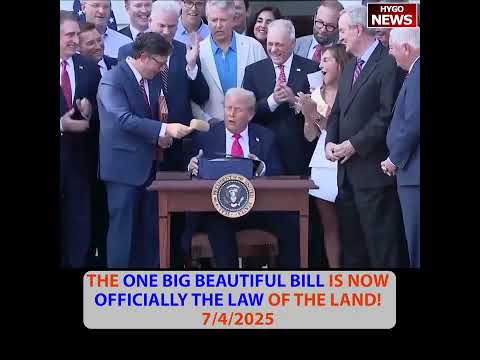
The One Big Beautiful Bill officially became law on July 4, 2025, at a ceremonial signing at the White House that featured a flyover of a B-2 Spirit bomber from Whiteman Air Force Base — the same kind of aircraft that executed the Iran strike — escorted by two F-35 Lightning II fighters. Speaker Mike Johnson formally presented Trump with the gavel used to enact the bill. The Star-Spangled Banner played. And Trump outlined the specific provisions now in law: no tax on tips, no tax on overtime, no tax on Social Security, a tax deduction on auto loan interest for American-made vehicles, and a permanent expansion of the child tax credit for 40 million American families.
”The Gavel We Used To Enact”
Speaker Mike Johnson opened the ceremony with the specific handoff. “This is the gavel we use to enact the big beautiful bill and I want you to have that.”
Congressional gavels used in major legislative actions often become presidential keepsakes. Johnson’s presentation of the specific gavel to Trump creates a physical artifact that ties the president’s signature to the legislative process. The gavel will presumably end up in the Trump presidential library or private collection as a permanent memento of the day.
”The Biggest Bill Of Its Kind”
Trump’s opening characterization. “We’ve delivered no tax on tips, no tax on overtime, and no tax on social security for our great seniors. And that’s why when you hear things like that, this is the biggest bill of its kind ever done by far.”
The three central tax provisions — tips, overtime, Social Security — are the ones Trump has emphasized throughout the legislative process. Each benefits a specific American constituency. Together, they represent the bill’s working-class-focused tax architecture.
“The biggest bill of its kind ever done by far” is the historical claim. Measurement is complicated. As fiscal legislation, the bill combines multiple substantial provisions. Whether it exceeds the 2017 Tax Cuts and Jobs Act (which it extends and expands), the Reagan tax cuts, or other historical milestones depends on measurement methodology.
”Level Of Success And Popularity”
Trump’s political framing. “We are going to have something where people are going to realize the level of success and popularity of this bill.”
The prediction is that implementation will validate the bill. As Americans see the bill’s specific provisions take effect in their paychecks, in their child tax credits, in their family farm operations, and in their small businesses, support will grow.
Polling on major legislation often shifts over time. Unpopular bills can become popular when voters see specific benefits. Popular bills can become unpopular when unintended consequences emerge. Trump is predicting the former trajectory for the One Big Beautiful Bill.
Child Tax Credit Permanent
Trump highlighted the specific permanent change. “And so to close it out, it makes the child tax credit permanent for 40 million American families.”
The child tax credit’s permanent expansion affects 40 million American families with children. That is a substantial portion of American families — approximately one-third of all American households. Each of those families benefits from a larger and more permanent child tax credit than had existed before.
The permanence is key. Temporary tax provisions create ongoing uncertainty about whether they will be renewed. Permanent provisions provide families with predictable tax treatment that allows them to plan their financial lives with confidence.
”Interest On A New Car Payment”
Trump then introduced a new provision that has not received as much attention. “And to increase the car affordability, it makes interest on a new car payment. So this had never happened before. You buy a car, you borrow money, you’re allowed to deduct for income tax purposes, your payment of interest, you’re allowed to deduct it.”
The provision is novel. Interest deductibility on auto loans has not been a feature of the American tax code since the 1986 tax reform eliminated various consumer interest deductions. The new bill restores the deductibility, at least for new auto loans.
Why The Auto Loan Provision Matters
The provision has practical significance for ordinary households. American families who purchase vehicles through financing pay substantial interest over the life of the loans. Typical new car loans run 60-72 months at rates that have recently been elevated. Interest payments can total thousands of dollars per loan.
Making that interest deductible reduces the effective cost of vehicle ownership. Families can claim the interest as a deduction on their income taxes, recovering some portion of what they pay in interest through reduced income taxes.
The specific amount of benefit depends on the loan amount, the interest rate, and the household’s marginal tax rate. A household with a $40,000 car loan at 7% interest in a 22% marginal tax bracket would receive approximately $2,800 of tax benefit over the first year of the loan.
”It’s Only Good If It’s Made In America”
Trump then made the critical limitation clear. “But I have to tell you, it’s only good, Mike, if it’s made in America. If it’s made in another country, you don’t get it.”
The restriction is strategic. The deduction applies only to vehicles manufactured in the United States. Foreign-made vehicles do not qualify.
The provision therefore serves multiple purposes. It provides tax relief to American car buyers. It encourages purchase of American-made vehicles. It supports American manufacturing employment. It reduces trade deficits by shifting consumer demand toward domestic production.
“Run out and buy a car” is Trump’s framing. The provision creates an incentive for accelerated vehicle purchases, with the accelerated demand flowing specifically to American manufacturers.
Why The Manufacturing Requirement Matters
The “made in America” requirement is the specific industrial policy dimension. Without the restriction, the auto loan interest deduction would benefit foreign manufacturers just as much as American manufacturers. Japanese, Korean, German, and other foreign automakers would see demand for their American market sales increase.
With the restriction, the benefits flow only to American manufacturers — Ford, General Motors, Chrysler (Stellantis), Tesla, Rivian, Lucid, and various others that operate American assembly plants. Those manufacturers see increased demand. Their American workforces see increased employment. Their American suppliers see increased business.
The provision therefore functions as both a consumer benefit and an industrial policy tool. American consumers benefit from reduced effective cost of vehicle ownership. American manufacturers benefit from demand shifting toward domestic production.
The Star-Spangled Banner
The video then captured the ceremonial moment. “The rampar key parts, the birds of Calendary streaming. And the rockets’ red glare, the bombs bursting in air, gave proof through the night that our flag was still there. Oh say does that star-spangled banner yet wave Earth, the land of the free and the home of the brave.”
The Star-Spangled Banner, played during the signing ceremony, captures the specific patriotic framing of the event. The national anthem’s lyrics — written during the War of 1812 — tie the current moment to the broader American historical tradition.
“Gave proof through the night that our flag was still there” is Francis Scott Key’s famous line about Fort McHenry withstanding the British bombardment. The specific resonance with the current moment is worth pause. The bill, in the administration’s framing, is itself a specific demonstration that America’s institutional and economic foundation is still intact despite the challenges of recent years.
The B-2 Flyover
The specific aircraft configuration captured in the video. “LIVE AT THE WHITE HOUSE: A B-2 Bomber from Whiteman Air Force Base is escorted by two F-35 fighters for a special flyover — in honor of those who participated in Operation Midnight Hammer — as the Star-Spangled Banner is played.”
The B-2 Spirit is one of two aircraft types in the strategic bomber fleet. The specific aircraft flying over the White House came from Whiteman Air Force Base in Missouri — the same base from which the Iran mission originated.
“In honor of those who participated in Operation Midnight Hammer” is the specific dedication. The pilots who flew the Iran mission are being honored by the flyover at the bill signing. The B-2 itself — the specific kind of aircraft that executed the mission — is the honoring medium.
The F-35 Escort
Two F-35 fighters escorted the B-2. The F-35 Lightning II is the multi-role fifth-generation fighter that has become the backbone of American and allied air forces. Its combination of stealth capability, sensor fusion, and multi-role flexibility represents the current state of the art in Western fighter technology.
The F-35 escort demonstrates American air power in its most current form. The B-2, which is older but still among the most capable aircraft in the world, flies with the newest generation fighters. The combination captures American aviation’s depth — both the established strategic capability and the leading-edge tactical capability.
Why The Flyover Matters Politically
The flyover ties the domestic policy achievement (the bill) to the foreign policy achievement (the Iran strikes) in a single visual moment. Voters watching the ceremony see both simultaneously. The administration has produced both. The military has executed both.
The specific honoring of the Midnight Hammer pilots also serves to counter the earlier media critiques of the Iran mission. Media outlets that had questioned the operation’s completeness now see the pilots being honored in the most public possible way. The administration is making clear that the pilots deserve recognition, not skeptical journalism.
”The Greatest Victory Yet”
Trump’s framing of the signing moment. “A few moments, we’re going to make official the greatest victory yet when I signed the one big, beautiful bill.”
“The greatest victory yet” is Trump’s framing. Not the greatest victory possible — victories still to come would exceed this one — but the greatest of what has been achieved so far. The bill signing is the capstone of the first 165 days of the administration’s activity.
”I’ve Never Seen People So Happy”
Trump’s observation about reactions. “And before I start, I want to tell you that I’ve never seen people so happy in our country because of that. Because so many different groups of people are being taken care of, the military, civilians of all types, jobs of all types.”
The observation is the administration’s preferred framing of voter response. Specific constituencies — military, civilians, workers across categories — each see benefits flowing from the bill. Their satisfaction with those benefits produces the happiness Trump is referencing.
Whether voter happiness has actually increased is an empirical question that polling will answer over time. Immediate reactions from supporters will be positive. Immediate reactions from opponents will remain negative. The marginal voter — those who are not strongly aligned with either party — will decide based on what they experience as the bill’s provisions take effect.
”Military, Civilians Of All Types, Jobs Of All Types”
Trump’s specific constituency framing. Military personnel benefit from the bill’s defense provisions and recruiting enhancements. Civilians of all types benefit from the specific tax provisions. Jobs of all types benefit from the economic growth the bill is designed to produce.
The claim that “so many different groups of people are being taken care of” is the pluralist framing. The bill is not narrow — it covers many constituencies. Voters across demographic categories can find specific provisions that benefit them.
”So Many Things Are Being Added”
Trump’s closing observation. “We’re adding things like the biggest tax cut in the history of our country, a child tax credits. So many things are being added that we wouldn’t even have time to discuss them.”
The observation captures the bill’s breadth. The specific provisions Trump has named in his public remarks cover only a portion of the full legislation. Additional provisions — regulatory adjustments, specific industry supports, various technical changes — operate in the background without receiving specific political attention.
Americans who examine the bill’s full text will find provisions they did not know about. Some of those provisions will be favorable to specific readers. Some will be unfavorable. The bill’s aggregate political impact depends on whether the favorable elements outweigh the unfavorable elements for the marginal voter.
The Historical Moment
The July 4, 2025 signing of the One Big Beautiful Bill will be a specific historical moment. Future histories of the second Trump administration will identify this date as the culmination of the administration’s first-year legislative effort.
The specific ceremonial elements — B-2 flyover, F-35 escort, national anthem, Speaker’s gavel presentation — combine to produce a ceremony that will be remembered distinctly. The ceremony’s timing on Independence Day ensures that future July 4 celebrations will include anniversaries of the signing.
The Implementation Phase
With the bill’s signing complete, the administration’s focus shifts to implementation. Treasury regulations will need to be issued to implement the tax provisions. Administrative agencies will need to operationalize the spending provisions. State governments will need to adjust to the modified fiscal relationships with the federal government.
Implementation can produce both intended and unintended consequences. The intended consequences — increased take-home pay, family farm protection, manufacturing incentive, border security funding — will become visible over months and years. The unintended consequences — whatever they turn out to be — will also emerge over time.
The administration’s political future depends substantially on whether implementation produces the outcomes the bill’s framework predicts. If voters experience the promised benefits, the political advantage flows to the administration. If the benefits fall short or unintended negatives emerge, the political advantage shifts.
Key Takeaways
- Speaker Johnson’s gavel presentation: “This is the gavel we use to enact the big beautiful bill and I want you to have that.”
- The specific provisions now law: no tax on tips, no tax on overtime, no tax on Social Security, child tax credit made permanent for 40 million families.
- The new auto loan interest deduction: “You buy a car, you borrow money, you’re allowed to deduct for income tax purposes, your payment of interest. It’s never happened before — so run out and buy a car.”
- The manufacturing requirement: “It’s only good, Mike, if it’s made in America. If it’s made in another country, you don’t get it.”
- The ceremonial flyover: B-2 bomber from Whiteman Air Force Base, escorted by two F-35s, “in honor of those who participated in Operation Midnight Hammer.”