 HYGO News
 Sullivan: 'Not Agree With Your Characterization of the Previous Admin. But I'm Not Interested in Comparisons'
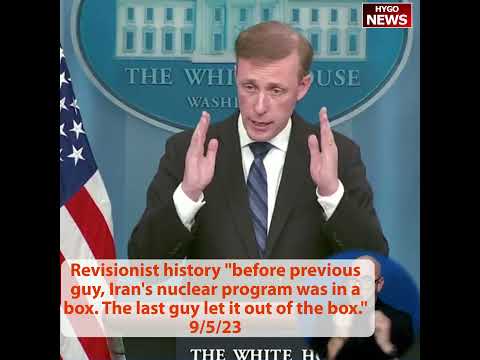
Sullivan: “Not Agree With Your Characterization of the Previous Admin. But I’m Not Interested in Comparisons”
On September 5, 2023, a reporter at the White House briefing posed a direct challenge to National Security Advisor Jake Sullivan: with U.S. relationships with Russia, China, North Korea, and Iran all appearing worse than before Biden took office, how could the administration defend its foreign policy record? Sullivan’s response was to declare he was “not interested in comparisons” — a remarkable position for an official whose administration had spent years blaming its predecessor for every inherited challenge.
The Exchange
The reporter framed the question around a widely observed pattern: “Jake, it seems like every administration, when it gets into office, complains about the problems it inherits from the previous administration. But how do you defend this administration’s role with issues like Russia, China, North Korea, Iran? It seems like, in all of those cases, our relationship is worse than it was before.”
The question was pointed because it listed four major adversarial relationships and asked Sullivan to account for deterioration in all of them. It also called out the administration’s habit of blaming its predecessors — a habit that made Sullivan’s subsequent answer ironic.
Sullivan’s response on China was notable for its careful phrasing: “With respect to China, I’m not sure I’d agree with your characterization of the previous administration. But I’m not interested in comparisons. We’re taking our own approach on this, which is to ensure that we compete intensively to put the United States in the strongest position possible while, at the same time, managing that competition so that it doesn’t tip over into conflict. We believe we are managing the competition effectively.”
He then offered what he presented as evidence: “And from the question of what we inherited to where we are today, if you look at the U.S. economy and you look at China’s economy, if you look at the U.S.’s alliances and the strength that we have built up in the Indo-Pacific and beyond, we feel very good about the strategic position of the United States."
"Not Interested in Comparisons”
Sullivan’s claim that he was “not interested in comparisons” was striking given the Biden administration’s consistent pattern of blaming the Trump administration for challenges it faced. The same September 5 briefing included Sullivan making exactly such a comparison on Iran, stating: “Under the administration before the previous guy, Iran’s nuclear program was in a box. The last guy let it out of the box. We are now trying to manage the results of that decision.”
In other words, Sullivan was selectively interested in comparisons. When comparisons allowed him to blame Trump — as with Iran’s nuclear program — he was happy to make them. When comparisons highlighted areas where the Biden administration’s performance was difficult to defend — as with the overall trajectory of U.S. adversarial relationships — he declared himself “not interested.”
This rhetorical inconsistency was not unique to Sullivan. It reflected a broader pattern in the Biden White House, where officials would alternate between claiming credit for inherited positive trends and blaming predecessors for inherited challenges, depending on which framing was more politically useful at any given moment.
The Russia Record
On Russia, the administration’s record by September 2023 was difficult to characterize as successful. Russia had launched its full-scale invasion of Ukraine in February 2022, the first major land war in Europe since World War II. The invasion had occurred on Biden’s watch despite the administration’s public warnings that it was coming.
Critics of the administration pointed to several factors. Biden’s chaotic withdrawal from Afghanistan in August 2021 had been widely interpreted as a signal of American weakness. Biden himself had publicly mused about the distinction between a “minor incursion” and a full invasion during a January 2022 press conference, prompting immediate damage-control efforts from the White House. The administration had also waived sanctions on the Nord Stream 2 pipeline in May 2021, a decision that was later reversed after the invasion but which critics argued had emboldened Moscow.
The Biden administration responded to the invasion with an extensive sanctions regime and military aid to Ukraine, which supporters credited with helping Ukraine resist the invasion. But the fundamental question the reporter was asking — whether U.S.-Russia relations were worse than before — had an obvious answer that Sullivan chose not to address directly.
The China Record
Sullivan’s claim that the administration was “managing the competition effectively” with China was subject to debate. During Biden’s presidency, China had conducted aggressive military maneuvers around Taiwan, expanded its nuclear arsenal, accelerated its military buildup, and continued economic coercion against U.S. allies including Australia and Lithuania.
The administration’s China policy had produced some notable friction. House Speaker Nancy Pelosi’s visit to Taiwan in August 2022 triggered the most aggressive Chinese military exercises in the Taiwan Strait in decades. A Chinese surveillance balloon traversed the entire continental United States in January-February 2023 before being shot down off the coast of South Carolina, an incident that highlighted gaps in U.S. air defense awareness and delayed planned diplomatic engagements.
Sullivan pointed to economic comparisons — “if you look at the U.S. economy and you look at China’s economy” — as evidence of effective management. While China was indeed experiencing an economic slowdown, it was unclear how much of that was attributable to Biden administration policies versus China’s own domestic policy choices, including its prolonged COVID-19 lockdowns and crackdowns on its technology sector.
The Iran Record
On Iran, Sullivan made his most explicit comparison to the Trump administration, blaming “the last guy” for letting Iran’s nuclear program “out of the box.” This was a reference to Trump’s 2018 withdrawal from the Joint Comprehensive Plan of Action (JCPOA), the nuclear deal negotiated under the Obama administration.
Sullivan’s characterization omitted several relevant facts. The Obama-era JCPOA had been controversial because it included sunset provisions that would eventually allow Iran to expand its nuclear program, released billions in frozen Iranian assets, and did not address Iran’s ballistic missile program or regional proxy activities. Trump’s decision to withdraw and impose maximum pressure sanctions had been aimed at securing a more comprehensive agreement.
Under Biden, the administration had spent months attempting to revive the JCPOA without success. Meanwhile, Iran had enriched uranium to 60 percent purity — close to weapons-grade — and had significantly expanded its stockpile of enriched material. The International Atomic Energy Agency reported reduced access to Iranian nuclear facilities. By any measure, Iran was closer to nuclear weapons capability in September 2023 than it had been when Biden took office.
The North Korea Record
Sullivan also addressed North Korea, claiming: “The previous administration believed that if it simply engaged in summit-level diplomacy, it could end North Korea’s missile and nuclear program. By the time we took office, North Korea’s missile and nuclear programs had accelerated dramatically.”
This characterization was debatable. During the Trump administration’s summit diplomacy with Kim Jong Un, North Korea had suspended nuclear and long-range missile testing for an extended period. That testing moratorium ended in 2022, after Biden took office. North Korea conducted a record number of missile tests in 2022, including intercontinental ballistic missiles, and continued testing in 2023.
Sullivan’s claim that North Korea’s “most important breakthrough” — the first ICBM test — happened before Biden took office was technically accurate but misleading. North Korea’s first ICBM test occurred in 2017, during Trump’s first year, but the pace and sophistication of testing increased significantly after the collapse of diplomatic engagement during the Biden years.
The “Feel Very Good” Claim
Sullivan concluded his assessment by saying the administration felt “very good about the strategic position of the United States.” This confidence was not widely shared among foreign policy analysts across the political spectrum. By September 2023, the United States was simultaneously managing a major war in Europe, escalating tensions with China over Taiwan, an accelerating Iranian nuclear program, and an emboldened North Korean missile program.
The reporter’s question had been simple and fair: in all four major adversarial relationships, things appeared worse. Sullivan’s response — that he was not interested in comparisons, except when those comparisons favored his administration — did not answer the question so much as demonstrate why it remained unanswered.
Key Takeaways
- On September 5, 2023, a reporter challenged NSA Jake Sullivan on deteriorating U.S. relationships with Russia, China, North Korea, and Iran, asking how the Biden administration defended its foreign policy record.
- Sullivan declared he was “not interested in comparisons” to the Trump administration on China, while simultaneously blaming Trump for Iran’s nuclear advances in the same briefing.
- Sullivan claimed the administration was “managing the competition effectively” with China and felt “very good about the strategic position of the United States.”
- The reporter’s question highlighted the contrast between the administration’s habit of blaming its predecessor and its reluctance to accept direct comparisons on outcomes.
- By September 2023, Russia had invaded Ukraine, China had escalated military pressure on Taiwan, Iran had enriched uranium to near-weapons-grade levels, and North Korea had conducted record missile tests — all on Biden’s watch.