 HYGO News
 Noem: TSA not remove shoes; Rollins: ban Chinese purchase farmland; Bessent: $100 to $300B tariff
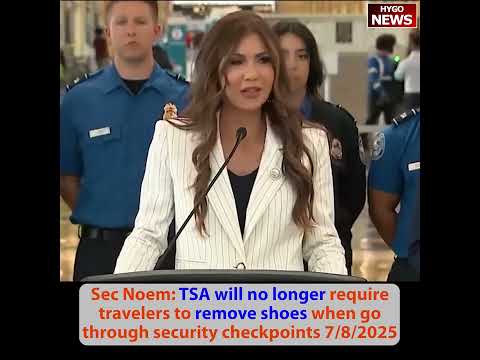
Noem: TSA not remove shoes; Rollins: ban Chinese purchase farmland; Bessent: $100 to $300B tariff
Five substantial policy announcements in a single day. DHS Secretary Kristi Noem announced the end of the TSA shoe removal requirement — a small administrative change that affects every American air traveler. Agriculture Secretary Brooke Rollins unveiled the USDA’s National Farm Security Action Plan — seven action items led by a ban on Chinese nationals and other foreign adversaries purchasing American farmland. CEA Chairman Stephen Miran released analysis showing that imported goods are actually getting cheaper under the administration’s tariff framework. Treasury Secretary Scott Bessent announced tariff revenue is running at $100 billion so far this year and projects to exceed $300 billion annually. And Trump announced a specific 10% BRICS tariff penalty for any country that joins the BRICS bloc — “BRICS was set up to hurt us.”
The TSA Shoe Removal Ends
Noem opened with the specific TSA policy. “We have some very exciting news to announce that today we have started a new no-shoes policy with the Department of the Transportation Security Administration. TSA will no longer require travelers to remove their shoes when they go through our security checkpoints.”
The TSA shoe removal requirement had been in place since 2006, implemented as a response to Richard Reid’s failed 2001 shoe bomb attempt on a transatlantic flight. For nearly 20 years, American travelers had been required to remove their shoes at security checkpoints.
The requirement had been consistently unpopular with travelers. It slowed security lines. It was physically awkward for many travelers. It produced specific inconveniences without obvious corresponding security benefits, given that specific screening technology could detect shoe-based threats without requiring removal.
Why The Change Matters
The change matters to ordinary Americans in ways that more consequential policy changes sometimes do not. Every American who has flown through an American airport in the past two decades has experienced the shoe removal requirement. Removing the requirement is a tangible improvement in their travel experience that they will notice the first time they encounter the new protocol.
That kind of visible, tangible improvement is politically valuable. Voters who may not track macroeconomic data or foreign policy developments do notice whether airport security is faster and less unpleasant. The change produces specific positive experiences that the administration can credit to its policy approach.
”Life Better For All Americans”
Noem’s framing. “This is something that I know for quite some time people have talked about and discussed and we know that when President Trump was elected that he pledged to make life better for all Americans and that includes those who are travelers going through our busy airports.”
“Make life better for all Americans” is the Trump 2024 campaign framing applied to the specific TSA change. The framing positions the administrative change not as an isolated policy decision but as fulfillment of a broader campaign commitment to improve Americans’ daily lives.
The cumulative effect matters. Each specific improvement — TSA shoes, gas prices, grocery prices, tax provisions — contributes to voters’ overall sense that the administration is delivering on its promises. No single improvement is transformational on its own. The accumulated improvements, experienced across multiple dimensions of daily life, produce political support.
Rollins On Farm Security
Agriculture Secretary Brooke Rollins then pivoted to the more consequential announcement. “With this announcement today we are taking this purpose and our American farmland back. Today we announced the USDA’s National Farm Security Action Plan. This plan includes seven key action items but very quickly and perhaps the most important, the first of the seven, is securing and protecting American farmland ownership.”
The National Farm Security Action Plan addresses what has been a growing concern about foreign ownership of American agricultural land. Chinese entities and other foreign interests have acquired substantial American farmland over the past two decades. That acquisition pattern raises specific national security and strategic concerns.
”Ban The Purchase Of American Farmland By Chinese Nationals”
Rollins’ specific action item. “Actively engaging at every level of government to take swift legislative and executive action to ban the purchase of American farmland by Chinese nationals and other foreign adversaries.”
The ban extends beyond Chinese nationals to “other foreign adversaries.” That category captures not just China but potentially Russia, Iran, North Korea, and other countries designated as adversaries to American interests. The specific mechanism — legislative and executive action — means both Congress and the administration will be active in implementing the ban.
”Standing On The Shoulders Of Great Governors”
Rollins acknowledged state-level precedent. “Standing on the shoulders of great governors, three of whom are standing behind me, who have already been leading the way on this issue.”
Multiple state governments have already implemented restrictions on foreign land ownership. Texas, Florida, and various other states have passed legislation restricting specific foreign nationals from purchasing agricultural land. The federal action builds on those state-level precedents.
The federalism dimension is important. State governments have been experimenting with various restriction models. Those experiments produce specific data about what works, what does not, what the constitutional constraints are, and what administrative mechanisms are required. The federal action can learn from state experience.
”Claw Back What Has Already Been Purchased”
Rollins described the retroactive dimension. “Working to do everything within our ability, including presidential authorities, to claw back what has already been purchased by China and other foreign adversaries.”
The clawback dimension is more aggressive than just preventing future purchases. Existing foreign ownership of American farmland would, under the clawback framework, face specific divestiture pressure. The administration is looking at “presidential authorities” for this purpose.
The specific authorities would presumably include the Committee on Foreign Investment in the United States (CFIUS) authority over foreign investment with national security implications, Agriculture Department authorities under various statutes, and potentially other tools available to the executive branch.
Whether existing foreign landowners can be forced to divest depends on the specific legal mechanism and the constitutional protections for property rights. If the land was purchased legally under then-existing law, retroactive divestiture faces specific legal challenges. The administration’s willingness to pursue the clawback anyway reflects the priority it places on addressing foreign ownership.
Treasury And Defense Coordination
Rollins continued. “Additionally, working with the Secretary of the Treasury along with our Defense Department on memorandums to ensure that moving forward there is a much more intentional look at who is buying what in this country and from where they are in the world.”
The Treasury and Defense coordination captures the cross-departmental nature of the farmland security question. Treasury tracks financial flows. Defense assesses security implications. Agriculture manages the specific agricultural policy dimensions. The three departments working together produce a more comprehensive policy framework than any single department could produce.
Why Farmland Security Matters
Foreign ownership of American farmland matters for several reasons.
Food security — American agricultural production is strategically important. Foreign control over specific agricultural assets creates specific dependencies that can be exploited during conflicts.
Strategic positioning — Some foreign-owned farmland is near sensitive American military or critical infrastructure sites. Ownership provides specific observation and access opportunities that can be exploited for intelligence gathering.
Economic sovereignty — American farm assets represent substantial wealth. Foreign ownership means the economic returns flow to foreign countries rather than to American families.
Generational continuity — American family farms have been a cultural and economic institution for generations. Foreign ownership ends that generational continuity, replacing it with transactional relationships.
Each concern has specific weight. Together, they justify the specific policy response the administration is pursuing.
Miran On Imported Goods Getting Cheaper
CEA Chairman Stephen Miran then offered the economic analysis. “So in new work that our team has done that will be on the Council of Economic Advisers website today, what we did was we looked at in every category in the inflation index, we looked at how much of it is coming from imports, both whether the good itself is an import but also whether it uses intermediate goods that is parts in between the raw product and the finished product that come from abroad.”
The analysis is methodologically rigorous. For each category in the Consumer Price Index, the CEA has measured the import content — both direct imports and imports used as inputs in domestic production. That measurement allows specific analysis of how tariff policy affects different categories of consumer goods.
”Imported Goods Are Actually Getting Cheaper”
Miran’s key finding. “We have a measure for each product in the index about how much of an import it is and what we find is exactly what you said before that imported goods are actually getting cheaper.”
The finding contradicts the mainstream economic prediction. Mainstream analysis had predicted that tariffs would cause imported goods to become more expensive, because tariff costs would be passed through to consumer prices. Miran’s analysis finds the opposite — imported goods are actually declining in price.
The specific mechanism for the counterintuitive finding could include:
- Foreign producers absorbing tariff costs rather than passing them through.
- Currency movements that offset tariff costs.
- Supply chain reorganization that reduces costs for foreign producers.
- Competition from domestic producers that keeps consumer prices low.
- Reduced demand for imported goods that reduces their prices.
Whatever the specific mechanism, the empirical finding is clear. Tariffs are not producing the consumer price increases critics predicted.
Why The Miran Finding Matters
The Miran finding matters politically because it contradicts the central economic critique of Trump’s tariff policy. Critics have argued that tariffs hurt American consumers by raising prices. Miran’s analysis, using the specific CPI categories, finds that consumer prices on imported goods are not rising but actually declining.
That empirical finding provides specific support for continued tariff policy. If tariffs are producing revenue without consumer price increases, the political case for tariffs is substantially stronger than the mainstream economic framework had predicted.
Bessent On Tariff Revenue
Treasury Secretary Bessent then provided specific revenue numbers. “We will be taking in about a hundred billion dollars in tariff income thus far this year and that’s with the major tariff not having started until the second quarter so we could expect that that could be well over 300 billion by the end of the year.”
$100 billion in tariff revenue so far this year is substantial. Annualized, that pace produces revenue at historical highs. Bessent’s projection of “well over 300 billion by the end of the year” captures the acceleration as more tariff categories take effect.
$300+ billion in annual tariff revenue is transformational. Historical tariff revenue has been a small fraction of federal revenue. $300 billion represents a meaningful portion of the federal budget — approximately 5% of total federal revenue at current levels.
The CBO Comparison
Bessent added the CBO context. “We don’t agree with CBO scoring but for those who do the CBO scored tariff income over the next 10 years at 2.8 trillion which we think is probably low.”
CBO projected $2.8 trillion in tariff revenue over 10 years. That works out to approximately $280 billion annually. Bessent’s projection of “well over 300 billion by the end of the year” is consistent with the CBO projection, suggesting even conservative projections are being exceeded.
“We don’t agree with CBO scoring” is the specific institutional framework. The administration has been arguing that CBO’s methodology systematically understates revenue from policies like tariffs. The current data support that argument — the actual revenue is running close to or above CBO’s 10-year projection in the first year.
BRICS 10%
Trump then introduced the specific BRICS tariff. “So you talked about India coming but then a couple days ago you issued a new tariff threat to members of the BRICS countries for if they aligned with anti-American countries that would be India, Brazil, Russia, South America. If they’re in BRICS because BRICS was set up to hurt us.”
BRICS is the acronym for Brazil, Russia, India, China, and South Africa — the founding members of the bloc that has expanded to include additional countries. The bloc was originally positioned as an economic alliance among emerging economies. More recently, it has taken on specific political dimensions, including explicit objectives around dollar displacement.
”BRICS Was Set Up To Hurt Us”
Trump’s specific characterization. “BRICS was set up to degenerate our dollar and take our dollar as the standard, take it off as the standard and that’s okay if they want to play that game but I can play that game too so anybody that’s in BRICS is getting a 10% charge.”
The “degenerate our dollar” framing captures the American concern about BRICS. If the bloc successfully displaces the dollar as the global reserve currency, American ability to finance deficit spending would be substantially constrained. Interest rates on federal debt would rise. Currency values would fall. Consumer costs would increase.
“That’s okay if they want to play that game but I can play that game too” is Trump’s response. BRICS countries are free to pursue their anti-dollar strategy. But Trump will respond with specific tariff penalties that raise the cost of BRICS membership. Countries that join BRICS face specific American tariff consequences.
”Anybody That’s In BRICS Is Getting A 10% Charge”
The specific policy. “If they’re a member of BRICS they’re going to have to pay 10% tariff just for that one thing and they won’t be a member of the Gage.”
A 10% tariff penalty specifically for BRICS membership is a policy tool that has no direct historical precedent. The tariff is not based on the specific trade balance with the country. It is not based on the specific goods involved. It is based on the country’s bloc membership.
The logic is that bloc membership itself has specific consequences for American interests. By penalizing membership, the administration makes the bloc more costly to join and easier to leave. That specific leverage changes the calculations of countries considering BRICS membership.
Why The BRICS Tariff Matters
The BRICS tariff matters because it targets one of the most strategically significant international economic institutions. The bloc has been expanding, with multiple additional countries joining over recent years. A 10% American tariff penalty on BRICS membership specifically creates disincentives for further expansion and incentives for departure.
Countries that are considering BRICS membership face the specific calculation. Does the bloc offer enough benefit to justify a 10% tariff penalty from the United States? For most countries, the answer will be no. The American market access is too important to sacrifice for the benefits of bloc membership.
The Full Policy Integration
The day’s five announcements — TSA shoes, farmland security, import price analysis, tariff revenue, BRICS 10% — are not disconnected. They fit together as components of a specific administration operational philosophy.
The TSA change reflects administrative responsiveness to ordinary citizen concerns. The farmland security plan reflects strategic American economic protection. The import price analysis provides empirical validation for tariff policy. The tariff revenue numbers demonstrate fiscal outcomes. The BRICS tariff deploys tariff policy as strategic leverage against anti-American international coordination.
Each element is consistent with the others. Americans benefit from administrative improvements. Strategic assets are protected. Tariffs produce revenue without consumer cost. International coordination that targets American interests faces specific consequences. The cumulative framework serves American interests across multiple dimensions simultaneously.
Key Takeaways
- Noem on TSA: “TSA will no longer require travelers to remove their shoes when they go through our security checkpoints” — ending a 2006 requirement.
- Rollins on farmland: “Ban the purchase of American farmland by Chinese nationals and other foreign adversaries” — with clawback of existing foreign ownership.
- Miran’s empirical finding: “What we find is that imported goods are actually getting CHEAPER” — contradicting mainstream economic predictions about tariffs.
- Bessent on tariff revenue: “About $100 billion in tariff income thus far this year…we could expect that that could be well over $300 billion by the end of the year.”
- Trump’s BRICS tariff: “Anybody that’s in BRICS is getting a 10% charge…BRICS was set up to degenerate our dollar…I can play that game too.”