 HYGO News
 'Noble Prize' Winners: KJP's Mispronunciation Highlights Questions About Her Selection as Press Secretary
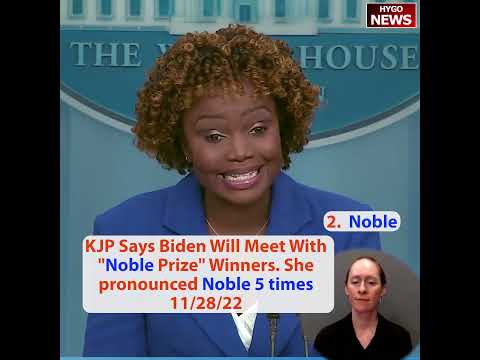
“Noble Prize” Winners: KJP’s Mispronunciation Highlights Questions About Her Selection as Press Secretary
On November 28, 2022, White House Press Secretary Karine Jean-Pierre stood at the podium and announced that President Biden had met with three U.S. winners of the 2022 “Noble Prize.” She did not misspeak once and correct herself. She pronounced “Nobel” as “Noble” five consecutive times without ever realizing her error, delivering a prepared statement that turned one of the most prestigious awards in the world into something that sounded like a character trait. The moment became one of the most widely circulated examples of Jean-Pierre’s ongoing struggles with basic vocabulary and pronunciation, and it renewed questions about the criteria the Biden White House used in selecting her for the role.
The “Noble Prize” Statement
Jean-Pierre’s full statement on the Nobel laureates read: “Now, finally, today, President Biden met with three U.S. winners of the 2022 Noble Prize: Dr. Carolyn Bertozzi, who won the Noble Prize in Chemistry; Dr. John Clauser, who won the Noble Prize in Physics; and Dr. Douglas Diamond, who won the Noble Prize in Economic Sciences. The President is restarting an important tradition that just like — just like he does for winning sports teams, as you have seen him do in the past 20 months or so, the President meets with U.S. winners of the Noble Prize.”
Five times. Five opportunities to self-correct. Each repetition of “Noble Prize” was another chance to hear the word coming out of her own mouth and recognize something was wrong. Jean-Pierre did not catch the error even once.
The Nobel Prize is named after Alfred Nobel, the Swedish inventor and philanthropist who established the awards in his will. The name “Nobel” is pronounced with emphasis on the second syllable and is one of the most recognized proper nouns in international discourse. It appears in news coverage regularly, and any press secretary would encounter it multiple times throughout their career. The fact that Jean-Pierre apparently did not know how to pronounce it suggested a gap in general knowledge that went beyond a simple verbal slip.
”Going Out of School”
The “Noble Prize” mispronunciation was not the only language error in Jean-Pierre’s remarks that day. In the same statement about the laureates, she used the phrase “I’m going to go out of school for a second” when she clearly meant to say “go off script.”
“Their achievements show how taking on the biggest questions can establish new fields of inquiry, promote technology, innovation, and expand the boundaries of what is possible,” she said. “Their work is a reminder of why the President often says that the — America can be defined by one word, and you all know that word that he uses is ‘possibilities.’ With that, I’m going to go out of school for a second.”
“Go off script” is a common idiom used by public speakers to indicate they are departing from prepared remarks. “Go out of school” is not a recognized English expression and appears to be a malapropism, a substitution of a similar-sounding but incorrect phrase. The double error in a single appearance — “Noble” for “Nobel” and “out of school” for “off script” — compounded the impression that Jean-Pierre was operating at the limits of her verbal capacity.
Why She Was Chosen: The “Beyond Capable” Interview
The contrast between Jean-Pierre’s podium performance and the White House’s justification for selecting her was thrown into sharp relief by a podcast interview she gave with journalist Stacy Brown. In that appearance, Jean-Pierre explained the reasoning behind her appointment.
“They decided to put me in this position,” she said, referring to President Biden and First Lady Jill Biden. “They decided that they wanted Karine Jean-Pierre, with all of the things, all of the communities that I represent, clearly being a black person, right, being a black woman. They said, we want you to represent us, we want you to represent the White House. We want to meet this moment that we’re in, and we know that you are beyond capable of doing that, right. You are — you are, uh, you are experienced, and you are the voice that we want to have.”
Jean-Pierre’s own description of why she was chosen emphasized identity and representation over traditional qualifications for the role. She highlighted her status as a Black woman as a primary factor in the selection, describing it as meeting “this moment.” While she also referenced being “experienced” and the “voice” the Bidens wanted, the framing placed identity at the center of the hiring decision.
She further stated: “Knowing that I am representing the voice of the president, then I have to do that, right? That’s the job.”
The disconnect between this self-assessment and the reality of her daily briefings was difficult to overlook. Jean-Pierre frequently lacked answers to straightforward questions, regularly referred reporters to other departments rather than providing information, and consistently blamed the Trump administration for ongoing issues well into Biden’s presidency.
The Meritocracy Question
Jean-Pierre’s “beyond capable” interview, combined with her pattern of high-profile verbal errors, fed into a broader national debate about meritocracy and hiring practices. Critics argued that her appointment exemplified a hiring philosophy that prioritized demographic representation over professional competence, noting that the ability to do the job effectively should be the primary criterion for any position, especially one as visible and consequential as White House press secretary.
The press secretary role demands a specific set of skills: the ability to think quickly under pressure, command of the English language, familiarity with a vast range of policy topics, and the verbal precision to convey the president’s positions without creating additional news stories through errors. Previous press secretaries across both parties had generally demonstrated these capabilities, even when they were evasive or combative with reporters.
Jean-Pierre’s struggles were not limited to the “Noble Prize” incident. Her tenure produced a catalog of mispronunciations and malapropisms that included “warload” for “warlord,” “hypo-theoreticals” for “hypotheticals,” “armtice” for “armistice,” “Bi-Carmel” for “bicameral,” and “$70 per gallon” instead of “$70 per barrel” when discussing oil prices. Each individual error might have been forgettable; the accumulation made them impossible to ignore.
The Role of the Press Secretary
The White House press secretary occupies a unique position in American government. They serve as the primary public interface between the executive branch and the American people through the press corps. Their words are parsed carefully by journalists, foreign governments, and financial markets. Precision matters because the press secretary’s statements are treated as official positions of the President of the United States.
Previous administrations understood this and selected press secretaries accordingly. Whether it was Ari Fleischer navigating the aftermath of September 11, Tony Snow bringing broadcast journalism experience to the podium, or Jen Psaki deploying careful messaging with verbal dexterity, the role traditionally went to individuals whose communication skills were beyond question.
Jean-Pierre’s appointment broke from this pattern in ways that her supporters attributed to historic barrier-breaking and her critics attributed to misplaced priorities. Her own description of why she was chosen, with its emphasis on identity and community representation, provided ammunition for both interpretations.
The Longer Video
This clip is drawn from a longer compilation video that documents multiple examples of Jean-Pierre’s verbal difficulties at the podium. The full compilation includes the “hypo-theoreticals” gaffe from August 30, 2023, the “Russian warload” mispronunciation, the “Bi-Carmel” error from December 2022, and the oil pricing mistake, all alongside her “beyond capable” self-assessment.
Viewed together, the compilation created a powerful contrast between Jean-Pierre’s stated confidence in her abilities and the evidence of her actual performance. The “Noble Prize” clip served as one of the most striking individual examples because of its sheer repetition, five consecutive mispronunciations of one of the world’s most well-known proper nouns.
Key Takeaways
- Karine Jean-Pierre pronounced “Nobel” as “Noble” five consecutive times during a November 28, 2022, statement about President Biden meeting with Nobel Prize laureates, never catching or correcting her error.
- In the same appearance, she said “I’m going to go out of school for a second” instead of “go off script,” compounding the verbal difficulties on display.
- Jean-Pierre explained in a podcast interview that the Bidens selected her because she was “beyond capable” and they wanted her to represent multiple communities, explicitly referencing her identity as a Black woman as a factor in the hiring decision.
- Her pattern of verbal errors, including “warload,” “hypo-theoreticals,” “armtice,” “Bi-Carmel,” and “$70 per gallon,” fueled debate about whether the appointment prioritized representation over traditional qualifications for the role.
- The contrast between Jean-Pierre’s “beyond capable” self-assessment and her documented podium performance became one of the defining narratives of the Biden White House communications operation.