 HYGO News
 NOBLE: Karine Jean-Pierre said 'Noble Prize' 5 times, I'm going to go out of school for a second
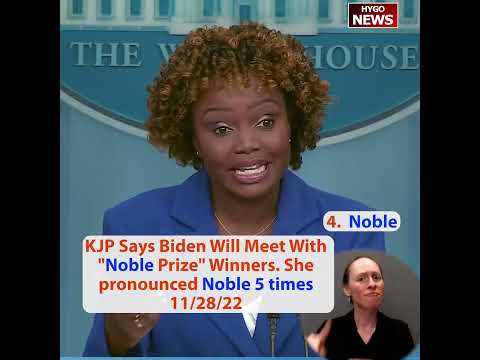
KJP Mispronounces “Nobel Prize” as “Noble Prize” Five Times While Announcing Biden’s Meeting With Nobel Laureates
On 11/28/2022, White House Press Secretary Karine Jean-Pierre opened her press briefing by announcing President Biden’s meeting with 2022 U.S. Nobel Prize winners — and consistently mispronounced “Nobel” as “Noble” throughout the announcement. “Today, President Biden met with three U.S. winners of the 2022 Nobel Prize,” KJP said, pronouncing it “Noble.” She then mispronounced it four more times while listing the winners: “Dr. Caroline Bertozzi, who won the Noble Prize in Chemistry, Dr. John Clauser, who won the Noble Prize in Physics, and Dr. Douglas Diamond, who won the Noble Prize in Economic Sciences. President meets with U.S. winners of the Noble Prize.” The repeated mispronunciation — while announcing a meeting specifically to celebrate the prestigious award — became a viral moment that highlighted ongoing concerns about KJP’s preparation and attention to detail.
The Repeated Mispronunciation
The Nobel Prize (pronounced “no-BELL”) is named after Alfred Nobel, the Swedish inventor of dynamite who established the awards in his will. “Noble” (pronounced “NO-bull”) is a different word meaning aristocratic or morally admirable. The two words are easily confused by those unfamiliar with the prize’s etymology, but they are distinct words with distinct meanings and pronunciations.
KJP pronounced “Nobel” as “Noble” throughout her announcement — not once, but five times in rapid succession. Each repetition reinforced the error. A single mispronunciation could be dismissed as a verbal slip. Five consecutive mispronunciations suggested that KJP didn’t know the correct pronunciation and was saying what she thought was the correct word.
This was a preparation failure. Before announcing a presidential meeting with Nobel laureates, any competent press secretary would have verified the pronunciation of the award they were announcing. The mispronunciation suggested that either no one had reviewed KJP’s statement with her, or the review hadn’t caught the error, or KJP had dismissed the correction and said it her way anyway.
The Laureates
Despite the mispronunciation, the substance of the announcement was significant. Biden had met with three American winners of the 2022 Nobel Prizes:
Dr. Carolyn Bertozzi (whom KJP called “Caroline”) won the Nobel Prize in Chemistry for her work on “click chemistry” and bioorthogonal chemistry — techniques that allow chemical reactions to occur inside living organisms without disrupting biological processes. Her work has applications in drug development, cancer treatment, and fundamental biological research.
Dr. John Clauser won the Nobel Prize in Physics for his experimental work on quantum entanglement — demonstrating that quantum mechanics’ predictions about “spooky action at a distance” were correct despite Einstein’s skepticism. His work laid the foundation for quantum computing, quantum cryptography, and other quantum technologies.
Dr. Douglas Diamond won the Nobel Prize in Economic Sciences for his work on banks and financial crises — explaining how banks reduce economic risk through intermediation and why bank failures can cascade into broader financial crises.
These were significant scientific and academic achievements. The laureates represented the best of American research. A meeting with them at the White House was an appropriate gesture of respect from the government to the scientific community.
The Tradition
KJP referenced that Biden was “restarting an important tradition.” The tradition of presidential meetings with Nobel laureates has been inconsistent across administrations. Some presidents have held formal ceremonies; others have met individually; others have sent congratulatory letters without in-person meetings.
KJP drew a comparison to sports: “Just like he does for winning sports teams, as you have seen him do in the past 20 months or so, the President meets with U.S. winners of the Nobel Prize,” she said.
The sports comparison was revealing. Presidents routinely meet with championship-winning sports teams — Super Bowl winners, NBA champions, World Series winners. These meetings are photo opportunities that honor athletic achievement and generate positive coverage. KJP was framing Nobel laureate meetings as a similar tradition — honorific ceremonies that recognized elite achievement.
But the comparison also implicitly diminished the Nobel laureates’ significance. Sports championships are annual events. Nobel Prizes recognize lifetime achievement in fundamental research. The two types of recognition aren’t equivalent, and treating them as similar suggested that the White House was applying a photo-op framework to scientific achievement.
”Expand the Boundaries of What Is Possible”
KJP offered the standard Biden talking point. “Expand the boundaries of what is possible. Their work is a reminder of why President often says that the America can be defined by one word, and you all know that word that he uses as possibilities,” KJP said.
“Possibilities” was a frequent Biden theme — he often said that America’s defining characteristic was that “anything is possible” or that the country was built on possibilities. The phrase appeared in many Biden speeches and was part of the administration’s rhetorical toolkit.
Applying “possibilities” to Nobel laureates was thematically appropriate — scientific breakthroughs do expand the boundaries of what’s possible. But the application was generic rather than specific. The same “possibilities” framing could apply to any achievement, from space exploration to infrastructure projects to legislative wins. It wasn’t specifically about Nobel-level scientific achievement.
The Broader Briefing Context
The “Noble Prize” mispronunciation came at the start of KJP’s briefing, in her prepared announcement about Biden’s Nobel laureate meeting. The placement was significant. Prepared announcements are typically the most carefully crafted portions of briefings — drafted in advance, reviewed by communications staff, and finalized before the press secretary reads them aloud.
If even the prepared announcement contained a pronunciation error that KJP made five times, it raised questions about the quality of preparation for the rest of the briefing. If KJP didn’t know how to pronounce “Nobel,” what else might she not know? If her communications team hadn’t caught the error before the briefing, what other errors might appear in unprepared responses to reporter questions?
The mispronunciation became a minor symbol of broader concerns about KJP’s briefing preparation. Throughout her tenure, she had been criticized for verbal stumbles, unfamiliarity with basic facts, and reliance on talking points that didn’t address reporters’ actual questions. The “Noble Prize” error was a small instance of a larger pattern.
The Media Reaction
The mispronunciation became a viral moment on social media and conservative news outlets. Clips of KJP saying “Noble Prize” five times in rapid succession circulated widely. Commentators noted the irony of mispronouncing the prize being announced. Others speculated about what the error revealed about KJP’s preparation and attention to detail.
Supportive commentators argued that the error was a minor verbal slip that could happen to anyone. Unfamiliarity with the pronunciation of foreign names and words is common, and a press secretary delivering dozens of announcements per week might occasionally mispronounce something. The focus on the error, they argued, was partisan nitpicking.
Critics argued that pronunciation errors in prepared statements reflected preparation failures. A competent communications team would have caught the error during review. KJP’s reading of the prepared text without noticing the repeated mispronunciation suggested either that she wasn’t paying attention to what she was saying, or that no one had taken the time to coach her on correct pronunciation before the briefing.
”I’m Going to Go Out of School for a Second”
KJP concluded the Nobel announcement with an unusual phrase: “With that, I’m going to go out of school for a second and…” before transitioning to another topic.
“Go out of school” was an odd expression. Typically, “out of school” refers to being absent from classes or having completed formal education. Using it as a transition phrase in a press briefing was unusual. KJP may have meant “go off script” or “take a brief digression,” but the literal meaning of “go out of school” didn’t fit either interpretation.
The phrase joined the broader collection of KJP verbal oddities — phrases that almost made sense but didn’t quite match standard usage. Like “wedding TikTok” (instead of “tick-tock”), “global major company” (instead of “major country”), and various other near-misses, “go out of school for a second” was a linguistic construction that sounded wrong without being definitively wrong.
Key Takeaways
- KJP announced Biden’s meeting with 2022 U.S. Nobel Prize winners, consistently mispronouncing “Nobel” as “Noble” five times in rapid succession.
- The winners included Dr. Carolyn Bertozzi (Chemistry), Dr. John Clauser (Physics), and Dr. Douglas Diamond (Economic Sciences).
- KJP framed the meeting as “restarting an important tradition,” comparing Nobel laureate meetings to championship sports team visits.
- The repeated mispronunciation appeared in a prepared announcement, raising questions about White House communications preparation.
- KJP’s closing transition phrase “I’m going to go out of school for a second” was another example of her unusual verbal constructions.
Transcript Highlights
The following is transcribed from the video audio (unverified — AI-generated from audio).
- President Biden met with three U.S. winners of the 2022 Nobel Prize.
- Dr. Caroline Bertozzi, who won the Nobel Prize in Chemistry.
- Dr. John Clauser, who won the Nobel Prize in Physics.
- Dr. Douglas Diamond, who won the Nobel Prize in Economic Sciences.
- Expand the boundaries of what is possible. Their work is a reminder of why President often says that the America can be defined by one word — possibilities.
- I’m going to go out of school for a second.
Full transcript: 136 words transcribed via Whisper AI.