 HYGO News
 No warm greeting between 2st Couple & 2nd Couple; Biden failed term hang over just as Carter's did
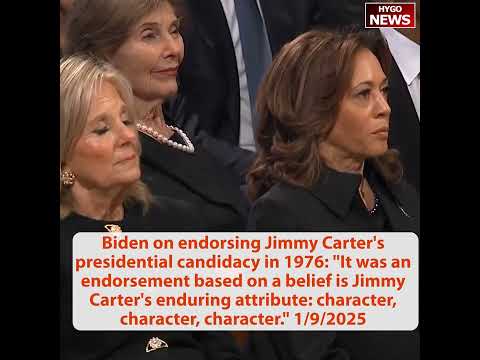
No warm greeting between 1st Couple & 2nd Couple; Biden failed term hang over just as Carter’s did
The state funeral of President Jimmy Carter on January 9, 2025, at the Washington National Cathedral brought together all five living presidents and their spouses, creating a tableau rich with political symbolism. Observers noted the conspicuous lack of warmth between the Biden first couple and the Harris second couple, while commentators drew pointed parallels between the Carter and Biden presidencies. Biden himself delivered the eulogy, sharing a deeply personal account of his six-decade friendship with Carter. But the analysis surrounding the funeral focused on a more uncomfortable question for Democrats: whether Biden’s failed single term would haunt the party for years, just as Carter’s had.
The Body Language: No Warm Greeting
Among the most closely watched dynamics at the funeral was the interaction, or lack thereof, between the Bidens and the Harrises. Media commentators noted that the two couples did not share a particularly warm greeting upon encountering each other at the ceremony.
“You didn’t see a particularly warm greeting between the first couple and the second couple,” one commentator observed, “but again, we are at a funeral, so one has to take that into account when trying to read the body language of the individuals there.”
The cautious framing acknowledged the solemn setting while implicitly noting that the coolness between Biden and Harris reflected deeper tensions. The two had navigated an awkward political transition over the preceding months. Biden’s withdrawal from the 2024 race had paved the way for Harris’s nomination, but the manner of the transition and the subsequent election loss had left unresolved questions about blame, strategy, and the future direction of the Democratic Party.
Harris had begun the year as “a would-be Democratic presidential nominee, and we all know what happened after that,” as one commentator put it, encapsulating the arc of her political year in a single understated sentence.
The Carter-Biden Parallel: Failed Presidencies
The most substantive commentary surrounding the funeral centered on the striking parallels between the Carter and Biden presidencies and what those parallels meant for the Democratic Party’s future.
“For Democrats, this is the first failed presidency since Carter,” a commentator noted. “Clinton got reelected, Obama got reelected. Democrats, I think, judged those things to have been successes. But Carter was a failed president, and the image and the caricature of Carter has hung over the Democratic Party for a very long time.”
The analysis then turned directly to Biden’s predicament: “If you’re Joe Biden, you must be wondering: is how I’m leaving office going to hang over my party? Not only did I not get reelected, but I also brought back Donald Trump stronger and more influential than ever.”
The parallel was historically grounded. Carter’s defeat by Ronald Reagan in 1980 inaugurated an era of Republican dominance that lasted, with one interruption, until Bill Clinton’s election in 1992. For twelve years, Democrats struggled under the weight of the Carter legacy, which Republicans effectively weaponized as a symbol of liberal incompetence, economic mismanagement, and foreign policy weakness.
The question for Biden was whether his presidency would have a similar effect. His decision to withdraw from the 2024 race, the subsequent loss by his chosen successor Harris, and the return of Trump to the White House created a narrative of failure that could define Democratic politics for years to come.
Biden’s Eulogy: A Personal Tribute to Carter
Despite the political undercurrents, Biden delivered a eulogy that was notable for its warmth and personal intimacy. He drew on a friendship that stretched back to the 1970s to paint a portrait of Carter as a man defined above all by his character.
“In April 2021, Jill and I visited Jimmy and Rosalynn on a warm spring day down in Plains, Georgia,” Biden recounted. “We wanted to see them. Rosalynn met us at the front door with her signature smile. Together, we entered a home that they had shared for almost 77 years of marriage.”
Biden described the modest setting that reflected the Carters’ values: “An unassuming red brick ranch home reflects their modesty more than any trappings of power. We walked into the living room where Jimmy greeted us like family. That day, just the four of us sat in the living room and shared memories that spanned almost six decades.”
He then recounted his early support for Carter’s presidential campaign: “A deep friendship that started in 1974. I was a 31-year-old senator, and I was the first senator outside of Georgia, maybe the first senator, to endorse his candidacy for president.”
Biden elevated the tribute to a statement about Carter’s defining quality: “It was an endorsement based on what I believe is Jimmy Carter’s enduring attribute: character, character, character.”
He concluded with a reflection on the connection between personal virtue and national life: “Because of that character, I believe it was destiny in our lives and, quite frankly, destiny in the life of the nation. It’s an accumulation of a million things built on character that leads to a good life in a decent country. Life of purpose, life of meaning.”
The Assembly of Presidents
The funeral was a rare gathering of every living American president. President-elect Donald Trump and First Lady Melania Trump arrived at the National Cathedral and were seated alongside former Presidents Barack Obama, George W. Bush, and Bill Clinton. Biden, as the sitting president, was given the position of honor as eulogist.
The seating arrangements placed political rivals and allies in close proximity, creating the conditions for the Trump-Obama conversation that became one of the most discussed moments of the day. The presence of all five presidents also underscored the nonpartisan nature of the occasion and the tradition of honoring former presidents regardless of political affiliation.
Biden had declared a National Day of Mourning and closed federal offices, a formal acknowledgment of Carter’s service that also gave the funeral an official gravity befitting a state ceremony.
The Weight of Presidential Legacy
The symmetry between Carter’s funeral and Biden’s political situation was unavoidable. Both men were one-term Democratic presidents. Both had faced crippling economic challenges during their presidencies, including inflation. Both had seen their parties’ political fortunes decline during their time in office. And both had been succeeded by Republican presidents who promised to restore American strength and prosperity.
For Biden, delivering the eulogy for Carter while standing on the precipice of his own departure from office must have been an exercise in uncomfortable self-reflection. The qualities he praised in Carter — character, humility, modesty, decency — were the same qualities Biden had long claimed for himself. Yet the political verdict on both presidencies was the same: the voters had chosen a different direction.
Key Takeaways
- Media commentators noted the lack of a warm greeting between the Biden first couple and the Harris second couple at Carter’s funeral, reflecting tensions from the 2024 election cycle.
- Analysts drew a direct parallel between the Carter and Biden presidencies, asking whether Biden’s failed term would “hang over” the Democratic Party for years, just as Carter’s did.
- Biden delivered a personal eulogy recounting a six-decade friendship with Carter, calling character Carter’s “enduring attribute” and describing a 2021 visit to the Carters’ home in Plains, Georgia.
- Biden recalled being the first senator outside Georgia to endorse Carter’s 1976 presidential candidacy, a decision he described as based on “character, character, character.”
- All five living presidents were in attendance, with Biden delivering the eulogy, Trump and Melania arriving together, and Obama, Bush, and Clinton also present.