 HYGO News
 No one earning $400K pay a single penny in Fed taxes
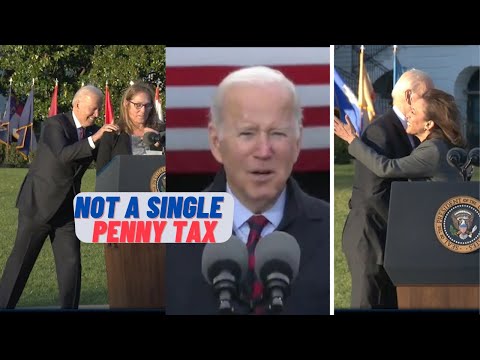
Biden’s Tax Gaffe: “No One Earning Less Than $400K Will Pay a Single Penny in Federal Taxes”
On November 15, 2021, President Biden signed H.R. 3684, the Infrastructure Investment and Jobs Act, at a White House ceremony attended by bipartisan members of Congress. During his remarks, Biden made a statement that drew immediate attention: “And no one — no one earning less than $400K a year will pay a single penny in federal taxes because of it.” The intended message was that no one under $400,000 would pay additional taxes, but Biden dropped the word “more,” making it sound like Americans earning under $400,000 would owe zero federal taxes. The following day, Biden traveled to New Hampshire for his first stop on a national infrastructure tour, where he delivered remarks that critics described as incoherent, struggling through descriptions of natural disasters, bridge collapses, and fire response times while promoting the bill’s provisions.
The Signing Ceremony and the Missing Word
The White House ceremony for the Infrastructure Investment and Jobs Act was meant to be a celebratory milestone for the Biden administration. The $1.2 trillion bipartisan bill represented one of the largest infrastructure investments in American history, covering roads, bridges, broadband internet, water systems, and electric vehicle charging stations.
Biden used the occasion to emphasize his central tax promise: that his economic agenda would not raise taxes on Americans earning less than $400,000 a year. But the specific phrasing he chose created an unintended meaning. Biden stated: “And no one — no one earning less than $400K a year will pay a single penny in federal taxes because of it.”
The intended statement was clearly that no one under the threshold would pay a single penny more in federal taxes. But by omitting the word “more,” Biden appeared to claim that the infrastructure law would eliminate all federal tax obligations for anyone earning under $400,000 — an absurd proposition that would wipe out the vast majority of federal revenue.
Biden repeated the formulation during his remarks. The transcript captured him saying the same line essentially twice during the signing ceremony, suggesting it was not a one-time slip but a consistent error in his prepared delivery. This was not the first time Biden had struggled with the precise wording of his tax pledge; he had previously stated: “No one earning, no one earning in America less than $400,000 will pay a single, solitary extra penny in federal taxes.” The “extra penny” version represented the intended message, making the signing day omission all the more notable.
The Bipartisan Coalition on Display
The signing ceremony highlighted the unusual bipartisan nature of the infrastructure bill. Biden singled out two Republican senators who had been instrumental in negotiating the legislation.
He praised Ohio Senator Rob Portman effusively, noting that Portman was retiring from the Senate: “Senator Rob Portman is a really hell of a good guy. I’m not hurting you, Rob, because I know you’re not running again.” The comment reflected Biden’s frequent approach of using personal relationships to make political points, while the retirement caveat acknowledged the political cost Republicans could face for cooperating with the Democratic president.
Arizona Senator Kyrsten Sinema was introduced as Biden’s co-leader of the bipartisan effort. Sinema’s role in the infrastructure bill stood in contrast to her position on the larger Build Back Better Act, where she was one of two Democratic holdouts whose demands were reshaping the legislation. Biden acknowledged the connection between the two bills directly, telling the audience that the infrastructure law was “part one of two” and that “Congress must also pass the Build Back Better Act.”
The ceremony also included lighter moments that drew attention. Biden introduced his wife and the Second Gentleman, Doug Emhoff, with a stumble: he referred to Emhoff as “our first lady and our second husband” before catching himself and joking about it. He noted that Jill Biden and Emhoff “travel all over the country together” and added “I’m getting worried, you know.”
New Hampshire Tour: “The United States of Amerefa”
The day after the signing ceremony, Biden traveled to New Hampshire to begin a national tour promoting the infrastructure law. The speech was intended to translate the Washington legislative achievement into concrete benefits that local communities could understand.
Biden opened by connecting the legislation to New Hampshire’s specific weather vulnerabilities. He referenced 200-year storms hitting southwestern New Hampshire in recent years, Hurricane Irene’s impact on the state, and the recurring winter ice storms that knock out power.
But his delivery drew more attention than his content. Biden said: “More fires in the West burned to the ground homes, businesses and forests than the entire state of New Jersey…This is the United States of Amerefa for God’s sakes. Why is it happening? Well, the severe storms that are knocking down all the wires, anyway, there’s a lot going on.”
The mispronunciation of “America” as “Amerefa” became one of the speech’s most-shared clips. Critics pointed to it as evidence of cognitive decline, while supporters dismissed it as an ordinary verbal stumble of the kind any public speaker makes.
Biden then attempted to explain why bridge infrastructure mattered using a hypothetical scenario that confused rather than clarified: “How do I cross a bridge in a snowstorm… What happens if the bridge collapses and there’s a fire on the other side? It’s gonna take ten miles longer to get to the fire. People could die.”
The hypothetical — a bridge collapse during a snowstorm preventing fire response — was meant to illustrate the life-or-death stakes of infrastructure investment, but the convoluted delivery made it difficult to follow the logic of the scenario.
The Broader Infrastructure Pitch
Despite the verbal stumbles, Biden’s New Hampshire remarks laid out the administration’s case for the infrastructure law’s real-world impact. He emphasized that the legislation would rebuild bridges, water systems, power lines, and electrical grids.
Biden spoke about broadband access, a theme he had raised repeatedly throughout 2021. The infrastructure law included $65 billion for broadband expansion, which the administration argued would connect millions of Americans in rural and underserved areas who lacked reliable internet access.
Biden also spoke about the law’s provisions for electric vehicle infrastructure, including 500,000 new charging stations. He framed the investment as both an economic and environmental measure, arguing that modernizing the nation’s infrastructure would create jobs while addressing climate-related damage from increasingly severe weather events.
He emphasized the bipartisan nature of the achievement, noting that the bill had received support from both parties in Congress — a rarity in the deeply polarized political environment. Biden positioned the infrastructure law as proof that government could still function and that compromise was possible, even as partisan battles over the larger Build Back Better Act continued in Washington.
The Build Back Better Shadow
Biden’s declaration that the infrastructure bill was “part one of two” revealed the political tension underlying the celebration. The administration viewed the infrastructure law and the Build Back Better Act as complementary pieces of a single economic agenda, but the two bills had followed very different paths through Congress.
The infrastructure bill had attracted bipartisan support precisely because it was separated from the more ambitious social spending and climate provisions in Build Back Better. Progressive Democrats had initially resisted voting for infrastructure without a guarantee that Build Back Better would also pass, creating months of intraparty conflict.
By the time of the signing ceremony, Build Back Better’s fate remained uncertain. Senator Joe Manchin of West Virginia had not committed to supporting the bill, and his concerns about the legislation’s cost and inflation impact would ultimately lead him to sink it the following month. Biden’s insistence at the signing ceremony that Congress “must also pass” Build Back Better would prove to be aspirational rather than prophetic.
The juxtaposition was telling: a president celebrating a genuine legislative achievement while simultaneously demanding passage of a second bill that was already in serious trouble, all while making verbal errors that overshadowed the policy substance of both events.
Key Takeaways
- Biden said “no one earning less than $400K a year will pay a single penny in federal taxes” at the infrastructure bill signing, dropping the word “more” and inadvertently claiming the law would eliminate all federal taxes for Americans under the $400,000 threshold — a formulation he repeated during the same ceremony.
- The following day in New Hampshire, Biden mispronounced “America” as “Amerefa” and delivered a confusing bridge-collapse-during-snowstorm hypothetical while promoting the $1.2 trillion infrastructure law, drawing more attention to his delivery than to the bill’s provisions for roads, bridges, broadband, and EV charging stations.
- Biden called the infrastructure law “part one of two” and urged Congress to pass Build Back Better, praised Republican Senator Rob Portman as “a hell of a good guy,” and joked about Doug Emhoff after accidentally calling him “our second husband” at the bipartisan signing ceremony.