 HYGO News
 NEC Hassett: Intel CHIPS money exchange equity; Navarro: crack down China furniture; Eliz Warren
NEC Hassett: Intel CHIPS money exchange equity; Navarro: crack down China furniture; Eliz Warren
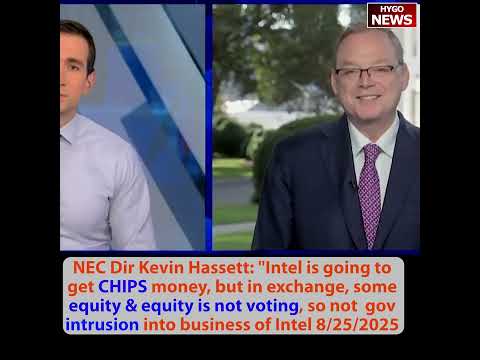
NEC Director Kevin Hassett explained the Intel-CHIPS Act restructuring — Intel gets the promised CHIPS money, but U.S. gets equity in exchange (non-voting, a “down payment on a sovereign wealth fund”). Senior Counselor Peter Navarro described how China’s WTO entry specifically destroyed North Carolina’s furniture and textile industries. Elizabeth Warren advocating specifically doubling down on Democratic agenda rather than moderating. Rep. Maxwell Frost calling Trump “authoritarian” despite specific measurable improvements. CNN acknowledging Democrats have lost 4.5 million net voter registrations. And a Muslim Democratic Senate candidate telling rally attendees to “take them to the mud and choke them out.” Hassett: “Intel is going to get the CHIPS money, but in exchange, we’re going to get some equity — and the equity is not voting, so there’s not going to be government intrusion into the business of Intel … It’s more like a down payment on a sovereign wealth fund, which many, many countries have.” Navarro: “Between textiles and furniture in North Carolina, China ripped the heart out of that state.” Warren on Democrats: “Nobody elected the Democrats to lie down and play dead. The number one thing we’ve got to do is stand up and fight back.”
Intel CHIPS Deal: Equity for Money
Hassett’s specific explanation. “Because of the CHIPS Act, the U.S. government had decided to give a whole bunch of money to Intel. President Trump and Howard Lecter, Secretary Lucknick, talked to Intel about the progress they were making in the hurdles they had to hop over in order to get the money. And I don’t think they’re particularly happy with that progress.”
“Howard Lucknick” is Whisper’s rendering of Howard Lutnick — Commerce Secretary. Lutnick has specific responsibility for CHIPS Act implementation. Lutnick and Trump specifically engaged Intel about Intel’s specific progress toward CHIPS Act requirements.
“Not particularly happy with that progress.” That is specific framing. Intel had received substantial CHIPS Act commitments but had not specifically executed the specific expected milestones. The administration was not satisfied.
“And so in the end, they worked out a deal where Intel is going to get the CHIPS money, but in exchange, we’re going to get some equity.”
Specific deal structure. Intel receives the CHIPS money as originally committed. U.S. government receives equity stake in Intel. That is substantially different from standard CHIPS Act arrangement — which was grants/loans without specific equity.
”Equity Is Not Voting”
“And equity is not voting, so there’s not going to be government intrusion into the business of Intel.”
Specific equity structure. Government’s equity is non-voting. That means government holds specific financial interest in Intel’s performance but does not specifically control Intel’s business decisions. Intel management retains specific operational control.
That specific structure addresses specific concerns about government “picking winners and losers.” Critics have specifically worried that CHIPS Act grants created specific corporate dependence on government. Equity structure specifically changes the relationship — government becomes specific shareholder rather than specific patron.
“It’s more like a down payment on a sovereign wealth fund, which many, many countries have.”
Specific international comparison. Sovereign wealth funds:
- Norway’s Government Pension Fund (largest globally, ~$1.6 trillion)
- Saudi Arabia’s Public Investment Fund (~$1 trillion)
- China Investment Corporation (~$1.3 trillion)
- Singapore’s GIC (~$770 billion)
- UAE’s Abu Dhabi Investment Authority (~$1 trillion)
The U.S. does not currently have a sovereign wealth fund despite being the world’s largest economy. Hassett’s framing: Intel equity as the first specific asset of what could become a U.S. sovereign wealth fund.
That is substantial policy development. A U.S. sovereign wealth fund would be specifically significant tool for long-term American economic strategy. Accumulating specific equity in strategic sectors (technology, energy, defense) would provide specific national security advantages and specific fiscal flexibility.
Elizabeth Warren: Fight Back
Moderator’s question to Warren. “The Democratic Party’s approval rating is also near an all-time low. So the question is, what do Democrats need to do to win back Congress in the midterms and just win back the people?”
Warren’s specific response. “Well, I’ve got to tell you, nobody elected the Democrats to lie down and play dead. The number one thing we’ve got to do is stand up and fight back.”
That is specific strategic framing. Not moderation. Not reconsideration. Not specific engagement with voters’ specific concerns. Aggressive continued opposition.
“Stand up and fight back.” Specific vocabulary. Active resistance. Not passive position management. That framework matches Pritzker’s “stop apologizing” framing from earlier segments.
The specific strategic implications. If Democrats with low approval ratings respond by intensifying their specific positions rather than moderating them, voters who find those positions problematic will specifically not return to Democrats. Warren’s specific strategy specifically risks driving additional voters away rather than attracting specific returning voters.
Navarro on China and North Carolina
Senior Counselor Peter Navarro’s personal context. “See, this is a beautiful thing. I don’t know if you know this, Maria, but when I was getting my PhD in economics at Harvard, I actually helped work my way through by managing a furniture store. And every year, I’d go up to High Point in North Carolina and buy a bunch of stuff for the store and stuff like that.”
Specific personal history. Navarro specifically worked in the furniture industry while pursuing his PhD. High Point, North Carolina — specifically America’s furniture manufacturing capital. Navarro has specific personal experience with the specific industry and specific location.
“And what I saw after China joined the World Trade Organization was a total devastation of our furniture industry, our cabinetry, kitchen cabinetry, and all of that by the same usual playbook of the Chinese communists, which is to dump into markets and use all the government subsidies.”
Specific historical sequence. China joined WTO in 2001. Subsequent decade saw specific destruction of American furniture manufacturing. The specific Chinese playbook:
- Dump products into American markets below cost
- Use Chinese government subsidies to sustain the dumping
- Drive American competitors out of business
- Establish specific market dominance
That pattern specifically devastated North Carolina’s furniture industry. Before China’s WTO entry, North Carolina had thousands of specific furniture manufacturers employing hundreds of thousands of workers. After WTO entry, most of those specific operations closed.
”Ripped the Heart Out”
“It really, I mean, North Carolina in particular, I mean, it ripped the heart. I mean, between textiles and furniture in North Carolina, China ripped the heart out of that state.”
“Ripped the heart out.” Specific vocabulary. Not mere economic disruption. Specifically devastating impact on the specific state’s economic identity. North Carolina’s economic fabric specifically destroyed.
Textiles AND furniture. Both specific industries that had been specifically central to North Carolina’s economy. Both specifically destroyed by specific China competition. The specific double impact made North Carolina specifically one of the worst-affected states.
”Setting Up Shop in Vietnam”
“But there’s a lot of other places in America that are flying furniture producers, cabinet, kitchen, cabinetry. Another game that goes on is like you slap a tariff on China and the next thing you know, they’re setting up shop in Vietnam, trans shipping to here.”
Specific workaround strategy. China specifically responds to U.S. tariffs by relocating specific production to Vietnam or other specific countries. Those specific products then ship to U.S. without specific China tariffs applying.
That is specific trade enforcement problem. Simple China tariffs do not work specifically because of specific relocation. Broader tariff structures — including specific tariffs on specific Vietnamese exports, specific rules-of-origin requirements, specific enforcement mechanisms — are required.
“President Trump’s cracking down on all of that and he’s going to do it for the craftsmen and workers of the American people. And that’s a good thing, Maria, and it couldn’t happen sooner.”
Specific policy framework. Trump administration specifically addressing specific transshipment issues. Protecting specific American craftsmen and workers. Comprehensive enforcement rather than specific gaps exploitable through specific country substitution.
Maxwell Frost: “Authoritarian”
“Throughout this administration, we’ve been taking notes and writing bills because if Donald Trump has shown us one thing is we have some potholes in our democracy and he won’t be the last authoritarian to try to come to power and tear it all apart.”
Rep. Maxwell Frost’s specific framing. Trump as “authoritarian.” “Potholes in our democracy.” Need to write bills preventing future “authoritarians.”
The specific factual framework. Trump operates under specific constitutional constraints. Congress meets regularly. Courts rule on specific cases. Elections occur as scheduled. Press operates freely (as demonstrated by specific hostile media coverage Leavitt specifically addresses).
“Authoritarian” is specifically inflammatory vocabulary. Actual authoritarians typically suspend elections, dissolve legislatures, jail political opponents without trials, control media, etc. None of those specific conditions apply to Trump administration.
Calling Trump “authoritarian” while specifically operating within legitimate democratic institutions represents specific vocabulary inflation. If everything Democrats disapprove of is “authoritarian,” the specific word loses specific meaning.
CNN: “4.5 Million Voter Deficit”
“In all 30 states that track party registration, we’re putting on the screen the data shows altogether Democrats have lost 2.1 million voters. Republicans have gained 2.4 million. That’s a deficit that you have of 4.5 million voters.”
Specific voter registration data. 30 states track specific party affiliation. Aggregate data shows:
- Democrats lost 2.1 million registered voters
- Republicans gained 2.4 million registered voters
- Net deficit: 4.5 million voters shifting from Democratic to Republican
That is extraordinary political shift. Voter registration is relatively stable metric. 4.5 million net shift represents specific ideological movement across millions of specific individuals.
The CNN host delivering specific information. Specific frustration in the voice. CNN specifically reluctantly reporting specific data unfavorable to specific Democratic framing. But the specific data is specifically factual and cannot be specifically suppressed.
”Take Them to the Mud and Choke Them Out”
The segment ends with Muslim Democratic Senate candidate. “With all due respect, if they go low, we don’t go high. We take them to the mud and choke them out.”
Specific reversal of Michelle Obama’s “when they go low, we go high” framing. The specific Democratic candidate specifically rejects that framework. Instead: “take them to the mud and choke them out.”
“Choke them out.” That is specific violent vocabulary. Combat sports term. MMA or wrestling technique for rendering opponents unconscious. Applying that specific vocabulary to specific political opponents represents specific vocabulary inflation.
The specific candidate specifically identifying as Muslim socialist running for Senate. That specific positioning combined with specific violent rhetoric specifically raises questions about the specific candidate’s suitability for specific Senate office. Rhetoric that metaphorically calls for “choking out” political opponents specifically crosses standard political discourse boundaries.
Six Distinct Elements
Intel-CHIPS equity restructuring (specific sovereign wealth fund seed). Warren’s “fight back” strategic framing (specific rejection of Democratic moderation). Navarro on China destroying North Carolina (specific historical economic context). Maxwell Frost’s “authoritarian” characterization (specific vocabulary inflation). CNN’s 4.5 million voter deficit disclosure (specific structural political shift). Senate candidate’s “choke them out” rhetoric (specific violent vocabulary).
Each reflects specific aspects of current political landscape. Administration economic innovation creating specific long-term national assets. Democratic strategic choices continuing toward specific intensification. Historical economic context informing specific current policy. Democratic rhetorical escalation continuing. Specific underlying political shifts. Specific Democratic candidate rhetoric patterns.
Key Takeaways
- NEC Director Kevin Hassett on Intel deal: “Intel is going to get the CHIPS money, but in exchange, we’re going to get some equity — and the equity is not voting, so there’s not going to be government intrusion into the business of Intel … It’s more like a down payment on a sovereign wealth fund, which many, many countries have.”
- Elizabeth Warren on Democratic strategy: “Nobody elected the Democrats to lie down and play dead. The number one thing we’ve got to do is stand up and fight back.”
- Peter Navarro on China’s impact: “Between textiles and furniture in North Carolina, China ripped the heart out of that state … the usual playbook of the Chinese communists, which is to dump into markets and use all the government subsidies.”
- CNN’s voter registration data: “Democrats have lost 2.1 million voters. Republicans have gained 2.4 million. That’s a deficit that you have of 4.5 million voters.”
- Muslim Democratic Senate candidate: “With all due respect, if they go low, we don’t go high. We take them to the mud and choke them out.”