 HYGO News
 Navarro on trade: deficit with Europe huge, unfair; tariffs & Samsung $500M washing machine plant
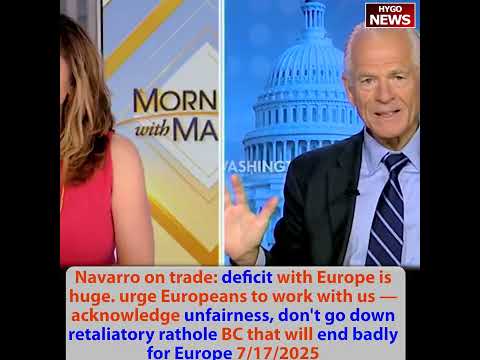
Navarro on trade: deficit with Europe huge, unfair; tariffs & Samsung $500M washing machine plant
White House Senior Counselor Peter Navarro laid out, in unusually operational detail, how the U.S. views its trade relationship with the European Union. EU auto tariffs four times higher than U.S. tariffs. A VAT tax Navarro called “not just an additional tariff on America” but also “an export subsidy.” Europe serving as a “transshipment point” for Chinese goods — with China’s surplus with Europe approximately equal to the U.S. deficit with Europe. Trump’s 2018 washing-machine tariffs drew $500 million from Samsung into a Newberry, South Carolina manufacturing plant that now employs 1,600 workers at starting wages more than double the local minimum wage. Gavin Newsom calling the National Guard deployment to LA “wasted” money. Rep. Ro Khanna endorsed Zohran Mamdani as “charismatic” and “relatable.” And Democrat Rep. Luz Rivas backed Mamdani while admitting she didn’t know how his government-grocery-store idea would work.
The European Trade Picture
Navarro opened with the operational framing. “If you look at the EU, you start with the tariffs. For example, four times higher on autos. So Germany sends us seven cars, wherever we want, we send them. That’s got to stop. That’s an easy lift.”
That is the asymmetry Navarro has been documenting. European auto tariffs on U.S. imports run approximately 10%. U.S. auto tariffs on European imports ran, for most of the past decades, approximately 2.5% — roughly four times lower. For every seven German cars that land in the U.S., the U.S. exports roughly one car to Germany. The trade flow is lopsided, and the tariff regime that governs it reflects that lopsidedness.
“That’s an easy lift” — the framing that unilateral U.S. action to equalize auto tariffs is operationally simple. The administration has, in fact, moved to equalize. The question is whether Europe responds with adjustment or escalation.
The Non-Tariff Barriers
“The non-tariff barriers are the ones where, as a block, it’s going to be very difficult for the EU to deal with.”
Non-tariff barriers — regulatory requirements, product standards, technical specifications, approval processes — are the subtler form of trade friction. They are often described as consumer-protection or environmental-standard measures, which means attacking them is politically more complex than attacking tariffs. But their cumulative effect on U.S. exports to Europe is substantial.
The EU’s ability to coordinate on non-tariff barriers is what Navarro is flagging as the “as a block” complication. Twenty-seven member states, twenty-seven regulatory traditions, twenty-seven domestic politics — renegotiating non-tariff barriers requires consensus across all of them, which Europe is not currently able to produce efficiently.
The VAT: “Not Just a Tariff”
“And then, of course, they have the VAT tax, which adds 19%, I think, to the effective tariff. The VAT tax is not just an additional tariff on America. It’s also an export subsidy, the way it works under the rules of the World Trade Organization.”
Navarro’s VAT argument is the most sophisticated piece of his case. The European VAT system works like this: a 19% VAT is added to imported goods entering Europe, and VAT is rebated to European goods when they are exported. That structure is treated by the WTO as neutral — because it applies equally to domestic and foreign goods within Europe.
But from the U.S. perspective, the effect is asymmetric. American goods entering Europe pay 19% VAT on top of the tariff. European goods entering the U.S. pay no VAT. When European goods are exported, they receive a 19% rebate, effectively a subsidy that lowers their export price. The combined effect is that European exporters enjoy a de facto trade advantage that the WTO rules allow.
Navarro’s argument: this is not a neutral consumption tax. It is, in its actual operation, both an import tariff and an export subsidy — and the WTO’s rules that permit it are rules the U.S. should no longer accept.
”They Cheat Us So Badly”
“It’s a difficult, difficult negotiation, because they cheat us so badly. Remember, that deficit with Europe is huge.”
“Cheat” is strong language from a senior White House trade adviser about a major ally and trading partner. Navarro is signaling that the administration does not view current U.S.-EU trade terms as fair negotiation — it views them as exploitation that requires unwinding.
The China Transshipment
“And what’s interesting, China has a surplus with Europe, which is about equal to our deficit with Europe. So a lot of things are coming in from China, and Europe, essentially, is a transshipment point for goods here. So it’s a very complex one.”
That is the single most interesting observation in Navarro’s remarks. If China has a surplus with Europe approximately equal to the U.S. deficit with Europe, and a lot of European exports to the U.S. contain Chinese inputs or Chinese-origin components, then the U.S. trade deficit with Europe is, in part, a laundered U.S. trade deficit with China.
Europe, in this framing, is not independently producing the surplus it runs with the U.S. It is, in part, converting Chinese goods into European-branded exports that then face less scrutiny than direct Chinese imports would. That pattern — transshipment — is one of the structural challenges in U.S. trade policy with China.
”Don’t Go Down the Retaliatory Rat Hole”
Navarro issued a warning-cum-plea. “I would just urge the Europeans to work with us, acknowledge the unfairness of this, and don’t go down the retaliatory rat hole, because that will end badly for Europe.”
That is the core of the negotiating posture. Cooperate or escalate. If Europe chooses to cooperate — accepting tariff equalization, accepting scrutiny of the VAT/transshipment dynamics, accepting higher European defense spending and Ukraine financing commitments — the trading relationship becomes more symmetric. If Europe chooses to retaliate with counter-tariffs, the asymmetric power positions mean the U.S. economy absorbs less damage than the European economies.
“End badly for Europe” is operational realism. European exporters depend on the U.S. market more than U.S. exporters depend on European markets. A tariff war hurts the dependent side more.
The WTO Ruling Issue
Navarro added a specific grievance about Europe’s WTO compliance. “One other thing, Maria, this boggles your mind. It’s like, we’ve won cases at the WTO against Europe with respect to our agricultural imports, pork and beef. They don’t respect it. Europe did not abide by those rulings by the World Trade. I mean, that boggles the mind, really.”
The WTO agricultural disputes are long-running. The U.S. has won cases against EU agricultural import restrictions — specifically involving hormone-treated beef, genetically modified organisms, and pork from certain production systems. Europe has, across multiple cycles, declined to comply with the WTO rulings, citing public-health and environmental concerns that the WTO did not accept as legitimate trade barriers.
Navarro’s “boggles the mind” framing is designed to puncture the common perception that the U.S. is the party that dismisses WTO rulings. In this specific case, Europe has been the non-compliant party, and the U.S. has been the party whose agricultural exporters have paid the cost.
Samsung: The $500M Data Point
The segment then pivoted to concrete evidence that tariffs produce the reshoring the administration predicts. “President Trump’s tariffs are now luring at least a couple of foreign companies to manufacture their products stateside. This includes South Korea’s Samsung. They are now going to produce their washing machines out of Newbury, South Carolina. Washing machines are actually rolling off the assembly lines right behind me.”
The reporter’s framing — “there’s not a whole lot of debate in Newbury, South Carolina about whether or not President Trump’s tariffs help or hurt the economy” — reflects the local consensus in a community that has seen concrete jobs appear as a result.
“Putting in 20% to 50% tariffs on foreign-made washing machines back in 2018, motivated Samsung to build a $500 million washing machine manufacturing plant here, making them instantly the county’s largest taxpayer. That factory also created more than 1,600 jobs here, starting salary of $17 an hour. That’s a lot higher than the local minimum wage here of just $7.50 an hour.”
$500 million plant. 1,600 jobs. Starting wage of $17/hr in a county where minimum wage is $7.50/hr. Samsung instantly the county’s largest taxpayer. That is the kind of tangible data point — not a model, not a projection, but actual jobs and actual capital spending — that the administration cites as proof the tariff-reshoring theory works.
Newsom: “$2,000 in Cash” and “Wasted”
The segment then pivoted to Gavin Newsom’s complaints about the federal response to LA riots. “When was the White House indicated to you when they might consider pulling back to what it means to have $2,000 in cash from the White House? Well, they better do it now, today, next few hours. I’m a taxpayer. I don’t like to see my money wasted like this.”
Newsom — who oversaw California during the Los Angeles riots when his state and municipal authorities failed to restore order — describing the federal National Guard deployment as “wasted” money is a political posture. He is attempting to reverse the story: not that the federal government had to step in because California couldn’t, but that the federal government wasted money by stepping in.
The administration’s framing is that the National Guard deployment cost money precisely because Newsom’s state and municipal apparatus failed to do its job. The waste, if there is waste, is downstream of the gubernatorial failure, not of the federal response.
Ro Khanna: “I Will Endorse Him”
Rep. Ro Khanna was the next House Democrat to fully endorse Zohran Mamdani. “Look, he’s a very charismatic, relatable person.”
“I will endorse him.” That is the direct statement. Khanna is not Pramila Jayapal’s level of progressive positioning, but he is on the progressive wing of the party, and his endorsement of Mamdani adds to the growing list of national Democrats who are committing to the nominee.
“Charismatic, relatable” is the endorsement vocabulary that avoids the substantive record. Mamdani’s policy positions — defund-style rhetoric on policing, anti-Israel activism, democratic-socialist economics — are not addressed in Khanna’s framing. The person, not the platform, is what Khanna is endorsing.
Rep. Rivas on Mamdani’s Groceries
Rep. Luz Rivas offered a telling admission when asked about Mamdani’s government-grocery-store proposal. “He talked about freezing rent, faster buses in New York City, and universal childcare, which seems to be the message that really resonated with New York City voters. He didn’t think of that. He didn’t talk about that. It was just more how he was getting that message out.”
Then the question: “What do you think of his idea for government on groceries to work? Do you think that’s a good idea?”
Rivas’s answer: “I don’t know how that would work. I haven’t really looked at how that would work.”
That is a striking admission from a Democrat endorsing Mamdani. She is endorsing the candidate without having “really looked at” his signature economic proposal. Government-run grocery stores are one of the defining policy markers of Mamdani’s campaign, and a member of Congress admitting she has not examined whether it is feasible is a data point about what Mamdani endorsements are actually endorsing.
Key Takeaways
- Peter Navarro: EU auto tariffs are “four times higher” than U.S. tariffs — “Germany sends us seven cars, wherever we want, we send them. That’s got to stop.”
- Navarro on the VAT: “not just an additional tariff on America. It’s also an export subsidy, the way it works under the rules of the World Trade Organization … they cheat us so badly.”
- Europe as a “transshipment point” for Chinese goods: “China has a surplus with Europe, which is about equal to our deficit with Europe. So a lot of things are coming in from China.”
- Trump’s 2018 washing-machine tariffs drew a $500 million Samsung plant to Newberry, SC — creating 1,600 jobs at $17/hr starting wage vs. local $7.50 minimum wage, making Samsung “instantly the county’s largest taxpayer.”
- Rep. Ro Khanna endorsed Mamdani as “charismatic, relatable”; Rep. Luz Rivas endorsed him while admitting on Mamdani’s government-grocery proposal: “I don’t know how that would work. I haven’t really looked at how that would work.”