 HYGO News
 Nat'l Security? allies can still participate in intelligence gathering still be trusted with secret?
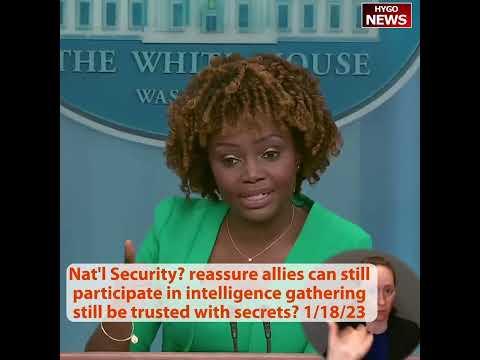
Reporter: Can Allies Still Trust U.S. With Secrets? KJP Refuses to Discuss — “I’m Not Going to Open This Up for Discussion”
In January 2023, a reporter pressed White House Press Secretary Karine Jean-Pierre on whether the U.S. was reassuring allies that they could still trust America with classified intelligence following the Biden classified documents revelations. “We don’t know what’s in these documents, but can the U.S. and is the U.S. working to reassure allies and partners that can still participate in intelligence gathering and still be trusted with secrets?” the reporter asked, specifically referencing Jake Sullivan’s trip to Israel. KJP’s response was to deflect: “I’m going to say this. The President takes classified information seriously. You heard that directly from him. I’m not going to open this up for discussion. We have answered many questions when it is related to the documents.” The refusal to address a significant national security implications question showed the administration’s blackout extended even to broader foreign policy consequences.
The National Security Dimension
The reporter’s question addressed a serious implication. Beyond investigation questions or procedure questions, the classified documents incident raised:
Ally trust concerns — Had foreign partners been affected?
Intelligence sharing implications — Would partners continue sharing?
Foreign reassurance efforts — Was administration addressing concerns?
Jake Sullivan diplomacy — Specific administrative response.
Ongoing partnerships — Future of intelligence cooperation.
This was a higher-order question than daily process inquiries. It addressed whether the documents incident was affecting U.S. foreign relations and intelligence partnerships — a legitimate area of presidential accountability that didn’t require commenting on investigation specifics.
”I’ll Take Another Stab at It”
The reporter’s framing showed prior attempts. “So I’ll take another stab at it,” the reporter said, indicating this was a repeat or recast attempt.
The context suggested:
Previous questions deflected — On related topics.
Reframing strategy — Finding angle KJP might address.
Persistence — Through multiple questions.
Adaptation — To deflection patterns.
Escalation attempt — To higher-stakes framing.
Reporters had developed strategies for getting around KJP’s deflection patterns. Asking about foreign policy implications rather than investigation specifics was one such strategy. The reporter was testing whether elevating the question to the national security level would break through.
”We Don’t Know What’s in These Documents”
The reporter’s framing was careful. “We don’t know what’s in these documents,” the reporter acknowledged.
The acknowledgment was strategic:
Accepting information limits — Not asking about contents.
Not demanding specifics — Respecting legal process.
Broader implications focus — Beyond specific documents.
Working within KJP’s framework — Of what she wouldn’t discuss.
Establishing question scope — To prevent deflection.
By acknowledging that document contents were unknown, the reporter was attempting to move past the most likely deflection (commenting on specifics). The question was about general diplomatic response, not about what was in the papers.
”Can the U.S. and Is the U.S. Working to Reassure Allies”
The substantive question was about diplomatic effort. “Can the U.S. and is the U.S. working to reassure allies and partners that can still participate in intelligence gathering and still be trusted with secrets?” the reporter asked.
The question had specific components:
Active diplomacy — Is the U.S. working on this?
Reassurance efforts — Telling allies they can trust us?
Intelligence gathering — Continued participation?
Trust with secrets — Future sharing?
General diplomatic status — Current state?
These were questions about ongoing administration activity. If the U.S. was working to reassure allies, that was a fact that should be confirmable or deniable. The administration either was or wasn’t engaged in such diplomacy.
The Jake Sullivan Reference
The reporter cited a specific example. “Is that, are those conversations that the President is having right now or that top of the administration officials are having, for example, Jake Sullivan in Israel?” the reporter asked.
Jake Sullivan’s trip to Israel provided concrete context:
National Security Advisor — Senior administration official.
Israel visit — Major ally relationship.
Intelligence partner — Significant cooperation.
Specific trip — Current event at the time.
Natural context — For such discussions.
Sullivan’s Israel trip was a real occurrence where such conversations about trust and intelligence sharing might naturally come up. The reporter was anchoring the question in a specific, public event — asking whether this public activity involved the issues the reporter was asking about.
”The President Takes Classified Information Seriously”
KJP’s response used her standard deflection anchor. “I’m going to say this. The President takes classified information seriously. You heard that directly from him,” KJP said.
The response used familiar elements:
Character claim — Taking seriously.
Reference to Biden — “Directly from him.”
No substantive response — To the specific question.
Generic statement — Not ally-specific.
Deflection opening — For what followed.
The “takes classified information seriously” line had become a KJP standard response. It was meant to convey administration gravity without actually addressing specific questions. In this instance, it didn’t address allied trust, diplomatic efforts, or Jake Sullivan’s trip.
”I’m Not Going to Open This Up for Discussion”
KJP explicitly declined discussion. “I’m not going to open this up for discussion. We have answered many questions when it is related to the documents,” KJP said.
The refusal had notable aspects:
Explicit declaration — Of non-engagement.
“Open this up” — Treating discussion as optional.
“Many questions” — Claiming prior answering.
Closing the topic — Unilaterally.
No route offered — For information.
The “not going to open this up for discussion” framing was striking. This treated the press briefing as something where the spokesperson could unilaterally decide what topics would be discussed. But briefings are supposed to be for addressing reporter questions, not for spokesperson topic selection.
The “Many Questions” Claim
KJP’s claim to have “answered many questions” was debatable:
Deflection count — Was high.
Actual answers — Were few.
Process explanations — Hadn’t been provided.
Substantive responses — Were rare.
Pattern of referrals — Characterized briefings.
From reporters’ perspective, “answered many questions” meant responded to many questions — but the responses were almost uniformly deflections. The claim to have answered misrepresented the nature of the responses. Questions being deflected isn’t the same as questions being answered.
The National Security Stonewall
KJP’s refusal to discuss the national security dimension was particularly notable:
Beyond DOJ scope — National security wasn’t the investigation.
Administration activity — Diplomatic engagement was ongoing.
Public facts — Sullivan’s trip was known.
Legitimate area — For briefing discussion.
Factual responses possible — Without compromising anything.
Other administrations routinely discussed foreign policy and diplomatic efforts. Whether the U.S. was reassuring allies about intelligence partnerships was the kind of topic press secretaries typically addressed. The blanket refusal suggested administration concern that any discussion might highlight problems.
The Allied Trust Reality
The underlying concern was real. Allies had reasons for concern:
Intelligence leaked — Potentially through mishandled documents.
U.S. reliability — In question.
Partnership trust — Could erode.
Future sharing — Might be reduced.
Specific concerns — By specific partners.
Allies watching the classified documents saga would have genuine questions about whether their shared intelligence had been compromised and whether U.S. systems were adequate. These concerns would be raised in diplomatic contexts. The administration would have to respond.
The Sullivan Israel Context
Jake Sullivan’s January 2023 Israel trip occurred during the classified documents revelations:
Senior-level visit — National Security Advisor.
Sensitive timing — Amid document news.
Major ally — Israel as intelligence partner.
Active discussions — Covering various topics.
Natural questions — About document implications.
Whether Sullivan addressed Israeli concerns about document handling would have been a legitimate question. Israel’s reliance on shared U.S. intelligence was substantial. Israeli officials would want reassurance. Whether they received it was information about ongoing diplomacy.
KJP’s refusal to address any of this — even to confirm that diplomacy was happening — was a notable stance. It suggested either that no such diplomatic efforts were occurring or that they were too sensitive to confirm. Either interpretation had its own concerns.
The Broader Diplomatic Context
Beyond Israel, the classified documents issue had broader implications:
Five Eyes partners — UK, Australia, Canada, New Zealand.
NATO allies — Intelligence sharing arrangements.
Specific bilateral relationships — With various partners.
Multilateral frameworks — For intelligence cooperation.
Private partners — Various formal and informal.
All of these relationships involved classified material sharing. All could be affected by U.S. document handling concerns. Whether the administration was addressing concerns in each of these relationships was a legitimate question that KJP declined to discuss.
The Congressional Oversight Parallel
Similar questions were being asked in Congressional contexts. The Senate Intelligence Committee and House Intelligence Committee would have similar concerns:
Congressional oversight — Of intelligence.
Committee briefings — Traditional channel.
Classified sessions — For sensitive information.
Member access — To relevant material.
Administration cooperation — Required by law.
Whether the administration was providing adequate information to Congress on the classified documents matter was a parallel question. The resistance to press discussion mirrored resistance to Congressional inquiry.
The Transparency Gap
The national security dimension highlighted the transparency gap:
Public interest — In foreign relations.
Administration silence — On diplomatic effort.
Foreign partner uncertainty — About status.
Voter information — Limited.
Press function — Blocked.
The gap between what the public could reasonably know and what the administration was willing to share was substantial. On a topic with significant national security implications, the White House was essentially declining to discuss anything.
The Political Calculation
Administration silence probably reflected specific political calculation:
Volunteering might highlight — Problems.
Discussing reassurance — Might imply doubt existed.
Acknowledging diplomacy — Might confirm allies had concerns.
Any discussion — Risked feeding narrative.
Silence — Seemed safest.
The calculation was defensible but limited. By refusing to discuss the foreign relations dimension, the administration left foreign policy commentary to others — critics, foreign officials, former diplomats. The vacuum of administration statements was filled by voices less favorable to the administration.
The Pattern Continuation
This exchange fit the January 2023 pattern of:
Reporters asking substantive questions — About implications.
KJP deflecting — Regardless of scope.
Expanding deflection — To unrelated topics.
Media coverage — Of deflections themselves.
Political pressure — Not yielding change.
The foreign relations dimension was one more area where the pattern held. Whether the topic was domestic procedure, DOJ investigation, Biden’s views, or international diplomacy — the answer was the same: non-response.
Key Takeaways
- A reporter asked KJP whether the U.S. was working to reassure allies about intelligence sharing after the Biden classified documents revelations.
- The question cited Jake Sullivan’s trip to Israel as a specific example of relevant diplomatic engagement.
- KJP deflected with her standard line: “The President takes classified information seriously. You heard that directly from him.”
- She explicitly declined engagement: “I’m not going to open this up for discussion. We have answered many questions when it is related to the documents.”
- The blackout extended even to national security and foreign relations dimensions that didn’t require commenting on investigation specifics.
- The refusal left significant foreign policy questions about allied trust and intelligence partnerships unaddressed through normal White House briefings.
Transcript Highlights
The following is transcribed from the video audio (unverified — AI-generated from audio).
- Let me ask about the document if you get it. So I’ll take another stab at it.
- We don’t know what’s in these documents, but can the U.S. and is the U.S. working to reassure allies and partners that can still participate in intelligence gathering and still be trusted with secrets?
- Is that, are those conversations that the President is having right now or that top of the administration officials are having, for example, Jake Sullivan in Israel?
- I’m going to say this. The President takes classified information seriously. You heard that directly from him.
- I’m not going to open this up for discussion.
- We have answered many questions when it is related to the documents.
Full transcript: 116 words transcribed via Whisper AI.