 HYGO News
 mRNA Vaxxes More Dangerous Than Traditional, Robert F. Kennedy Jr Halts $500M in mRNA Funding
mRNA Vaxxes More Dangerous Than Traditional, Robert F. Kennedy Jr Halts $500M in mRNA Funding
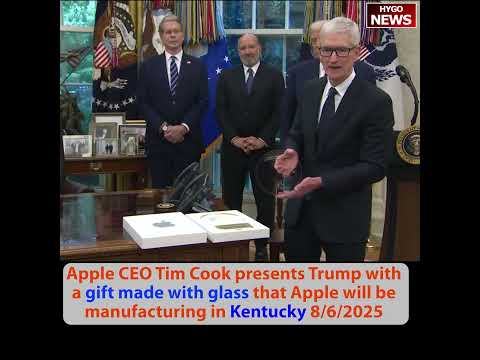
Two major announcements. Apple CEO Tim Cook, at the White House, announced Apple will invest $600 billion in the U.S. over the next four years — “$100 billion more than they were originally going to invest.” Cook presented Trump with a personal gift: glass manufactured at Apple’s forthcoming Kentucky facility, engraved, with a 24-karat gold base from Utah, “designed by a U.S. Marine Corps corporal” who works at Apple. Separately, HHS Secretary Robert F. Kennedy Jr. announced BARDA is terminating 22 mRNA vaccine development investments totaling nearly $500 million. Kennedy’s rationale: “mRNA vaccines don’t perform well against viruses that infect the upper respiratory tract … one mutation and the vaccine becomes ineffective … the vaccine paradoxically encourages new mutations and can actually prolong pandemics.” Funding shifts to “whole virus vaccines and novel platforms that don’t collapse on viruses mutate."
"$600 Billion. That’s With a B”
Trump’s announcement. “Today, Apple is announcing that it will invest $600 billion. That’s with a B in the United States over the next four years.”
$600 billion. Four-year period. Apple’s single largest investment anywhere ever.
“That’s with a B” is Trump’s characteristic emphasis. Billions, not millions. The scale of the commitment places Apple among the top private-sector investors in the U.S. over the coming years.
“That’s $100 billion more than they were originally going to invest.”
$100 billion additional. Apple had planned $500 billion in U.S. investment. The current announcement increases that to $600 billion. The additional $100 billion reflects, presumably, the administration’s ongoing engagement with Apple about tariff exposure, manufacturing reshoring, and strategic supply-chain decisions.
“And this is the largest investment Apple has ever made in America and anywhere else.”
“Anywhere else” matters. Apple has invested heavily in China for decades. Its Chinese manufacturing operations represent tens of billions of dollars of accumulated investment. That the U.S. investment now exceeds anything Apple has done in China (or anywhere else globally) is a significant reshoring signal.
”Coming Home”
“Apple’s been an investor in other countries a little bit. I won’t say which ones, but a couple. And they’re coming home.”
Trump’s framing. Apple is “coming home.” The Chinese operations, Indian operations, Vietnamese operations, and other global manufacturing footprint have been relatively contained. The U.S. investment surge represents return to American production.
“$600 billion, that’s the biggest there is.”
For a specific company’s commitment to domestic U.S. investment, $600 billion is indeed at the top of the scale. Apple joins TSMC ($300 billion Arizona), AstraZeneca ($50 billion), and other major commitments announced during the administration.
Kentucky Manufacturing
“The company is also unveiling its ambitious new American manufacturing program, which will bring factories and assembly lines across our country all roaring to life. You might show them a little bit about the product that you’re going to be doing in Kentucky, Tim.”
Tim Cook, Apple CEO, presenting what Apple will manufacture in Kentucky. Apple’s Kentucky facility will produce specific product components — apparently including the specialized glass used in iPhones and other Apple products.
“Absolutely. Do you mind if I stuff up your head? Yes, please.”
Cook’s presentation to Trump.
“This bond was made in the U.S., California. And this glass comes off in the morning light. It’s engraved for President Trump. It’s a unique unit of one.”
The gift. A unique, one-of-one piece. Made in California (the bond, likely some base structural element). Glass that will be manufactured at Kentucky (the decorative/display element). Engraved for Trump. One unit only.
”Designed by a U.S. Marine Corps Corporal”
“It was designed by a U.S. Marine Corps corporal, a former one, that works at Apple now.”
That is a specific detail. The designer of the gift is a former U.S. Marine Corps corporal now employed at Apple. Cook is highlighting the veteran employee who created the piece.
That detail matters for the political signaling. Apple’s workforce includes veterans. The veteran employee got the design commission for the presidential gift. Apple is publicly foregrounding veteran employees in its engagement with the administration.
“Excuse me? Well, designed for you. And the base comes from Utah. It’s 24 karat gold. And it’s just…”
The base. Utah gold. 24 karat. American sourcing throughout — California for the bond, Kentucky for the glass, Utah for the gold, American (Marine Corps veteran) labor for the design.
“I’ll take the liberty of setting it up. Wow. Well, there we go. Congratulations. Thank you, Mr. President. Thank you so much. The great people of Kentucky. You’re going to find it a great place for you guys to be soon.”
The gift is set up. Trump closes with a nod to Kentucky residents. The state will benefit from Apple’s new manufacturing facility. Jobs, tax revenue, infrastructure investment.
BARDA’s mRNA Terminations
Secretary RFK Jr.’s segment on vaccine policy. “Over the past few weeks, Barda reviewed 22 mRNA vaccine development investments and began canceling them.”
BARDA — the Biomedical Advanced Research and Development Authority — is HHS’s advanced research arm for medical countermeasures. BARDA has been the primary federal funder of mRNA vaccine development, including Operation Warp Speed during COVID.
22 mRNA investments being canceled. That is a substantial portfolio. Each investment represents a specific research program, corporate partnership, or development milestone that BARDA had been funding.
“Let me explain why. Most of these shots are for flu or COVID, but as the pandemic showed us, mRNA vaccines don’t perform well against viruses that infect the upper respiratory tract.”
That is the specific scientific claim. mRNA vaccines, per Kennedy, underperform against upper respiratory infections. COVID is an upper respiratory infection. Flu is an upper respiratory infection. mRNA vaccines were deployed against both during COVID. Per Kennedy, they did not perform well.
”Single Mutation”
“Here’s the problem. mRNA only codes for a small part of the viral proteins, usually a single antigen. One mutation and the vaccine becomes ineffective.”
That is the technical explanation. mRNA vaccines work by encoding a single viral protein (usually the spike protein for coronaviruses). Immune response targets that single protein. When the virus mutates that protein — through antigenic drift — the immune response no longer matches the virus. The vaccine becomes ineffective.
Traditional whole-virus vaccines, by contrast, expose the immune system to many viral proteins simultaneously. Immune response targets multiple proteins. A mutation in one protein does not eliminate the response to others. The vaccine remains effective even as the virus mutates.
“This dynamic drives a phenomenon called antigenic shift, meaning that the vaccine paradoxically encourages new mutations and can actually prolong pandemics as the virus constantly mutates to escape the protective effects of the vaccine.”
“Antigenic shift.” The phenomenon where vaccine-induced immune pressure on a specific viral protein creates selection pressure for mutations in that protein. Vaccinated populations provide the selection environment. Viruses that mutate successfully spread while viruses that don’t mutate die off. The population-level vaccination can, paradoxically, accelerate viral evolution.
“The vaccine paradoxically encourages new mutations and can actually prolong pandemics.”
That is the scientific hypothesis. Widespread mRNA vaccination may extend pandemics rather than ending them, by creating selection pressure for escape variants.
”Millions of People”
“Millions of people, maybe even you or someone you know, got the Omicron variant despite being vaccinated. That’s because a single mutation can make mRNA vaccines ineffective.”
The empirical evidence. Omicron emerged in late 2021, after widespread COVID vaccination. Vaccinated individuals became infected with Omicron at high rates. The vaccine did not prevent Omicron infection.
Kennedy is offering this as supporting evidence for the single-mutation critique of mRNA vaccines. The vaccines were designed against the original SARS-CoV-2 spike protein. Omicron had mutations in that protein. The vaccines did not adequately target Omicron.
“The same risk applies to flu.”
Flu viruses mutate rapidly. Annual flu vaccine reformulation is required because of antigenic drift. mRNA flu vaccines would face the same challenge — targeting a single antigen that the virus can rapidly mutate beyond.
”HHS Has Determined”
“After reviewing the science and consulting top experts at NIH and FDA, HHS has determined that mRNA technology poses more risks than benefits for these respiratory viruses.”
That is the HHS determination. Not Kennedy alone. HHS as an agency, after review and expert consultation, has determined mRNA technology is net negative for upper respiratory viruses.
“That’s why after a extensive review, Barda has begun the process of terminating these 22 contracts, totaling just under $500 million.”
$500 million in terminated contracts. That is a significant financial action. The recipients of those contracts — pharmaceutical companies, research institutions, biotechs — will lose the funding stream. Some will continue mRNA research with other funding. Some will pivot to alternative vaccine platforms. Some may fail.
”Whole Virus Vaccines”
“To replace the troubled mRNA programs, we’re prioritizing the development of safer, broader vaccine strategies like whole virus vaccines and novel platforms that don’t collapse on viruses mutate.”
The replacement strategy. Whole virus vaccines — traditional technology that has been used for generations, including smallpox, measles, polio, and others. Whole virus vaccines expose the immune system to the complete viral particle (either killed or attenuated). Immune response targets multiple proteins. Single mutations do not compromise the response.
“Novel platforms that don’t collapse on viruses mutate.” Other emerging vaccine technologies that maintain effectiveness across viral mutations — potentially including recombinant protein vaccines, viral vector vaccines with multiple antigens, or other approaches.
“Let me be absolutely clear, HHS supports safe, effective vaccines for every American who wants them. That’s why we’re moving beyond the limitations of mRNA for respiratory viruses and investing in better solutions.”
Kennedy’s framing. HHS is not anti-vaccine. HHS is moving away from a specific platform (mRNA) that has performance limitations. Better platforms exist. HHS will invest in those better platforms.
The Political and Scientific Context
The mRNA decision is both scientifically and politically significant. Scientifically, it represents a specific determination about vaccine platform effectiveness. If mRNA vaccines genuinely produce antigenic-shift acceleration, the policy reversal has sound scientific basis. If the argument is overstated, the policy reversal abandons a valuable platform.
Politically, the decision reverses the Biden-era approach. The Biden administration invested heavily in mRNA technology during COVID and continued investment afterward. Kennedy’s decision signals that HHS under Trump 2.0 has different scientific assessments and different priorities.
For Moderna, Pfizer, and other mRNA-focused companies, the decision has specific financial consequences. BARDA funding has been significant for these companies’ respiratory-disease vaccine pipelines. The funding loss will force business-model adjustments.
Two Different Stories
Apple’s $600 billion investment and RFK Jr.’s mRNA cancellation are different categories of news. Apple is economic/industrial. RFK Jr. is public health/scientific.
But both reflect the broader administration posture. Apple’s investment is the kind of private-sector commitment the administration has been cultivating through tariff pressure and alignment incentives. RFK Jr.’s mRNA decision reflects the administration’s willingness to challenge Biden-era scientific consensus when evidence and expertise support alternative conclusions.
Both reflect executive-branch activism. Both reflect specific administration priorities. Both will produce long-term consequences that will be visible over the remaining term.
Key Takeaways
- Apple CEO Tim Cook announced $600 billion in U.S. investment over the next four years — “$100 billion more than they were originally going to invest” — “the largest investment Apple has ever made in America and anywhere else.”
- Cook presented Trump with a one-of-one gift: California bond, Kentucky-manufactured glass, Utah 24-karat gold base, designed by “a U.S. Marine Corps corporal, a former one, that works at Apple now.”
- HHS Secretary RFK Jr. announced BARDA is terminating “22 mRNA vaccine development investments … just under $500 million.”
- Rationale: “mRNA vaccines don’t perform well against viruses that infect the upper respiratory tract … one mutation and the vaccine becomes ineffective … the vaccine paradoxically encourages new mutations and can actually prolong pandemics.”
- Replacement strategy: “whole virus vaccines and novel platforms that don’t collapse on viruses mutate” — HHS “supports safe, effective vaccines for every American who wants them.”