 HYGO News
 Monitoring? KJP Won't Say If Biden Admin Would Try To Shut Twitter Down For Posts It Doesn't Like
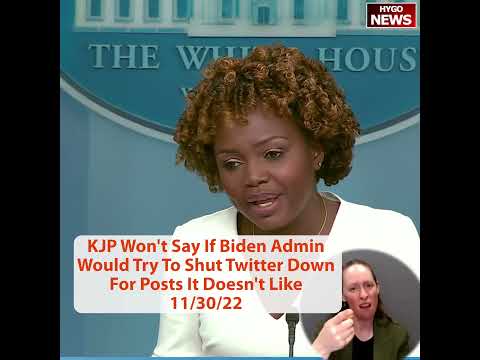
Doocy: If You See Something on Twitter You Don’t Like, Would You Try to Shut It Down? KJP: “We Very Much Monitor the News”
On 11/30/2022, Fox News reporter Peter Doocy asked White House Press Secretary Karine Jean-Pierre a pointed question about the administration’s posture toward Twitter under Elon Musk’s ownership. KJP had said the White House was “monitoring” Twitter. Doocy’s question: “When you say that you’re going to be monitoring some of the speech on there, if you see something that you don’t like, would you try to shut Twitter down?” KJP’s response deflected from the substance: “I hate to break it to you, Peter, just like everybody else, we very much monitor the news. We pay close attention to everything that you all are reporting, and Twitter is in the news a lot. And so that’s what we’re paying attention to.” The response avoided addressing whether the administration would take action against Twitter based on speech it disapproved of — a question with significant First Amendment implications.
The Context: “Monitoring”
The exchange followed previous statements from the Biden White House that the administration was “monitoring” Twitter closely. These monitoring statements came as Elon Musk was implementing significant changes to Twitter’s content moderation policies — reversing many previous bans, reducing enforcement of certain policies, and signaling a more permissive approach to speech on the platform.
The word “monitoring” carries specific implications when used by government officials. Private citizens monitor the news as a matter of personal interest. Governments monitoring private platforms raises questions about what action the government might take based on what it observes, and whether that monitoring itself represents a form of pressure on the platform.
The Biden administration had a complicated history with social media monitoring. Earlier in 2022, reports had surfaced about the administration’s communications with social media companies regarding content moderation — particularly around COVID-19 misinformation, election integrity, and other topics. These communications had raised First Amendment concerns among some legal scholars and press freedom advocates.
Doocy’s Question
Doocy’s question was precisely constructed to test the administration’s posture. “When you say that you’re going to be monitoring some of the speech on there, if you see something that you don’t like, would you try to shut Twitter down?” Doocy asked.
The question had several important elements:
“Some of the speech” — Doocy was asking about content moderation, not about corporate governance or business operations. The focus was on what people were saying on the platform.
“Something that you don’t like” — The phrasing implied government disapproval as the basis for potential action. This was the core First Amendment concern: government retaliation against protected speech.
“Try to shut Twitter down” — The extreme scenario. Doocy wasn’t asking about modest pressure or quiet conversations; he was asking whether the administration would take the most drastic action possible.
The structure of the question forced KJP to either deny the extreme scenario (which would have been a useful clarification) or refuse to engage with it (which would allow the implication that extreme action was possible to linger).
”I Hate to Break It to You”
KJP’s response opened with an unusual phrase. “So look, you know, when you talk about monitoring, you know, it is, I hate to break it to you, Peter, just like everybody else, we very much monitor the news,” KJP said.
The “I hate to break it to you” framing was condescending — it treated Doocy as if he were naive for asking about monitoring, as if “everyone monitors the news” were a sufficient answer to a question about potential government action against a communications platform.
But the rhetorical move obscured the real issue. Yes, “everyone” monitors the news in the sense of reading newspapers, watching TV, and following current events. But “monitoring” conducted by the White House — and referenced specifically in the context of Twitter and speech — carried different implications than a private citizen casually reading Twitter.
When KJP had earlier said the administration was “monitoring” Twitter, she wasn’t saying administration officials were reading Twitter for entertainment. She was saying the administration had some form of organized attention to what was happening on the platform. That was significantly different from “everybody monitors the news."
"We Very Much Monitor the News”
KJP continued with the normalization framing. “We pay close attention to everything that you all are reporting, and Twitter is in the news a lot. And so that’s what we’re paying attention to. We’re paying attention to what is in the news and what is being reported on the misinformation that’s out there,” KJP said.
The framing was carefully designed to make government monitoring sound benign. Three elements worked together:
“Pay close attention to everything you all are reporting” — Positioning White House monitoring as responding to press coverage rather than directly surveilling the platform. This framing made the monitoring sound passive and reactive.
“Twitter is in the news a lot” — Attributing White House interest to news coverage rather than independent concern about the platform. This deflected responsibility for the monitoring onto the press.
“Misinformation that’s out there” — Justifying the monitoring with a reference to misinformation, which implied the administration had a legitimate interest in tracking false information. But “misinformation” is a contested category — governments have historically used misinformation concerns to justify censorship of speech they disagreed with.
The combined effect was to make government monitoring of Twitter sound like ordinary, defensible activity. But the substance of the question — whether the administration would take action against the platform based on its disapproval of speech — remained unanswered.
The Missing Answer
Doocy’s actual question — would the administration try to shut Twitter down over speech it didn’t like — was never addressed. KJP talked about monitoring but didn’t say what the administration would do with the information it gathered through that monitoring. She talked about misinformation but didn’t say what the administration considered misinformation or what it might do about it. She talked about paying attention to news but didn’t address whether that attention might translate into action against the platform.
The non-answer preserved maximum flexibility for the administration. If Twitter’s content moderation approach continued to diverge from what the White House preferred, the administration could theoretically take various actions — regulatory pressure, public criticism, encouraging advertisers to boycott, legal scrutiny of Musk’s businesses. KJP’s refusal to rule out any of these options left all of them theoretically on the table.
The First Amendment Dimension
The exchange had significant First Amendment implications. The government cannot constitutionally retaliate against private speech — including speech on private platforms — based on disagreement with the content. A government that “shut down” a platform because it didn’t like what people were saying on it would be violating core First Amendment protections.
KJP’s refusal to clearly state that the administration would not take such action was itself a kind of answer. A press secretary confident in the administration’s commitment to free speech principles would have said something like: “The First Amendment protects Twitter’s right to host speech the White House may disagree with, and the administration has no intention of taking action against the platform based on its content moderation decisions.”
Instead, KJP said the administration was “monitoring” and “paying attention to misinformation.” This formulation left significant ambiguity about what the administration considered acceptable speech and what action it might take if that speech continued.
The Broader Context
By November 2022, the Biden administration’s posture toward social media platforms had become a significant concern for press freedom advocates. Reports had documented:
- DHS’s “Disinformation Governance Board” — briefly established in 2022 before being disbanded amid controversy
- Administration communications with tech companies about content moderation
- Biden’s “worth being looked at” comment about Musk’s Twitter acquisition
- White House pressure on platforms regarding COVID-19 information
- Ongoing CFIUS review implications for the Twitter acquisition
These activities collectively suggested an administration that was actively trying to influence speech on private platforms through various channels. The “monitoring” language was consistent with this broader pattern.
Key Takeaways
- Peter Doocy asked KJP if the Biden administration would “try to shut Twitter down” if it saw speech it disapproved of.
- KJP didn’t answer the question directly, instead claiming “we very much monitor the news” and that “everybody” monitors the news.
- The response deflected from the substance by normalizing government monitoring as equivalent to ordinary news consumption.
- KJP mentioned “misinformation” as a framing for White House attention to Twitter — without defining the term or the potential response.
- The non-answer preserved the administration’s flexibility to take various actions against Twitter while avoiding explicit commitments about First Amendment limits.
Transcript Highlights
The following is transcribed from the video audio (unverified — AI-generated from audio).
- When you say that you’re going to be monitoring some of the speech on there, if you see something that you don’t like, would you try to shut Twitter down?
- When you talk about monitoring, I hate to break it to you, Peter, just like everybody else, we very much monitor the news.
- We pay close attention to everything that you all are reporting.
- Twitter is in the news a lot. And so that’s what we’re paying attention to.
- We’re paying attention to what is in the news.
- And what is being reported on the misinformation that’s out there.
Full transcript: 108 words transcribed via Whisper AI.