 HYGO News
 Miller: 'Why Would Any Civilization That Wants to Preserve Itself Allow Any Migration Negative to the Country?'; Rubio Implementing New Values-Based Immigration Screening; Rep. Dan Goldman Compares ICE to 'Gestapo-like' for Wearing Masks -- 413% Increase in Assaults on ICE Officers
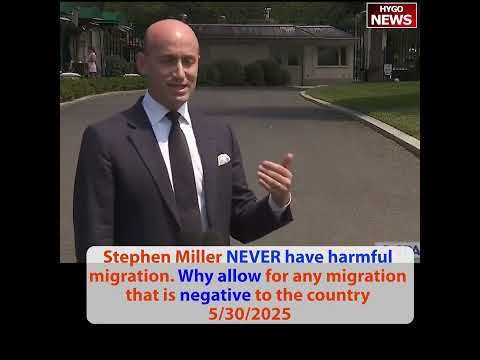
Miller: “Why Would Any Civilization That Wants to Preserve Itself Allow Any Migration Negative to the Country?”; Rubio Implementing New Values-Based Immigration Screening; Rep. Dan Goldman Compares ICE to “Gestapo-like” for Wearing Masks — 413% Increase in Assaults on ICE Officers
Stephen Miller articulated a fundamental immigration policy principle in June 2025. “The State Department under the leadership of Secretary Rubio is putting in place a system to ensure that anyone who comes to this country, but particularly for longer term immigration benefits, things that have a pathway to a green card or a pathway to citizenship or the holy grail of the US immigration system, putting in place a protocol both in terms of the interview process, the documentary process, the social media process of making sure that anybody that is admitted to this country is somebody that is going to be supportive of our values, of our way of life, that’s going to assimilate, that’s going to integrate into our national culture, that’s going to be financially self-sufficient. But it is, you should never have harmful migration, ever… Why would any society, why would any civilization that actually wants to preserve itself allow for any migration that is negative to the country as a whole?” Rep. Dan Goldman (D-NY) compared ICE agents to “Gestapo-like” for wearing masks during operations. The administration responded: “When our heroic law enforcement officers conduct operations, they clearly identify themselves as law enforcement while wearing masks to protect themselves from being targeted by known and suspected gang members, murderers, and rapists. ICE officers are now facing a 413% increase in assaults.”
Rubio’s New Immigration Screening
Miller described the new State Department approach.
“The State Department under the leadership of Secretary Rubio is putting in place a system to ensure that anyone who underscores this country, but particularly for longer term immigration benefits,” Miller said.
He specified the benefit categories: “Things that have a pathway to a green card or a pathway to citizenship or the holy grail of the US immigration system.”
He described the screening elements: “Putting in place a protocol both in terms of the interview process, the documentary process, the social media process.”
He articulated the goal: “Making sure that anybody that is admitted to this country, and in particular for these longer term benefits, is somebody that is going to be supportive of our values, of our way of life, that’s going to assimilate, that’s going to integrate into our national culture, that’s going to be financially self-sufficient.”
The New Immigration Framework
The values-based screening Miller described represented a significant policy shift:
Interview process changes:
- Deeper questioning about views on American values
- Questions about Islamist extremism, antisemitism
- Questions about willingness to assimilate
- Evaluation of responses beyond technical eligibility
- Human judgment about applicants’ suitability
Documentary process changes:
- Enhanced document verification
- Cross-checking against multiple databases
- Identification of fraudulent documents
- Assessment of claimed work and education history
- Investigation of sponsors and connections
Social media process changes:
- Review of applicants’ online statements
- Assessment of political and religious views
- Identification of extremist connections
- Evaluation of character and judgment
- Red flag identification for further review
Value criteria assessment:
- Support for American values
- Willingness to assimilate
- Integration potential
- Financial self-sufficiency
- Cultural compatibility
This represented a return to pre-1965 immigration screening standards, modified for contemporary conditions. Before 1965, American immigration had specifically sought applicants who would assimilate to American culture. The 1965 Immigration Act had moved toward a more value-neutral approach based on family reunification and diversity. The Trump-Rubio approach was restoring some of the pre-1965 considerations.
”Harmful Migration”
Miller’s articulation of the core principle was direct.
“But it is, you should never have harmful migration, ever,” Miller said.
He described what should be excluded: “There should never be a case where somebody’s coming into this country who has a negative view about America, about the West, about our civilization, isn’t going to be able to pay their own way, is going to have a hostile attitude about the way we live in this country.”
He asked the rhetorical question: “Like why would any society, why would any civilization that actually wants to preserve itself allow for any migration that is negative to the country as a whole?”
He endorsed Rubio: “And so I applaud Secretary Rubio for taking the steps he needs to make sure that America delivers for America.”
The Philosophical Foundation
Miller’s “why would any civilization… allow for any migration that is negative” question was philosophically fundamental.
The traditional assumption: Immigration was generally good because:
- Immigrants worked hard and contributed
- Cultural diversity enriched society
- Population growth supported economic growth
- America’s founding as immigrant nation gave special obligation
- Compassion for those seeking better lives
The counter-analysis Miller articulated: Immigration was only good when it was beneficial to America because:
- Nations exist primarily to serve their citizens
- Immigration should serve national interest, not applicant interest
- Immigrants hostile to American values threaten the nation
- Immigrants not self-sufficient burden taxpayers
- Large-scale immigration of incompatible populations can destabilize society
This was a fundamental shift in how immigration was conceived. Under the Miller-Rubio approach, each prospective immigrant should be evaluated on their contribution to American interest. Those likely to be harmful should not be admitted, regardless of humanitarian considerations.
The policy was consistent with historical American immigration practice. Before 1965, American immigration had included explicit requirements about character, political views, and likely assimilation. The 1965 Act had relaxed these considerations in favor of family reunification and diversity. The current reform was partly restoring earlier standards.
The Universal Principle
Miller’s “any civilization” framing was important.
This was not framed as uniquely American. Any civilization wanting to preserve itself should follow similar principles:
- Admit beneficial immigrants
- Exclude harmful immigrants
- Evaluate values and integration potential
- Prioritize national preservation
- Maintain cultural continuity
Other countries had long practiced such selective immigration:
- Japan: Minimal immigration, demanding assimilation requirements
- South Korea: Similar restrictive approach
- Singapore: Highly selective based on economic contribution
- Various European countries: Implementing more selective approaches
Even within the Western tradition:
- Switzerland: Highly selective with difficult naturalization
- Finland: Selective and assimilation-oriented
- Hungary: Explicitly preference for Christian European immigrants
The idea that civilizations should selectively choose immigrants based on their contribution to national preservation was not extreme. It was the dominant global practice. America’s post-1965 approach had been unusual internationally.
Rep. Goldman’s “Gestapo” Comparison
Rep. Dan Goldman (D-NY) made the Nazi comparison.
“This is Gestapo-like behavior where plain clothes officers wearing masks are terrorizing immigrants who are doing the right thing by going to court, following up on their immigration proceedings and trying to come into this country lawfully, which is through asylum,” Goldman said.
He described his experience: “I worked with the Department of Homeland Security, I worked with ICE agents, I worked with Homeland Security’s investigations.”
He made the personal claim: “I have never seen any plain clothes officer wearing a mask.”
He described his specific encounter: “And I asked them, why are you wearing a mask? One person told me, because it’s cold, I asked him if he would testify to that under oath, and he walked away and wouldn’t respond to me.”
He cited another response: “Another person admitted that they’re wearing masks so that they are not caught on video.”
The “Gestapo” Problem
The Gestapo comparison was particularly inflammatory:
What the Gestapo actually did:
- Secret state police of Nazi Germany
- Arrested Jews, political dissidents, and others
- Operated death squads
- Conducted torture
- Enabled Holocaust
- Killed millions
What ICE actually does:
- Enforces American immigration law
- Operates under court oversight
- Follows administrative procedures
- Provides due process
- Detains rather than executes
- Deports to home countries
The comparison trivialized actual Nazi atrocities. Comparing professional law enforcement conducting court-ordered deportations to Gestapo operations that had murdered millions was:
- Historically ignorant
- Morally obtuse
- Politically inflammatory
- Demeaning to actual Gestapo victims
- Threatening to current officers
The Mask Question
Goldman’s specific critique was about ICE officers wearing masks during operations.
His claim was that:
- Masks were unusual for legitimate law enforcement
- The only legitimate reason for masks had been disputed
- Officers told him masks were for “cold” weather
- Or for not being “caught on video”
- Neither was legitimate
Goldman tried to use the Trump administration’s own positions: “And in fact, the Trump administration is cracking down on universities for allowing protesters to wear masks. So apparently it is not okay to wear a mask if you are protesting the government, but it is okay if you are the government to wear masks.”
The Administration Response
The administration rebuttal directly addressed Goldman’s critique.
“When our heroic law enforcement officers conduct operations, they clearly identify themselves as law enforcement while wearing masks to protect themselves from being targeted by known and suspected gang members, murderers, and rapists,” the response said.
Key points:
- Officers identified themselves (with badges, clothing, etc.)
- Masks were for officer safety
- Threats against officers were real
- Masked gang members often targeted officers
- Officer protection was legitimate
”413% Increase in Assaults”
The administration cited the specific threat data.
“ICE officers are now facing a 413% increase in assaults,” the response concluded.
The 413% increase was remarkable. Assaults on ICE officers had quadrupled-plus. This reflected:
Environmental changes:
- Political rhetoric demonizing ICE
- Progressive media coverage portraying ICE as villains
- Activist organizations encouraging resistance
- Social media doxxing of officers
- Community protests at ICE operations
Practical threats:
- Gang members armed and hostile
- Ideological activists attacking officers
- Mob actions against deportation operations
- Organized resistance at facilities
- Protests at agent’s homes
Documented incidents:
- ICE offices bombed or vandalized
- Officers physically assaulted
- Officers’ homes attacked
- Officers’ families harassed
- Officers’ vehicles destroyed
Under these conditions, masking was legitimate safety measure:
- Protected officers from being identified and targeted
- Protected families from being tracked down
- Protected officers from doxxing campaigns
- Enabled continuing operational effectiveness
- Reduced officer psychological stress
The Protester Mask Distinction
Goldman’s attempted argumentum was logically flawed.
Protester masks on campuses:
- Concealed identity during illegal activities
- Enabled evasion of accountability for actions
- Created intimidation of counter-protesters
- Protected criminal conduct from identification
- Served to avoid consequences
Officer masks during operations:
- Protected against identification by dangerous suspects
- Preserved operational effectiveness
- Complied with standard officer safety protocols
- Did not evade accountability (officers wore badges, ID numbers)
- Served legitimate safety purposes
The two uses of masks were fundamentally different. Protester masks concealed accountability for potentially illegal activities. Officer masks protected against retaliation for legitimate activities.
Goldman’s attempt to treat them equivalently was either:
- Genuine confusion about the different purposes
- Deliberate misdirection to score political points
- Attempt to create false moral equivalence
- Rhetorical tactic rather than serious argument
The Broader Context
The Goldman episode reflected the broader Democratic Party approach to immigration enforcement:
Delegitimize enforcement:
- Call ICE “Gestapo”
- Characterize deportations as “kidnappings”
- Describe detention as “concentration camps”
- Portray officers as racist villains
Undermine operations:
- Advocate for non-cooperation by local authorities
- Support sanctuary city policies
- Provide legal defense for illegal immigrants
- Create obstacles to enforcement
Encourage resistance:
- Activist organizing against operations
- Legal challenges to deportation processes
- Political pressure on enforcement funding
- Public protests at ICE facilities
Protect illegal residents:
- Prevent information sharing with federal authorities
- Provide ID cards to illegal immigrants
- Extend public benefits to illegal residents
- Resist federal detainer requests
The cumulative effect had been to create conditions where:
- Officers faced dramatic increase in threats
- Enforcement became physically dangerous
- Operational effectiveness was constrained
- Immigration laws were effectively not enforced
The Goldman critique was part of this broader pattern. By comparing ICE to Gestapo, Democrats were:
- Undermining enforcement legitimacy
- Creating environment for continued violence
- Signaling support for resistance
- Encouraging additional assaults
The 413% increase in assaults was partly the product of this political environment.
The Free Speech Distinction
The administration position was philosophically defensible:
Protesters wearing masks on campus:
- Often engaged in illegal activities (blocking entrances, property damage, harassment)
- Evading accountability was the purpose
- Creating conditions for violence and intimidation
- Should face consequences for violations
Law enforcement officers wearing masks:
- Conducting legal activities (court-ordered deportations)
- Identified themselves as law enforcement
- Faced real safety threats
- Masks served safety, not evasion
The distinction was not “government can hide, citizens cannot.” The distinction was:
- Lawful activities conducted by identified officers could use safety equipment
- Unlawful activities conducted by unidentified protesters should face consequences
Key Takeaways
- Miller on immigration: “You should never have harmful migration, ever. Why would civilization that wants to preserve itself allow migration negative to the country?”
- Rubio’s new screening: Interview, documentary, and social media checks for values, assimilation potential, financial self-sufficiency.
- Rep. Goldman compares ICE to Gestapo for wearing masks during operations.
- Administration response: “413% increase in assaults on ICE officers.”
- Mask distinction: Officers wear masks for safety while identifying themselves; protesters wear masks to evade accountability.