 HYGO News
 Miller momentous ruling: elected President or unelected judges; Schumer: GOPs show backbone
Miller momentous ruling: elected President or unelected judges; Schumer: GOPs show backbone
White House Deputy Chief of Staff Stephen Miller delivered the most systematic articulation of the political theory behind the Supreme Court’s nationwide-injunctions ruling, framing it as the resolution of a fundamental democratic question: whether an elected president or unelected judges should make the country’s policy decisions. Democratic Senator Andy Kim of New Jersey disputed the administration’s characterization of the Iran operation, calling it “not comprehensive, not strategic” and denying the total obliteration framing. Senate Minority Leader Chuck Schumer continued pressuring Senate Republicans to break with the administration on the One Big Beautiful Bill, calling on them to “show some backbone” and “ignore fake deadlines.” The competing framings across the day demonstrate how each side is attempting to shape the emerging political narrative.
”Nobody Living In Texas”
Miller opened with a specific concrete example. “Nobody living in Texas, for example, consented to be ruled by a judge in San Francisco. Nobody living in Oklahoma consented to be ruled by a judge living in Chicago.”
The observation is the core democratic-theory argument. American federal judges are appointed by the president and confirmed by the Senate. Their authority extends over the specific cases before them. The individuals affected by those cases typically have some geographic or transactional connection to the case.
Nationwide injunctions, by contrast, extended single judges’ authority to the entire country. A Texan’s legal rights could be affected by a San Francisco judge’s ruling, even though the Texan had no connection to the case, no voice in its adjudication, and no political voice in the judge’s appointment.
“Consented to be ruled by” is the consent-based framework. In democratic theory, political authority requires some form of consent from the governed. Americans consent to the presidency through elections. Americans consent to Congress through elections. Americans consent to federal judges through the indirect consent of electing senators who confirm them. But Americans did not consent to be ruled by specific district judges whose authority was expanded by the nationwide-injunction device.
”Any Communist Judge, Any Marxist Judge, Any Crazy Left-Wing Judge”
Miller’s characterization of the judges issuing the injunctions was explicit. “But out of the system, any judge, any communist judge, any Marxist judge, any crazy left-wing judge could decide major national questions for the whole country.”
The progression — communist, Marxist, crazy left-wing — is Miller’s characterization of the ideological spectrum represented by the judges who had been issuing nationwide injunctions. The characterization is political rather than analytical. Most of the judges in question are Democratic appointees who operated within established progressive judicial philosophy. Whether that philosophy qualifies as “communist” or “Marxist” is a matter of Miller’s rhetorical choice rather than legal characterization.
The substantive point, however, is accurate. Judges with progressive philosophies were using nationwide injunctions to block conservative administration policies. The Supreme Court has now limited the device. The political benefit of the Supreme Court ruling will flow to conservative administrations in ways that the prior regime denied them.
The Hypothetical Examples
Miller walked through concrete cases. “A single district court judge could decide, for example, that an entire class of legal aliens is exempt from deportation in all 50 states in the entire country. Or a single judge could rule, for example, that a major federal agency would be forced to pursue illegal race-based discrimination, diversity, equity, and inclusion.”
Each example is drawn from real litigation. Nationwide injunctions had, at various points, required the administration to continue programs it wanted to end, or blocked it from implementing programs it wanted to start. The examples Miller cites represent the category of judicial action the Supreme Court has now foreclosed.
”Policy After Policy After Policy”
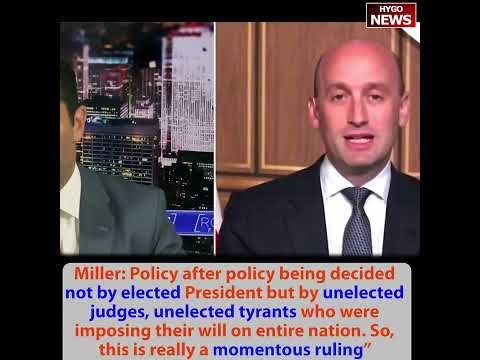
Miller’s summary was pointed. “So policy after policy after policy was being decided not by the elected president, the one official elected by the whole American people, but by unelected judges. And in many cases, we’re talking about unelected tyrants who are imposing their will on the entire nation.”
“Unelected tyrants” is strong language. The judges in question were not tyrants in any classical sense — they operated within judicial procedure, accepted appellate review, and were subject to impeachment by Congress. But Miller is using the term rhetorically to capture the democratic tension: a handful of judges, operating outside electoral accountability, made policy for 330 million Americans.
“The one official elected by the whole American people” is an important framing. The president is the only federal official elected by the entire country. Every other federal official represents a narrower constituency — a state, a district, or no electoral constituency at all (judges, cabinet secretaries, career officials). The elected-by-everyone authority of the presidency was, in Miller’s framing, being displaced by judges elected by no one.
”Going Back To 2017”
Miller then provided the historical framing. “So this is really a momentous ruling. It is a ruling that we have hoped for, not just by the way, over the last five months, but over the entirety of the last number of years, going back to 2017, when this judicial lawfare, really judicial, again, tyranny began of district court judges trying to sabotage the entire executive branch and with it.”
The 2017 anchor places the nationwide-injunction pattern’s emergence in Trump’s first term. The pattern began with injunctions against the travel ban, immigration policies, and various other first-term Trump administrative actions. That pattern continued through the Biden administration, with conservative plaintiffs using nationwide injunctions against Biden policies.
The Supreme Court’s ruling now applies prospectively to both parties’ future administrations. Whatever party controls the executive branch will face fewer nationwide-injunction obstacles to its policies.
Andy Kim On Iran
The video then pivoted to Democratic Senator Andy Kim of New Jersey, offering his assessment of the Iran operation. “This approach that Trump has taken was not comprehensive. It was not strategic. It is something that still leaves this threat very much on the table. I don’t know exactly how long it’ll take, but what we do know is they have the ingredients they need if they want to be able to proceed.”
Kim’s framing is the Democratic alternative to the administration’s “obliteration” characterization. In Kim’s telling, the operation was neither comprehensive nor strategic. It did not remove the threat. Iran retains the capability to proceed if it chooses.
The administration’s counter, which Witkoff and Rubio and others have repeatedly delivered, is that the operation was comprehensive in its specific targets (Isfahan, Natanz, Fordow), was strategic in its scope (addressing the three critical elements of the nuclear chain), and did remove the threat in the near term (years of setback, per the Israeli Atomic Energy Commission letter).
Whether Kim’s assessment or the administration’s assessment is correct depends on what Iran does next. If Iran rebuilds rapidly, Kim’s characterization looks vindicated. If Iran does not rebuild — or rebuilds very slowly over years — the administration’s characterization looks vindicated.
”Just Kicks The Can Down The Road”
Kim’s sharpest line. “And that is something that just kicks the can down the road without actually solving it.”
“Kicks the can down the road” is the standard political characterization for temporary solutions. Kim is arguing that the strikes delayed the problem without addressing its root cause. The root cause, in the Democratic framing, requires diplomatic engagement — a new nuclear agreement, economic integration incentives, a broader regional framework.
The administration’s counter is that prior diplomatic engagement (the JCPOA) did not solve the problem — it delayed it while Iran progressed on weapons capability. The choice was never between diplomacy and force. The choice was between force and continued delay that would ultimately result in Iranian weapons capability. The administration chose force.
Schumer’s “Backbone”
The video then pivoted to Schumer’s continued pressure on Senate Republicans regarding the One Big Beautiful Bill. “Everyone knows this Republican bill is a big mess. But now we’re hearing chatter. They might try to rush it to the floor as soon as tomorrow.”
“Try to rush it to the floor as soon as tomorrow” references the administration’s target of passage before July 4. For Democrats, the compressed timeline is evidence that the bill is being rushed through without proper consideration. For the administration, the timeline reflects the political calendar — a signature accomplishment delivered before Independence Day.
”Deeply Flawed”
Schumer continued. “So let’s be absolutely clear. This bill is deeply flawed. It’s devastating for American families. It rips healthcare from 16 million people. It has the biggest cuts to food funding ever, losing over two million jobs, and the biggest cuts to food funding ever.”
The “16 million people losing healthcare” claim is a specific Democratic characterization. The bill’s Medicaid changes — work requirements for able-bodied adults, eligibility tightening for noncitizens — affect a substantial population. Democrats characterize the changes as healthcare loss. The administration characterizes them as appropriate refocusing of Medicaid on its intended beneficiaries.
“The biggest cuts to food funding ever” refers to changes in SNAP and related programs. Again, the characterizations differ. Democrats characterize the changes as nutrition assistance cuts. The administration characterizes them as reforms that maintain assistance for the genuinely needy while eliminating waste, fraud, and benefits flowing to noncitizens.
”Instead Of Fixing The Egregious Provisions”
Schumer’s process critique. “And instead of fixing the egregious provisions of the bill, they’re trying to jam it through. They don’t want the American people to find out what’s in it.”
The claim is that Republicans are rushing the bill because they do not want voters to understand the specific provisions. If voters understood, the claim goes, they would oppose the bill.
The administration’s counter is that voters do understand the provisions and support them. Polling on specific items — no tax on tips, no tax on overtime, expanded child tax credits — shows approval in the 70-80% range. The Democratic claim that voters would oppose the bill if they understood it is not supported by the polling.
”Show Some Backbone”
Schumer’s direct appeal to Republicans. “Republicans need to show some backbone and tell Donald Trump his bill is a disaster. It’s a disaster because it betrays Republicans own promises not to cut Medicaid, not to cut SNAP and the ACA. But of course their bill does. It has the biggest cuts to Medicaid and to SNAP ever.”
“Show some backbone” is the standard appeal to Republican senators who might be inclined to break with the administration. Schumer is positioning any Republican defection as an act of principle rather than political calculation.
The strategic problem for Schumer is that Republican senators who have been skeptical of specific bill provisions are more likely to be skeptical from the right — wanting more aggressive changes, not less. Schumer’s framing assumes Republicans are skeptical from the left, which is not the dominant pattern within the current Republican caucus.
Why The Schumer Message May Not Land
The Democratic messaging on the One Big Beautiful Bill has been consistent across Schumer, Wyden, Baldwin, Warren, Duckworth, Jeffries, and Merkley. The framing has been that the bill cuts healthcare, benefits billionaires, and harms families.
The administration’s counter-messaging has been equally consistent. The bill extends 2017 tax cuts that benefit all income brackets, adds specific working-class provisions (no tax on tips, no tax on overtime), expands the child tax credit, and adjusts Medicaid to focus on intended beneficiaries.
Voters watching the competing messages will form their own judgments based on what they see in their tax returns, their paychecks, and their access to services. If the bill’s implementation matches the administration’s characterization, Democratic opposition will not survive the implementation phase. If the bill’s implementation matches the Democratic characterization, political backlash will follow.
The actual outcome depends on implementation details that are not yet visible. Both sides are making claims about what the bill will do. The reality will be tested in months and years.
The Day’s Political Math
The day’s threads reveal the administration’s operating leverage. The Supreme Court ruling removes a major institutional constraint. The DRC-Rwanda peace signing provides a major diplomatic achievement. The Canada trade pressure demonstrates commercial leverage. The One Big Beautiful Bill is moving toward July 4 signing.
Democratic opposition is vocal but fragmented. Schumer, Kim, and others are each making their specific critiques, but no coherent alternative is emerging. The Democratic caucus has not offered an Iran policy, a Supreme Court position, or a Big Beautiful Bill alternative that voters can evaluate.
That asymmetry — administrative action vs. Democratic reaction — is what the administration has been cultivating since January. Each successful action reduces the political cost of the next action. The compounding effect may be what eventually shapes the 2026 midterm environment.
Key Takeaways
- Miller: “Nobody living in Texas…consented to be ruled by a judge in San Francisco…Nobody living in Oklahoma consented to be ruled by a judge living in Chicago.”
- Miller on the character of judges: “Any communist judge, any Marxist judge, any crazy left-wing judge could decide major national questions for the whole country.”
- Miller’s summary: “Policy after policy after policy was being decided not by the elected president…but by unelected judges. And in many cases, we’re talking about unelected tyrants who are imposing their will on the entire nation.”
- Sen. Andy Kim on Iran: “This approach that Trump has taken was not comprehensive. It was not strategic…they have the ingredients they need if they want to be able to proceed.”
- Schumer on the One Big Beautiful Bill: “Republicans need to show some backbone and tell Donald Trump his bill is a disaster…It rips healthcare from 16 million people.”