 HYGO News
 Stephen Miller on MAHA: 'What's Been Fake for Generations Is the Medical and Nutrition Advice the Government Has Given Our Families'; 'Diseases of Civilization': High Rates of Cancer, Immunological Disorders, Allergies in Developed Countries; 'Foods People Have Eaten for Thousands of Years Are Causing Crippling Allergies in Children'
Stephen Miller on MAHA: “What’s Been Fake for Generations Is the Medical and Nutrition Advice the Government Has Given Our Families”; “Diseases of Civilization”: High Rates of Cancer, Immunological Disorders, Allergies in Developed Countries; “Foods People Have Eaten for Thousands of Years Are Causing Crippling Allergies in Children”
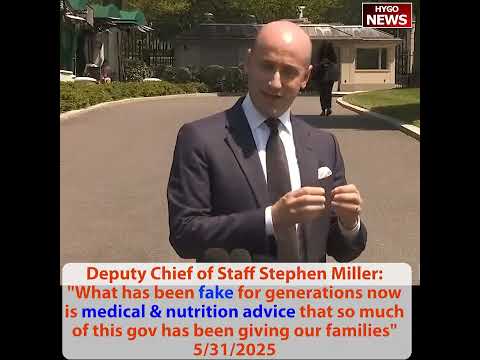
Stephen Miller delivered a comprehensive MAHA framework in early June 2025. His core claim: “What has been fake for generations now is the medical and nutrition advice that so much of this government has been giving our families.” On COVID: “Fake rules from the so-called experts about masking and social distancing and everything else, or pretending that there’s the same risk profile for a healthy four-year-old kid as an elderly and obese person.” On the MAHA Report: “The most significant and important breakthrough moment in terms of prioritizing prevention.” Core questions he raised: “Why are there such persistently high rates of pediatric cancer? Why have they increased so significantly since 1970? Why are pediatric cancer rates so much higher in the developed world than the developing world? Why do you even have a concept called diseases of civilization?” On pediatric food allergies: “Foods that people have eaten for thousands of years are certainly causing these crippling allergies in children.” On the migration evidence: “Why is it that a person from the developing world has a lower cancer rate than an American does? But within a single generation, their family has the exact same cancer rate."
"Fake for Generations”
Miller’s opening claim was extraordinary.
“That what has been fake for generations now is the medical and nutrition advice that so much of this government has been giving our family,” Miller said.
This was an indictment of decades of federal health policy. Miller was arguing that:
- Official nutritional guidelines had been misleading
- Medical recommendations had been based on flawed science
- Public health advice had damaged American health
- Federal agencies had propagated false information
- The cumulative effect had been harmful across generations
This was the MAHA framework applied systematically. Rather than accepting the conventional view that expert advice was based on objective science, Miller was arguing that the advice itself had been flawed — not just implementation.
The COVID Example
Miller cited specific recent examples.
“You know, we saw of course, you know, during COVID with like fake rules about from the so-called experts about masking and social distancing and everything else or pretending that there’s the same risk profile for a healthy four-year-old kid as an elderly and obese person,” Miller said.
This was a pointed critique of COVID-era public health advice:
Masking policies:
- Had been initially discouraged by CDC and WHO in early 2020
- Then aggressively mandated as consensus
- Had been made to change based on political and institutional considerations
- Had limited evidence of effectiveness in specific contexts
- Had been imposed without adequate cost-benefit analysis
Social distancing rules:
- Arbitrary distance requirements (6 feet)
- Enforcement against outdoor activities with minimal transmission risk
- Religious and political exceptions
- Inconsistent application across activities
- Limited scientific basis for specific parameters
Risk profile distortion:
- Pretending children faced similar risks as elderly people
- Closing schools despite low risk to children
- Mandating masks on children despite developmental concerns
- Imposing vaccination requirements on children despite low risk profile
- Preventing normal childhood development for health theater
The Risk Profile Point
Miller’s “same risk profile for a healthy four-year-old kid as an elderly and obese person” was factually critical.
The actual COVID data showed:
- Children had extremely low risk of severe outcomes
- Deaths from COVID in children under 18 were exceptionally rare
- Healthy young adults had low risk
- Elderly with comorbidities had high risk
- Risk correlated strongly with age and health status
Yet public health policy had been applied uniformly across risk categories:
- Schools closed for months or years
- Children forced into masks
- Healthy young people restricted from activities
- Economic devastation imposed on families
- Mental health crises among youth
The decision to apply uniform policies across vastly different risk profiles reflected:
- Political pressure to show action
- Risk-averse institutional thinking
- Desire to avoid controversy
- Failure to communicate risk stratification
- Bureaucratic rigidity
Miller’s point was that treating four-year-olds as equally at risk as elderly people had been both factually wrong and practically harmful.
The MAHA Report Framework
Miller praised the MAHA Commission Report.
“The MAHA report is the most significant and important breakthrough moment in terms of prioritizing prevention, underlying health, answering and asking the right questions,” Miller said.
He laid out the specific questions:
- “Why are there such persistently high rates of pediatric cancer in this country?”
- “Why have they increased so significantly since 1970?”
- “Why are pediatric cancer rates so much higher in the developed world than the developing world?”
- “Why do you even have a concept called diseases of civilization?"
"Diseases of Civilization”
The “diseases of civilization” concept was critical.
“I think you’ve all heard that concept before, right? Where in the most developed countries, you have such high incidences of cancer of immunological disorders, right? In other words, things like celiac disease, food allergies, eczema, psoriasis, gut disorders,” Miller said.
The Disorder Catalog
Miller listed specific conditions:
Celiac disease: Autoimmune disorder triggered by gluten. Prevalence had increased dramatically in developed countries. Rare in developing nations.
Food allergies: Allergies to common foods (nuts, dairy, eggs, wheat). Had exploded in prevalence in American children. Nearly absent in populations consuming traditional diets.
Eczema: Chronic skin condition affecting approximately 10-20% of American children. Very rare historically.
Psoriasis: Autoimmune skin disease. Increasing prevalence in Western populations.
Gut disorders: IBS, IBD, Crohn’s disease, ulcerative colitis. All increasing in Western populations.
The common thread: Immune system dysfunction. The conditions represented immune systems either:
- Overreacting to harmless substances (allergies)
- Attacking the body’s own tissues (autoimmune)
- Failing to function properly (inflammatory)
These weren’t isolated problems. They represented a general pattern of immune system dysfunction that tracked with modern lifestyle factors.
”No Path Out for Millions”
Miller emphasized the severity.
“You have so many quality of life disorders that can actually be crippling and debilitating, right?” Miller said.
He described the impact: “In other words, some of these disorders can completely degrade in the person’s entire quality of life permanently with no known cures that can treat these things.”
He cited a specific example: “Like Crohn’s disease, for example. They can treat these things with steroids. They can try to mitigate the symptoms, but there’s no path out for millions of Americans.”
The “no path out” framing captured the tragedy. People with these conditions:
- Had chronic disease for life
- Faced ongoing medical management
- Experienced reduced quality of life
- Carried financial burden of treatment
- Had limited hope for cure
Traditional medicine had approached these conditions through:
- Symptom management
- Immunosuppressant drugs
- Dietary restrictions
- Lifestyle modifications
- Limited hope for reversal
MAHA’s approach was asking different questions:
- What was causing the immune dysfunction?
- Could the underlying causes be addressed?
- Was prevention possible?
- Could changes in environment help?
- Were there historical populations without these conditions?
”What’s Causing This?”
Miller asked the fundamental question.
“What is causing young babies in this country to have these crippling allergic reactions or immune systems that don’t fire properly?” Miller said.
He described the dysfunction: “They underreact the serine illnesses, they overreact the other illnesses.”
He made the comparative observation: “And we don’t see these same things in the natural world and other primates.”
The natural world comparison was important:
- Wild animals didn’t have widespread allergies
- Other primates didn’t have pediatric cancer at human rates
- Traditional human populations had different disease patterns
- Disease patterns shifted dramatically with Western lifestyle adoption
If these conditions were caused by natural biological processes, they should appear similarly across species. The fact that they appeared predominantly in modern humans suggested:
- Environmental factors were causing them
- Lifestyle changes were disrupting normal function
- Modern diet, chemicals, and habits were implicated
- Return to more natural conditions might help
- The “diseases of civilization” framing was accurate
”The Chemical Load”
Miller praised Kennedy’s MAHA report for addressing chemical exposures.
“The report, which took just such extraordinary courage, and I’m so grateful to Bobby, in talking about the chemical load in our society, the chemical load that a child accrues from the day they’re born, in terms of everything that they touch and interact with in the world,” Miller said.
He described the food transformation: “The complete denuding our food supply. In other words, the eradication of all living things, all natural things from our food supply in the form of these ultra processed foods.”
He described the childhood reality: “So that children are living a life where they’re not having access to anything natural, they’re not having access to anything that’s healthy. Everything they do have is loaded up with insane amounts of sugar for years."
"Sugar in Baby Food”
Miller’s baby food observation was specific and damning.
“I still think it’s the case. If you went to like a store and looked at baby food, it’s filled with sugar. Why are people putting sugar into baby food?” Miller said.
He extended the observation: “And how many children’s snacks, right, are filled with dyes, artificial ingredients, and in massive amounts of sugar.”
He asked the fundamental question: “What is this doing to a young body from the day they’re born?”
The baby food sugar issue was well-documented:
- Commercial baby food often contained added sugar
- Sweeteners made bland vegetables more palatable to infants
- Sugar consumption from birth trained infant palates toward sweet preferences
- Early sugar exposure correlated with lifelong sugar preference
- Baby food industry had resisted reform
The broader pattern:
- American infants consumed far more sugar than historical norms
- Sugar consumption per capita had doubled or tripled over decades
- Added sugars were in virtually all processed foods
- High fructose corn syrup had entered food supply broadly
- Childhood obesity correlated with sugar consumption
The Vaccine Schedule
Miller addressed another controversial MAHA topic.
“Combined again with all the chemical exposures, the incredibly accelerated growth, and compression of the overall vaccine schedule from even when I was a kid,” Miller said.
The vaccine schedule had expanded dramatically:
1980s: Children received approximately 7-10 vaccines. 2000s: Children received approximately 20-25 vaccines. 2020s: Children received approximately 70+ vaccine doses by age 18.
Each additional vaccine had potential effects:
- Specific immunogenic responses
- Cumulative adjuvant exposure
- Immune system training effects
- Individual adverse reactions
- Herd immunity benefits vs. individual risk calculations
The MAHA approach was asking whether the dramatically expanded schedule had effects that had not been fully studied. Rather than accepting vaccines as purely beneficial, MAHA was asking:
- What are the cumulative effects?
- Are all vaccines equally necessary?
- Could the schedule be safely modified?
- Are there adverse effects not being recognized?
- Is individual choice appropriate?
The Parental Questions
Miller articulated the parental perspective.
“Parents have questions. They want to know, again, why do their kids have these chronic health conditions?” Miller said.
He listed specific questions:
- “Why do they go to the hospital when they’re sick?”
- “Why is their immune system firing wrong?”
- “Foods that people have eaten for thousands of years are certainly causing these crippling allergies in children.”
- “Why is it are these high and persistent rates of obesity that is no precedent in history amongst our young people?”
He identified the systemic costs: “What are the effects and the cost to our healthcare system over time when you have these high rates of chronic illnesses, heart disease, obesity, lung disease, asthma?”
The Immigration Evidence
Miller cited the definitive empirical evidence.
“Why is it that a person from the developing world has a lower cancer rate than an American does? I mean, on average, right?” Miller said.
He made the key observation: “But within a single generation, their family has the exact same cancer rate, likelihood of getting cancer, as the American population.”
He closed with gratitude to Kennedy: “These are questions that no one has wanted to ask or explore or assess and thank God that Bobby is doing so.”
The Generational Acquisition
The migration evidence was powerful:
First-generation immigrants: Came with relatively low cancer rates from developing countries.
Second-generation Americans: Acquired cancer rates matching established American population.
The mechanism: American lifestyle factors (diet, chemicals, environment, stress) caused cancer rates to rise to American levels within one generation.
The implication: Genetics was not the primary factor. Environment was. Changing environmental factors could potentially reduce cancer rates.
This was scientifically definitive for causation arguments. If:
- Same ethnic/genetic populations had different cancer rates in different environments
- Cancer rates converged when environments converged
- Generation-to-generation changes were rapid
Then environmental factors must be primary drivers. Genetic explanations would require:
- Rapid genetic shifts (impossible)
- Selection effects during migration
- Multigenerational genetic drift
None of these explained the observed pattern of rapid convergence.
Key Takeaways
- Miller: “What’s been fake for generations is the medical and nutrition advice the government has been giving our families.”
- On COVID: “Fake rules from so-called experts. Same risk profile for healthy 4-year-old as elderly obese person.”
- “Diseases of civilization”: Cancer, celiac, allergies, eczema, psoriasis, Crohn’s — high in developed world, low in developing world.
- Food indictment: “Baby food is filled with sugar. Why are people putting sugar into baby food?”
- The definitive evidence: “Person from developing world has lower cancer rate than American. But within single generation, their family has exact same cancer rate.”