 HYGO News
 NSA Waltz: Europe Was Consulted -- Trump Called Zelensky, Macron; Half the Cabinet Was at Munich
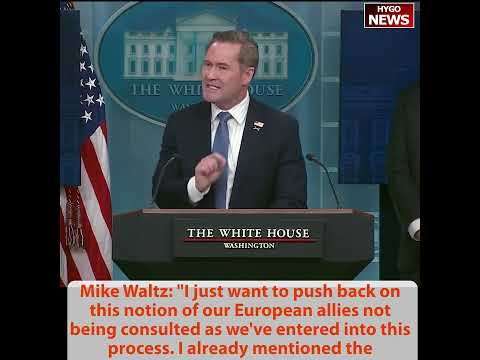
NSA Waltz: Europe Was Consulted — Trump Called Zelensky, Macron; Half the Cabinet Was at Munich
National Security Advisor Mike Waltz pushed back forcefully against the narrative that the Trump administration was sidelining European allies in its Ukraine peace efforts. Waltz catalogued the extensive diplomatic engagement: Trump had called Zelensky and spoken “repeatedly” with Macron, Prime Minister Starmer was visiting the following week, Waltz himself had spoken with “every one of my national security advisor counterparts” in Europe and with NATO Secretary General Rutte, and “half our cabinet, seven cabinet officials including the Vice President” had attended the Munich Security Conference. He then delivered the harder message: the “open-ended mantra” of the Biden administration was “over,” a third of NATO allies still were not meeting the 2% defense spending minimum, and Zelensky needed to “come back to the table” on the minerals deal.
”Push Back on This Notion”
Waltz opened by directly challenging the media framing that European allies were being excluded from the peace process.
“I just want to push back on this notion of our European allies not being consulted as we’ve entered into this process,” Waltz said. He then laid out the evidence in rapid succession.
“I already mentioned the immediate phone call President Trump made to President Zelensky. He has talked to President Macron of France repeatedly last week,” Waltz said. “President Macron convened European leaders and then is coming here on Monday. Prime Minister Starmer is coming next Thursday.”
The personal engagement was not limited to heads of state. “I’ve talked to every one of my national security advisor counterparts across the spectrum in Europe,” Waltz said. “I’ve talked to Secretary General Rutte, the leader of NATO, the Secretary General of NATO.”
He delivered the summary point: “Oh, by the way, we had half our cabinet — seven cabinet officials, including the Vice President — at the Munich Security Conference, all engaging, all listening, and all making sure our allies are heard.”
The catalogue was designed to be overwhelming. Seven cabinet members including the vice president at Munich. Phone calls with Zelensky and Macron. Upcoming visits from Macron and Starmer. Direct NSA-to-NSA conversations with every European counterpart. The NATO Secretary General personally consulted. The argument that Europe was being sidelined could not survive this volume of documented engagement.
”Unacceptable” Burden on U.S. Taxpayers
Having established that Europe was being consulted, Waltz pivoted to the tougher message about what those consultations involved.
“However, we’ve also made it clear for years, decades even, that it is unacceptable that the United States and the United States taxpayer continues to bear the burden not only of the cost of the war in Ukraine but of the defense of Europe,” Waltz said.
He affirmed the alliance commitment while demanding reciprocity: “We fully support our NATO allies. We fully support the Article 5 commitment. But it’s time for our European allies to step up.”
Waltz then revealed a candid exchange with the NATO Secretary General that illustrated the shift in tone. “One of the things that Secretary General Rutte said on our call was, ‘This last couple of weeks have been a real wake-up call,’” Waltz recounted. “And I asked him, ‘What have you been missing the last couple of years?’”
The question was pointed. European leaders were describing Trump’s demands as a “wake-up call” when the same demands had been articulated for years — first during Trump’s first term, and even before that by Obama administration officials. The fact that it took Trump’s second inauguration to wake Europe up reflected what Waltz characterized as years of willful inattention.
NATO: A Third Still Below 2%
Waltz provided a specific data point that underscored the frustration. “The fact that we are going to enter into a NATO summit this June with a third of our NATO allies still not meeting the 2% minimum — a commitment they made a decade ago, literally a decade ago, with a war on their doorstep,” Waltz said.
The details made the failure more striking with each phrase: a decade-old commitment, a war on their border, the largest conflict in Europe since World War II, and yet one-third of NATO members could not even hit the agreed minimum of 2% of GDP on defense.
“It’s, ‘Well, somebody else needs to pay, we’ve got other domestic priorities,’” Waltz said, mimicking the European excuse. “It’s unacceptable. President Trump’s made that clear. And the minimum needs to be met. We need to be at 100% in this June at the NATO summit, and then let’s talk about exceeding it, which is what President Trump has been talking about with 5% of GDP.”
The 5% target was a dramatic escalation from the 2% floor that most European nations still had not reached. Trump’s position was that 2% was a minimum from a decade ago that was no longer adequate given the current threat environment. Five percent was the new target — a number that would represent a transformational shift in European defense spending and would fundamentally alter the military balance on the continent.
Waltz concluded with a framework: “Europe needs to step up for their own defense as a partner, and we can be friends and allies and have those tough conversations.”
Zelensky Must “Come Back to the Table”
A reporter asked about Zelensky’s public rejection of the rare earth minerals deal that Treasury Secretary Bessent had presented to Ukraine. Waltz’s response was direct.
“He needs to come back to the table, and we’re going to continue to have discussions about where that deal is going,” Waltz said.
He then made the case for why the minerals deal served Ukraine’s own interests. “We have an obligation to the taxpayer. I think this is an opportunity — the President thinks this is an opportunity for Ukraine going forward,” Waltz said. “There can be, in my view, nothing better for Ukraine’s future and for their security than to have the United States invested in their prosperity long-term.”
The argument was that American investment in Ukrainian mineral resources would create a permanent American stake in Ukraine’s survival and success. A country in which the United States held significant economic interests would enjoy a de facto security guarantee that went beyond any treaty commitment — because the United States would have a direct financial interest in protecting that country from future aggression.
“And then a key piece of this has also been security guarantees,” Waltz added, noting that both Starmer and Macron had discussed “European-led security guarantees.” Waltz welcomed those proposals: “We’ve been asking Europe to step up and secure its own prosperity, safety, and security. So we certainly welcome that.”
He offered the clearest formulation of the bargain: “Come to the table with more if you want a bigger seat at the table. And we’ve been asking for that for quite some time."
"This Open-Ended Mantra Is Over”
Waltz delivered the administration’s most definitive statement about the shift in Ukraine policy.
“The reality that we’re talking about here is: is it in Ukraine’s interest, is it in Europe’s interest — it certainly isn’t in Russia’s interest, or in the American people’s interest — for this war to grind on forever and ever and ever,” Waltz said.
He then described what the conversation with Zelensky involved. “A key part of this conversation was helping President Zelensky understand: this war needs to come to an end,” Waltz said. “This kind of open-ended mantra that we’ve had under the Biden administration — that’s over. And I think a lot of people are having a hard time accepting that.”
The phrase “open-ended mantra” was a precise characterization of the Biden approach: supporting Ukraine “for as long as it takes” without defining what “it” was or what “takes” meant. The result had been years of fighting with no clear endpoint, escalating costs, and no peace process. Waltz was saying that Trump had replaced the open-ended commitment with a defined objective: end the war through negotiation on terms that served American interests.
The acknowledgment that “a lot of people are having a hard time accepting that” was directed at the foreign policy establishment in Washington, the European capitals, and elements within the Ukrainian government that had become comfortable with the status quo of unlimited American support. The Trump administration was telling all of them that the era of blank checks was finished.
Key Takeaways
- NSA Waltz documented extensive European consultation: Trump called Zelensky and Macron “repeatedly,” Starmer was visiting, and “seven cabinet officials including the Vice President” attended Munich.
- He revealed that NATO Secretary General Rutte called the past weeks “a real wake-up call,” to which Waltz responded: “What have you been missing the last couple of years?”
- Waltz said a third of NATO allies still do not meet the 2% defense spending minimum a decade after the commitment was made, and Trump expects 100% compliance by the June summit.
- He told Zelensky to “come back to the table” on the minerals deal, arguing that U.S. investment in Ukraine’s resources would provide long-term security “nothing better.”
- Waltz declared the Biden-era “open-ended mantra” on Ukraine “over,” saying “this war needs to come to an end” and “a lot of people are having a hard time accepting that.”