 HYGO News
 NSA Waltz: 'Ridiculous' That People Who Demanded Gaza Ceasefire Are Against One in Ukraine
NSA Waltz: “Ridiculous” That People Who Demanded Gaza Ceasefire Are Against One in Ukraine
National Security Advisor Mike Waltz delivered a wide-ranging defense of the Trump administration’s Ukraine policy in February 2025, calling it “frankly, ridiculous” that Washington voices who had “pounded the table for a ceasefire in Gaza are suddenly aghast that the President would demand one” in Ukraine. Waltz revealed the administration’s frustration with Zelensky over “unacceptable” rhetoric and insults toward Trump, described a historic minerals deal that could see a single Ukrainian aluminum foundry supply America’s entire annual import needs, confirmed Elbridge Colby as Trump’s pick for Under Secretary of Defense Policy, and declared that “if there’s anybody in this world that can go toe-to-toe with Putin, with Xi, with Kim Jong-un, it’s Donald J. Trump."
"World War I Style Trench Warfare”
Waltz opened by establishing the human stakes of the conflict. “His goal, Peter, is to bring this war to an end, period,” he said. “There has been ongoing fighting on both sides. It is World War I style trench warfare.”
The WWI comparison was deliberate and evocative. It conjured images of static front lines, futile assaults, and industrial-scale killing for minimal territorial gains — precisely the conditions that had defined the eastern Ukrainian front for over a year. The imagery underscored the administration’s argument that continuing the war indefinitely was not merely strategically questionable but morally unconscionable.
Waltz then articulated the administration’s specific frustrations with Ukrainian President Zelensky. “His frustration with President Zelensky, that you’ve heard, is multi-fold,” Waltz said.
“One, there needs to be a deep appreciation for what the American people, what the American taxpayer, what President Trump did in his first term, and what we’ve done since,” Waltz said. “Some of the rhetoric coming out of Kyiv, frankly, and insults to President Trump were unacceptable.”
The rebuke was notable for its directness. The administration was publicly stating that Zelensky’s public statements — which had included criticisms of the pace and terms of Trump’s peace efforts — had damaged the relationship and undermined the diplomatic process. The message was clear: the United States was Ukraine’s primary benefactor, and benefactors expected gratitude, not insults.
The Minerals Deal: “A Historic Opportunity”
Waltz then revealed the substance of a diplomatic proposal that had not been widely understood. Treasury Secretary Scott Bessent had personally traveled to Ukraine to present what Waltz described as a transformational economic partnership.
“Our own Secretary of Treasury personally made the trip to offer the Ukrainians what can only be described as a historic opportunity,” Waltz said. “That is for America to co-invest with Ukraine in their minerals, in their resources, to truly grow the pie.”
He provided a specific example that illustrated the scale of the potential. “There’s a foundry that processes aluminum in Ukraine. It’s been damaged. It’s not at its current capacity,” Waltz said. “If that is restored, it would account for America’s entire imports of aluminum for an entire year. That one foundry.”
The statistic was remarkable. A single Ukrainian aluminum processing facility, if restored, could supply the entirety of American aluminum imports for a year. The implication was that Ukraine’s mineral and industrial resources were far more valuable than most observers realized, and that American investment in those resources would create mutual benefits that outlasted any peace agreement.
Waltz outlined three benefits of the arrangement. “Not only is that long-term security for Ukraine, not only do we help them grow the pie with investments, but we do have an obligation to the American taxpayer in helping them recoup the hundreds of billions that have occurred,” he said.
The framing was significant: the minerals deal was not charity but a return on the American taxpayer’s investment. The hundreds of billions of dollars the United States had spent supporting Ukraine could be partially recovered through equity stakes in Ukrainian natural resources — transforming a sunk cost into an investment.
“Rather than enter into some constructive conversations about what that deal should be going forward, we got a lot of rhetoric in the media that was incredibly unfortunate,” Waltz said.
”Pounding the Table for Gaza, Aghast About Ukraine”
Waltz then delivered the line that became the most-quoted portion of his remarks. Speaking as a combat veteran, he made an argument about intellectual consistency that was difficult to rebut.
“As a veteran, as somebody who’s been in combat, this war is horrific,” Waltz said. “And I think we’ve lost sight of that, of the literally thousands of people that are dying.”
He continued: “I find it kind of, frankly, ridiculous. So many people in Washington that were just demanding, pounding the table for a ceasefire in Gaza, are suddenly aghast that the President would demand one — and both sides come to the table — when it comes to Ukraine, a war that has been arguably far greater in scope and scale.”
The comparison was logically airtight. If a ceasefire was the moral imperative in Gaza — a conflict with tens of thousands of casualties — then a ceasefire was an even greater moral imperative in Ukraine, where casualties ran into the hundreds of thousands or possibly millions. The people who opposed a Ukraine ceasefire while demanding one in Gaza were not applying a consistent principle; they were applying a political preference.
Waltz’s status as a combat veteran gave the observation additional weight. He was not a think-tank analyst making an abstract argument; he was a soldier who had experienced war personally and who found the double standard genuinely offensive.
Elbridge Colby Confirmed for Under Secretary of Defense
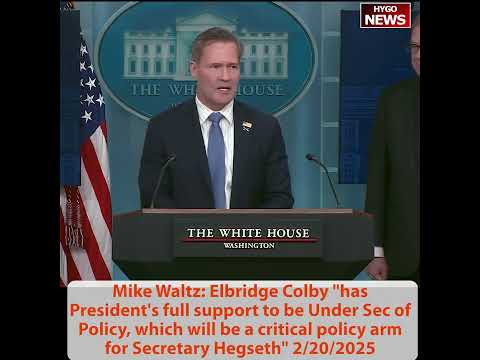
Waltz used the appearance to confirm a significant personnel announcement. “I’ve worked with Elbridge Colby in the past. He has the President’s full support to be the Under Secretary of Policy, which will be a critical policy arm for Secretary Hegseth going forward, that will implement a lot of these policies,” Waltz said.
Colby, a defense strategist known for his focus on great-power competition with China and his advocacy for prioritizing the Indo-Pacific over European security commitments, was a consequential pick. His appointment signaled that the Defense Department’s policy apparatus would be oriented toward the strategic competition that the administration viewed as the defining challenge of the era.
Waltz dismissed media speculation about internal friction over the appointment. “I think there’s been a lot of kind of breathless, I don’t know, back and forth in the press, but we’re full speed ahead to get the president’s team in place so we can implement his America First policy,” he said.
”Go Toe-to-Toe with Putin, Xi, Kim Jong-un”
Waltz concluded with a statement of confidence in Trump’s personal capacity to manage the world’s most dangerous adversaries.
“If there’s anybody in this world that can go toe-to-toe with Putin, that could go toe-to-toe with Xi, that could go toe-to-toe with Kim Jong-un — and we could keep going down the list — it’s Donald J. Trump,” Waltz said. “He is the dealmaker-in-chief. There is no question that he is the commander-in-chief.”
He then reinforced the historical pattern that Trump and other officials had cited repeatedly. “I’ll remind everyone that Putin had some type of conflict, invasion, issue with their neighbor under President Bush with Georgia, under President Obama with Ukraine 2014, not under President Trump 45, and again with President Biden in 2022,” Waltz said.
The recitation of Putin’s military actions under four presidents — aggression under Bush, Obama, and Biden; nothing under Trump — had become one of the administration’s most powerful talking points. Waltz delivered the conclusion: “The war should have been deterred, the war should have never happened, and I have no doubt it would not have happened under President Trump, and will stop under President Trump.”
Key Takeaways
- NSA Waltz called it “ridiculous” that Washington voices who demanded a ceasefire in Gaza were “suddenly aghast” that Trump would demand one in Ukraine, “a war that has been arguably far greater in scope and scale.”
- He revealed that Treasury Secretary Bessent had offered Ukraine “a historic opportunity” for American co-investment in minerals, citing an aluminum foundry that alone could supply America’s entire annual aluminum imports.
- Waltz publicly rebuked Zelensky, saying “insults to President Trump were unacceptable” and that Ukraine needed to show “deep appreciation” for American taxpayer support.
- He confirmed Elbridge Colby as Trump’s pick for Under Secretary of Defense Policy with “the President’s full support.”
- Waltz reiterated the Putin pattern — military aggression under Bush, Obama, and Biden but “not under President Trump 45” — and declared “I have no doubt the war will stop under President Trump.”