 HYGO News
 Maxine Waters complains: numbers he promised deported; Even Obama DHS Sec praising Trump border
Maxine Waters complains: numbers he promised deported; Even Obama DHS Sec praising Trump border
Five distinct political moments condensed into a single news cycle, and the through-line connecting them is the Democratic Party’s increasingly unsustainable position on the immigration debate. Representative Maxine Waters — in what was likely intended as criticism — acknowledged on tape that President Trump is delivering on the deportation numbers he promised. Obama-era DHS Secretary Janet Napolitano publicly complimented the Trump administration’s border operations. Treasury Secretary Scott Bessent pushed back on House rules being used to cut off his testimony. Representative Dan Goldman argued taxpayer funding of PBS and NPR is a First Amendment matter. And Representative Lloyd Smucker, questioning Bessent, elicited a striking number — 1.4 million illegal immigrants currently receiving Medicaid dollars — that may become the single most cited data point in the fight over the One Big Beautiful Bill.
Maxine Waters Concedes The Delivery
Waters opened with what she intended as a critique. “They should not be edged on and, you know, provoked in any way. And that’s what the President of the United States is doing, to exert his power and to show that he’s in charge and to show that he’s going to get the numbers that he promised to get, to get people deported.”
Read carefully, that statement is a tacit admission. Waters is accusing Trump of doing precisely what he campaigned on: hitting the deportation numbers he promised. The rhetorical frame is condemnatory — she is objecting to the method and the optics — but the factual substance is an acknowledgment that the president is keeping a campaign commitment.
The dynamic is politically unusual. A politician’s critics normally argue either that the politician is failing to deliver or that his delivery is harmful. Waters has collapsed into the second mode without seeming to realize that she has conceded the first. That concession matters. The administration can quote her criticism back at skeptics as evidence that the deportation operation is, by Waters’s own account, doing exactly what Trump promised.
”And So, You Know Him. Everybody Knows Him”
Waters’s next line captured the exasperation that animates much of Democratic commentary about Trump. “And so, you know him. Everybody knows him.”
The phrasing suggests that Trump’s actions are predictable because he has told voters, repeatedly, what he would do. That predictability is itself the argument Waters is making: Trump is not hiding his intentions. He is executing them.
Napolitano’s Endorsement Of The Border Operations
The more surprising concession came from Janet Napolitano, the former Secretary of Homeland Security under President Obama. “Look, I think the border needs to be secure. And actually, I will say many of the things that the Trump administration has done on the border from an operational standpoint have been useful in that regard.”
Napolitano has political credibility across the spectrum on immigration because she ran the agency responsible for immigration enforcement under a Democratic administration. Her judgment is not reflexively partisan. When she says the Trump administration’s border operations have been “useful,” the statement cannot be dismissed as MAGA loyalism. It is a professional assessment from a former cabinet officer of the opposite party.
Her phrasing is notable for its specificity. She did not endorse the entirety of the administration’s immigration agenda. She specified “from an operational standpoint” — meaning the tactics, procedures, and execution of border enforcement. Her praise is narrow, but the narrowness is what makes it credible. If Napolitano had offered blanket endorsement, it would have been dismissed as performance. By identifying precisely what works, she signals that she is evaluating as a practitioner.
Bessent Asserts Himself: “This Is The People’s House”
The hearing then turned, with some tension, to the question of who controls the microphone. Bessent had been repeatedly interrupted. His pushback preserved the distinction between the rules that govern a hearing and the deference a cabinet officer owes to a member of Congress.
“Excuse me. Let me, let me, let me get something straight with you first here. I’ve seen you interrupt everyone. When you come to someone’s house, you respect their rules. And in this house, we don’t interrupt individuals.”
Bessent’s response was patient but firm. “And you’re not going to interrupt my time. I’m going to give you time to respond. You may want to jot down some notes about things that you don’t agree with me on so that you can respond to them at that time. But while I’m speaking, as the person holding this time, you will refrain from speaking, sir, until I’m done. I look forward to responding. And then I will give you time to speak. Okay? Look forward to facts. Thank you.”
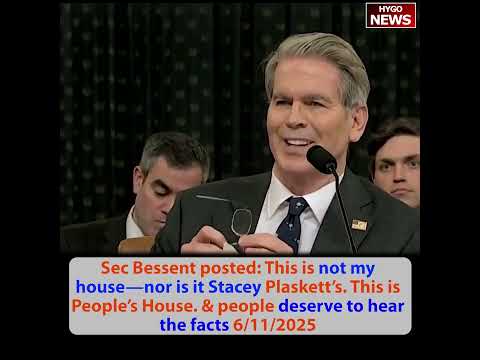
Bessent’s separate statement later in the day sharpened the point further. “This is not my house—nor is it Stacey Plaskett’s. This is the People’s House. And the people deserve to hear the facts.” That framing — that the hearing room belongs to the public, not the member — is a direct challenge to the notion that House rules can be weaponized to prevent the public from hearing the Treasury Secretary’s answers.
Goldman: Taxpayer PBS/NPR Funding As A First Amendment Issue
Representative Dan Goldman’s argument for continued federal funding of PBS and NPR staked out a constitutional claim. “But this is not about actual funding. This is caving to Donald Trump’s thin skin and his inability to deal with facts rather than to stand up for local stations, local communities, and the First Amendment, which specifically prevents Congress from abridging the freedom of the press.”
The invocation of the First Amendment is the load-bearing move. Goldman is arguing that ending federal funding of public broadcasting would constitute congressional action abridging freedom of the press. The implied syllogism: federal funding is support of the press; withdrawing federal funding is abridgment of the press; therefore withdrawal violates the First Amendment.
The counter-argument is that the First Amendment forbids Congress from restricting speech — not from declining to subsidize it. Americans may write, publish, and broadcast whatever they wish. Whether taxpayers must underwrite particular outlets is a separate question. Goldman’s framing collapses those two questions into one. Critics say that collapse is constitutionally illiterate.
”To Every Republican Listening”
Goldman concluded with a pitch designed to peel off votes. “So to every Republican listening, this is yet another chance to oppose Donald Trump’s attack on any objective form of accountability and do what’s best for your constituents.”
The framing — that federal funding of public broadcasting is “objective accountability” — is itself the contested premise. PBS and NPR have a long track record that critics, including many conservatives, view as tilted. Goldman’s argument that stripping funding is an “attack on accountability” presumes the outlets are providing accountability. Republicans who disagree with that premise are unlikely to be moved by the appeal.
The Pivot To The One Big Beautiful Bill
The hearing then pivoted to the substance of the pending legislation and to the Democratic talking points Bessent argued were factually wrong. His framing was direct. “We’re hearing a lot from the other side here today on things that just, they’re falsehoods about the bill, things that are not in this bill.”
He then walked through the provisions Democrats were voting against.
The Largest Tax Increase In History
“A vote against this bill is a vote for the largest tax increase in American history, a tax increase that will affect average households at every tax bracket level.”
The logic: the 2017 tax cuts are scheduled to expire. Failing to extend them would result in automatic tax increases across income brackets. Bessent is reframing a vote against the bill as a vote for those automatic increases. The framing is accurate in structure — the bill does extend the cuts, and failure to pass would allow the scheduled increases — but Democrats will argue the framing elides the larger fiscal picture.
The 50% Child Tax Credit Cut
“They’re voting for a decrease, in fact, a 50% decrease in the child tax credit, which is so important, provides important relief to every American family.”
Again, Bessent is weaponizing the scheduled expiration of existing provisions. The enhanced child tax credit that the 2017 law provided is set to revert to pre-2017 levels absent action. Bessent is framing a vote against the bill as a vote for that reversion. The rhetorical move — turning a default into an active choice — is politically potent because it forces Democrats to either defend the default or explain why they oppose preventing the default.
The Medicaid-For-Illegal-Immigrants Claim
Smucker then asked the question that produced the exchange’s most politically significant admission. “They’re voting for allowing Medicaid dollars to go to people who are here in the country illegally at the expense of American citizens.”
Bessent responded without hesitation. “Yes, sir, 1.4 million of them.”
The number — 1.4 million illegal immigrants receiving Medicaid dollars — is a figure that will travel. It will travel because it is specific, because it is large, and because it maps onto a policy debate that most voters already have intuitions about. Democrats defending the current policy architecture will argue that the 1.4 million figure reflects particular categories of emergency or state-level coverage that have been established for legitimate reasons. The administration is betting that the top-line number will reach more voters than any nuance Democrats offer in response.
Work Requirements And The Welfare Question
Bessent continued. “And they are voting to allow Medicaid dollars that are intended for people who really need them to go to individuals who could be working but choose not to. They are voting for Medicaid benefits, not to go to women and children as they should.”
The argument here is a traditional Republican work-requirements pitch. Medicaid dollars, in the administration’s framing, should flow to the genuinely needy — women, children, and able-bodied adults who are unable to work — rather than to able-bodied adults who are choosing not to work. Democrats will argue that imposing stricter work requirements produces administrative bloat and denies coverage to people who are genuinely eligible but fail to navigate paperwork. The argument is decades old; the One Big Beautiful Bill is the vehicle that has made it current again.
The Democratic Flip-Flops On Growth Provisions
Bessent’s sharpest point came when he noted that Democrats had previously supported key growth provisions now in the bill. “They’re also voting against policies they voted for before that will be critical to grow this economy and provide additional opportunity. Policies like full-expensing, they voted for that, or last session, full deductibility of R&D, I mentioned full-expensive, and then we’re adding full-expensing for structures, which will reenergize American manufacturing.”
The flip-flop charge is hard to refute. Full expensing for equipment, full deductibility of R&D, and similar provisions have enjoyed bipartisan support in prior sessions. Bessent is documenting that the current Democratic opposition to those provisions is not a matter of principle but of political positioning against the broader bill. When the provisions were packaged with other terms Democrats preferred, Democrats voted for them. When they are packaged with terms Democrats oppose, they are voting against them.
What The Day Added Up To
The hearing, taken as a whole, was the administration’s best day in weeks. Waters’s concession, Napolitano’s endorsement, Bessent’s “People’s House” reframe, Goldman’s constitutional overreach, and the 1.4 million number all flowed in the same direction. The administration was able to argue that even its critics concede the border operations are working, that the bill is delivering on its promises, and that the Democratic opposition is built on positions its own members have supported in the recent past.
Key Takeaways
- Maxine Waters concedes: Trump “is going to get the numbers that he promised to get, to get people deported” — a tacit admission he is keeping the campaign pledge.
- Obama DHS Secretary Janet Napolitano: “Many of the things that the Trump administration has done on the border from an operational standpoint have been useful in that regard.”
- Bessent on House rules: “This is not my house—nor is it Stacey Plaskett’s. This is the People’s House. And the people deserve to hear the facts.”
- Bessent’s 1.4 million figure: Democrats are “voting for allowing Medicaid dollars to go to people who are here in the country illegally…1.4 million of them.”
- Bessent documents Democratic flip-flops: “they’re also voting against policies they voted for before…policies like full-expensing, they voted for that, or last session, full deductibility of R&D.”