 HYGO News
 Manchin deals heavy blow to Biden's hopes for social spending, press conference 11/1/2021
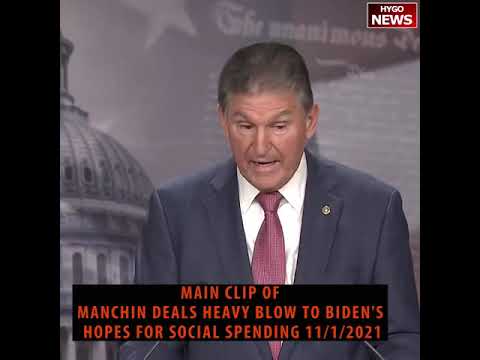
Manchin Deals Heavy Blow to Biden’s Social Spending Hopes in Press Conference
On November 1, 2021, Senator Joe Manchin (D-WV) held a press conference that dealt a devastating blow to President Biden’s domestic spending agenda. Manchin declared he would not support the $1.75 trillion reconciliation package, citing its impact on the national debt, inflation, and the solvency of Social Security and Medicare. He accused his progressive colleagues of an “all or nothing” approach to negotiation, called the bill’s cost estimates “shell games” and “budget gimmicks,” and demanded the House pass the bipartisan infrastructure bill immediately rather than holding it hostage to win his support for the larger spending package. The press conference marked the most forceful public break between Manchin and his party’s leadership since negotiations had begun months earlier.
”I Will Not Support This Bill”
Manchin opened with a series of declarations that left no room for ambiguity. “I will not support a reconciliation package that expands social programs and irresponsibly adds to our $29 trillion in national debt that no one seems to really care about or even talk about,” he said. “Nor will I support a package that risks hurting American families suffering from historic inflation.”
He stated his position in the clearest possible terms: “Simply put, I will not support a bill that is this consequential without thoroughly understanding the impact that it will have on our national debt, our economy, and most importantly, all of our American people.”
Manchin emphasized that his concerns were about fundamental fiscal responsibility, not details. “Every elected representative needs to know what they are voting for and the impact it has not only on their constituents but the entire country,” he said. He noted that he had “been around for a long time” in public service and had “never seen anything like this” in terms of the pressure campaign being waged to force a vote on the spending bill.
Social Security, Medicare, and “Shell Games”
Manchin’s most pointed argument centered on the bill’s interaction with existing entitlement programs. “How can I in good conscience vote for a bill that proposes massive expansion to social programs when vital programs like Social Security and Medicare face insolvency and benefits could start being reduced as soon as 2026 in Medicare and 2033 in Social Security?” he asked. “How does that make sense? I don’t think it does.”
He then attacked the bill’s official cost estimates, arguing that the real price tag was far higher than the $1.75 trillion figure. “What I see are shell games, budget gimmicks that make the real cost of the so-called $1.75 trillion bill estimated to be almost twice that amount if the full time is run out, if you extended it permanently, and that we haven’t even spoken about,” Manchin said.
He called the combination of expanded social programs, a mounting national debt, rising inflation, and impending interest rate increases “a recipe for economic crisis” and declared: “None of us should ever misrepresent to the American people what the real cost of legislation is."
"All or Nothing” — Manchin Blasts Progressives
Manchin directed some of his sharpest rhetoric at the progressive wing of his own party, which had been blocking a vote on the bipartisan infrastructure bill as leverage to force passage of the larger reconciliation package.
“It is obvious compromise is not good enough for a lot of my colleagues in Congress. It’s all or nothing, and their position doesn’t seem to change unless we agree to everything. Enough is enough,” Manchin said.
He pointed out that President Biden himself had addressed the House Democratic Caucus twice to urge action on the bipartisan infrastructure bill, and that Speaker Pelosi had urged a vote before Biden traveled overseas for the COP26 climate summit. “Still no action,” Manchin noted.
The senator described his frustration with the strategy of holding the infrastructure bill hostage: “Twice now the House has balked at the opportunity to send the BIF legislation to the president. It is time to vote on the BIF bill up or down and then go home and explain to your constituents the decision you made.”
Manchin’s Three-Month Negotiation Record
Manchin was careful to establish that his opposition was not born of unwillingness to negotiate. He detailed his engagement with the process over the preceding months.
“I’ve worked in good faith for the past three months with President Biden, Leader Schumer, Speaker Pelosi, and my colleagues on the reconciliation bill, and I will continue to do so,” he said. He noted that his work had aimed to “find the middle ground on a fiscally responsible piece of legislation that fixes the flaws of the 2017 Trump tax bill that I thought was weighted far, far too far for the high-end earners.”
Despite this openness, Manchin warned that his support was conditional on fiscal transparency. “I will not support the reconciliation legislation without knowing how the bill will impact our debt and our economy and our country, and we won’t know that until we work through the text.”
He also drew a line on his willingness to compromise further: “I’m open to supporting a final bill that helps move our country forward, but I am equally open to voting against a bill that hurts our country."
"It’s Time to Pass the Bill and Quit Playing Games”
Manchin concluded by urging the House to pass the bipartisan infrastructure bill — which had received 69 Senate votes and represented months of bipartisan work — as a standalone measure. He framed the infrastructure bill as the achievable victory that was being sacrificed in pursuit of the larger and more contentious reconciliation package.
“For the sake of our country, I again, and I am urging all of my colleagues in the House to vote and pass the bipartisan infrastructure bill. It’s bipartisan, 69 votes. We worked on that for many, many months,” Manchin said. “As I’ve said before, holding that bill hostage is not going to work to get my support of what you want.”
He closed with a plea for cooperation and a warning about the consequences of continued gamesmanship: “It’s time our elected leaders in Washington, all of us, stop playing games with the needs of the American people.”
Manchin added one final statement before departing: “I’m not going to negotiate in public on this because I’ve been dealing in good faith and I will continue to deal in good faith with all of my colleagues on both sides. It’s time to pass the bill and quit playing games.”
Key Takeaways
- Senator Manchin declared he would not support the $1.75 trillion reconciliation package, calling it loaded with “shell games” and “budget gimmicks” that disguised a true cost of “almost twice that amount” and warning it was “a recipe for economic crisis” amid historic inflation and $29 trillion in national debt.
- He challenged the logic of expanding social programs while Social Security and Medicare face insolvency — with benefits potentially reduced as soon as 2026 for Medicare and 2033 for Social Security — and accused progressive colleagues of an “all or nothing” negotiating posture.
- Manchin urged the House to immediately pass the bipartisan infrastructure bill, which had earned 69 Senate votes, declaring that “holding this bill hostage is not going to work to get my support” and calling on elected leaders to “stop playing games with the needs of the American people.”