 HYGO News
 Majority Dems don’t want 2024 BidenA: no concerns very clear: He intends to run, Watch him
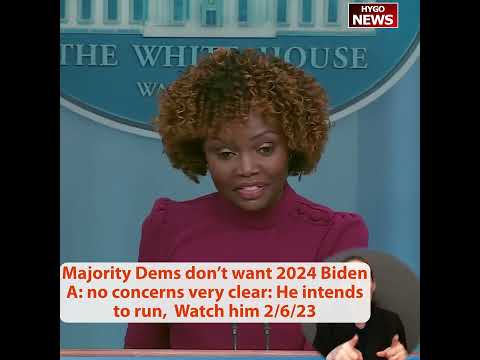
AP-NORC Poll Shows Majority Dems Don’t Want 2024 Biden — KJP: “Watch Him, Watch Him”
In February 2023, a reporter asked White House Press Secretary Karine Jean-Pierre about polling showing majority of Democrats didn’t want Biden to seek reelection, with concerns about his age and desire for new generation. “Number of surveys of the AP of the day again showed that majority Democrats don’t want the president to seek reelection. They look for new generation concerns about his age. Without getting into whether or not the president will announce, does the president believe that he has to address those concerns from his own constituents?” the reporter asked. KJP cited Hatch Act limitations then made points: “I’m gonna be very careful covered by the Hatch Act. Don’t want a president has been very clear he intends to run. And you know, I think the way that we should look at this is what we saw from the midterms. I’m not gonna get into what the president should respond to. I think you know, the president always says this, watch him, watch him and see what he does.”
The AP-NORC Poll Significance
Poll significance:
AP-NORC — Major polling firm.
Democratic majority — Against reelection.
Age concerns — Specific.
New generation — Wanted.
Not partisan — Democratic voters.
The AP-NORC poll was significant because it wasn’t partisan attack — Democratic voters themselves were expressing these concerns. Majority of party base not wanting Biden to seek reelection was substantial political problem.
The Reporter’s Smart Framing
Framing:
Constituent concerns — Emphasized.
Own party — Focus.
Address question — Direct.
Announce bypassed — Avoided.
Political response — Sought.
The reporter’s framing was strategic. By asking about addressing constituent concerns rather than when Biden would announce, the question bypassed Hatch Act complications while pressing on real political issue.
”Very Careful Covered by the Hatch Act”
Hatch Act invocation:
Legal constraint — Cited.
Campaign activity — Limited.
Official capacity — Separation.
Cover for deflection — Sometimes.
Standard — Practice.
The Hatch Act prevents federal employees from engaging in political campaign activity while in official capacity. KJP invoking it was legitimate constraint but also provided cover for deflection on political questions.
”Don’t Want a President Has Been Very Clear”
Verbal confusion:
“Don’t want” — Error.
Syntax issues — Confused.
Recovery — Attempted.
KJP pattern — Characteristic.
Pressure response — Evident.
The “Don’t want a president” verbal confusion was notable error. The syntax was confused. Recovery was attempted but the error remained. This was KJP’s characteristic under-pressure verbal pattern.
”He Intends to Run”
Intent stated:
“Intends to run” — Affirmed.
Not announcement — Technically.
Biden position — Continued.
Political posture — Maintained.
Planning signal — Clear.
The “he intends to run” framing was Biden’s standard position while not formally announcing. This maintained political planning signals while avoiding formal campaign launch that would trigger additional rules.
The Hatch Act Limits in Practice
Practical limits:
Formal announcement — Triggers rules.
Official communications — Restricted.
Campaign fundraising — Separate.
Endorsements — Limited.
Travel — Complicated.
In practice, once president formally announced reelection campaign, various activity rules changed. Official communications became more restricted. Campaign fundraising operations needed separation. Delaying formal announcement maintained flexibility.
”What We Saw From the Midterms”
Midterms framing:
Red wave — Didn’t materialize.
Democratic performance — Better than expected.
Biden context — Provided.
Political capital — Claimed.
Narrative — Shaping.
KJP’s invocation of “what we saw from the midterms” was important framing. Democrats had performed better than expected in 2022 midterms, outperforming typical first-term presidential party. This was cited as Biden vindication.
The Midterms Actual Results
Actual results:
Senate — Held.
House — Lost narrowly.
Governors — Net gain.
State legislatures — Mixed.
Better than expected — Yes.
The actual midterm results were better than historical expectations for president’s party. Democrats held Senate, lost House narrowly, had net gubernatorial gains, mixed state legislature results. “Better than expected” framing was supportable.
The Midterms Different From 2024
Different context:
Off-year — Lower turnout.
Candidate quality — Varied.
Republican nominees — Weak often.
Abortion — Key issue.
National mood — Different.
However, 2024 would be different context. Presidential election had higher turnout, national campaign dynamics, different issues dominant, and head-to-head with specific opponent rather than multiple Senate/House races.
The Polling Numbers Actually Mean
Polling meaning:
Base concerns — Real.
Turnout risk — Present.
Primary challenges — Possible.
Alternative candidates — Considered.
Trouble signals — Multiple.
The polling numbers actually signified real base concerns, turnout risks if not addressed, possible primary challenges, alternative candidate considerations, and multiple political trouble signals. Dismissing them was risky strategy.
”Watch Him, Watch Him”
The repeated phrase:
Double “watch him” — Emphasized.
Record-based — Approach.
Action-focused — Framing.
Standard line — Biden uses.
Not substantive — Response.
The “watch him, watch him” double repetition was Biden’s standard line about his record. Rather than substantively addressing concerns, the approach was to point to action and accomplishments. This wasn’t really responsive to age-specific concerns.
”See What He Does”
Action focus:
Doing — Over saying.
Record — Over polls.
Accomplishments — Cited.
Future action — Promised.
Not direct — Response.
“See what he does” was similar action-focused framing. The response directed attention away from age concerns and toward accomplishments. This was indirect response to specific concerns raised.
”Record Over the Last Two Years”
Record claimed:
Two years — Frame.
“Delivered” — Characterization.
Numbers — Referenced.
Pay attention — Directed.
Accomplishment claim — Made.
The “record over the last two years” claim pointed to Biden’s accomplishments as response to age concerns. The implicit argument was that effective performance should outweigh age concerns. This was substantive argument even if indirect.
The Substantive Biden Record
Actual record:
Infrastructure law — Passed.
CHIPS Act — Semiconductor.
Inflation Reduction Act — Climate, health.
COVID response — Transitioning.
Foreign policy — Varied.
Biden’s actual first-two-year record included substantial legislative accomplishments: bipartisan infrastructure law, CHIPS Act for semiconductor investment, Inflation Reduction Act for climate and healthcare, COVID response. Record argument had substance.
The Age Concerns Specifically
Age concerns:
Biden — Oldest ever.
80 at 2023 — Already.
86 by 2029 — End of term.
Visible aging — Sometimes.
Voter concerns — Real.
The specific age concerns were legitimate. Biden was already oldest president ever. He would be 86 at end of second term if elected. Visible aging was sometimes evident. Voter concerns were real, not manufactured.
The Democratic Alternatives Consideration
Alternatives:
Harris — VP.
Newsom — California.
Buttigieg — Transportation.
Others — Various.
Conversation — Happening.
Conversations about Democratic alternatives to Biden were happening. Kamala Harris as VP, California Governor Gavin Newsom, Transportation Secretary Pete Buttigieg, and others were being discussed. These conversations reflected real party dynamics.
The Base Turnout Risk
Turnout risk:
Enthusiasm gap — Concerning.
Young voters — Cooler.
Progressive base — Mixed.
General election — Impact.
Real concern — For strategists.
Democratic base enthusiasm gap was turnout risk. Young voters, progressive base, and others were cooler on Biden. General election turnout mattered for margin in close states. This was real concern for Democratic strategists.
The Primary Challenge Possibilities
Primary challenges:
Robert Kennedy Jr. — Would run.
Marianne Williamson — Would run.
Dean Phillips — Later.
Longer-shot — Technically.
Establishment — Against.
Primary challenges to Biden would materialize. Robert Kennedy Jr., Marianne Williamson, and later Dean Phillips would all run. They were long-shots technically but reflected base discontent that KJP’s response was dismissing.
The Administrative Strategy
Administrative strategy:
Deflect concerns — Primarily.
Cite accomplishments — Counter.
Hatch Act — Cover.
Forward positioning — Continue.
Reality — Managed.
The administrative strategy was to deflect concerns primarily, cite accomplishments to counter, use Hatch Act as partial cover, continue forward positioning, and manage reality through messaging. Whether effective was debated.
The Political Reality
Political reality:
Base concerns — Real.
Polls consistent — Showing.
Age factor — Persistent.
Strategy questions — Growing.
Decision time — Approaching.
The political reality was that base concerns were real, polls were consistently showing them, age factor was persistent, strategy questions were growing, and decision time on 2024 approaches was near. Deflection was time-limited strategy.
The Eventual 2024 Outcome
Eventual outcome:
Biden did run — Initially.
Debate disaster — June 2024.
Dropped out — July 2024.
Harris replaced — August 2024.
Polling dynamics — Played out.
The eventual outcome was Biden initially ran, had debate disaster June 2024, dropped out July 2024, Kamala Harris replaced him August 2024. The polling dynamics KJP was dismissing in February 2023 would ultimately play out consequentially.
The Press Briefing Function
Briefing function:
Message discipline — Primary.
Forward positioning — Standard.
Substantive avoidance — Common.
Politics — Background.
Official channels — Used.
The press briefing function was primarily message discipline, forward positioning, substantive avoidance of difficult topics, and political background management. KJP was executing standard function.
The Reporter’s Sustained Engagement
Reporter engagement:
Question substantive — Yes.
Framing smart — Constituent concerns.
Hatch Act bypass — Attempted.
Direct response — Sought.
Professional — Throughout.
The reporter’s sustained engagement through substantive question with smart framing attempting to bypass Hatch Act constraints seeking direct response was professional approach. Quality accountability journalism.
The Long-Term Political Strategy
Long-term strategy:
Formal announcement — Timing.
Campaign infrastructure — Building.
Primary field — Clearing.
General election — Preparing.
Unity — Cultivating.
Long-term political strategy involved formal announcement timing (eventually April 2023), campaign infrastructure building, primary field clearing, general election preparing, and unity cultivation. KJP was positioning for these priorities.
The Democratic Caucus Discipline
Caucus discipline:
Public support — Maintained.
Private concerns — Real.
Leadership alignment — Sought.
Alternative voices — Suppressed somewhat.
Unity messaging — Prioritized.
Democratic caucus discipline maintained public support for Biden despite private concerns. Leadership alignment was sought. Alternative voices were somewhat suppressed. Unity messaging was prioritized as party strategy.
The Media Coverage Dimensions
Media coverage:
Polling coverage — Extensive.
Age concerns — Highlighted.
Democratic splits — Noted.
Biden defense — Covered.
Balanced — Mostly.
Media coverage of polling, age concerns, Democratic splits, and Biden defense was extensive. Coverage was mostly balanced with both concerns and administration responses represented. This was standard political coverage.
Key Takeaways
- A reporter cited AP-NORC polling showing majority Democrats didn’t want Biden to seek reelection, with concerns about age and desire for new generation.
- KJP invoked legal limits: “I’m gonna be very careful covered by the Hatch Act.”
- She affirmed Biden intent: “President has been very clear he intends to run.”
- She deflected to midterms: “I think the way that we should look at this is what we saw from the midterms.”
- She repeated Biden’s line: “Watch him, watch him and see what he does.”
- She claimed record: “He has a record over the last two years that shows that he has delivered and that’s the numbers that we’re gonna pay attention.”
Transcript Highlights
The following is transcribed from the video audio (unverified — AI-generated from audio).
- Number of surveys of the AP of the day again showed that majority Democrats don’t want the president to seek reelection. They look for new generation concerns about his age.
- Without getting into whether or not the president will will announce does the president believe that he has to address those concerns from his own constituents?
- So I’m as you just laid out. I’m gonna be very careful covered by the Hatch Act.
- Don’t want a president has been very clear he intends to run and you know, I think the way that we should look at this is what we saw from the midterms.
- I’m not gonna get into what the person what the president should respond to.
- I think you know, the president always says this, watch him, watch him and see what he does.
Full transcript: 165 words transcribed via Whisper AI.