 HYGO News
 Stephen Miller on MAHA: 'Bobby's Life's Work Now Has a Government Seal on It -- Not Private Citizen, Not Nonprofit Leader, But Secretary of HHS'; Pediatric Cancer Is 'a Disease of Civilization'; Toxins 'Even in Mother's Breast Milk'
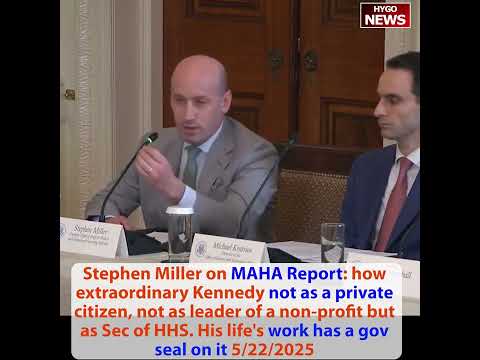
Stephen Miller on MAHA: “Bobby’s Life’s Work Now Has a Government Seal on It — Not Private Citizen, Not Nonprofit Leader, But Secretary of HHS”; Pediatric Cancer Is “a Disease of Civilization”; Toxins “Even in Mother’s Breast Milk”
Stephen Miller, Deputy Chief of Staff, delivered remarkable remarks on the MAHA Commission Report in May 2025, framing the significance of RFK Jr.’s cabinet position. “Through the prism of being a dad of three young children, and I’m married to a MAHA mom. My wife, Katie, is the one who deserves all the credit for educating me about this issue on the birth of our children.” On Kennedy’s position: “Think about how extraordinary this moment is that Bobby’s sitting there right now, not as a private citizen, not as the leader of a nonprofit, but as the Secretary of Health & Human Services. As whole life, Bobby has issued private reports, held private press conferences, engaged in private advocacy, and after generations of all of that work, his life’s work now has a government seal on it.” On pediatric cancer: “There’s no other primate in the world where pediatric cancer is commonplace, only in humans… It is a disease of civilization.” On breast milk: “Even in a mother’s breast milk, we find traces of toxic chemicals.” On Ritalin culture: “Too energetic in class, too happy, too excited — the teacher would call the parent and they would put that kid on drugs.”
The Personal Frame
Stephen Miller opened with personal context.
“Through the prism of being a dad of three young children, and I’m married to a MAHA mom,” Miller said.
He credited his wife: “My wife, Katie, is the one who deserves all the credit for educating me about this issue on the birth of our children.”
Katie Miller (née Waldman) had become known in conservative circles as a strong advocate for parental rights, children’s health concerns, and what had come to be called the “MAHA mom” movement. Her credit on this issue reflected the broader pattern where mothers were often the family members most engaged with children’s health concerns, reading labels, researching products, and advocating for healthier choices.
The “MAHA mom” movement represented a significant political constituency. It combined:
- Traditional conservative concerns about government overreach
- Progressive-adjacent concerns about corporate power and environmental toxins
- Parental protection instincts that crossed political lines
- Skepticism of medical establishment orthodoxy
- Interest in natural foods, reduced pharmaceutical use, alternative health practices
During the 2024 campaign, MAHA moms had been a significant factor in shifting previously Democratic-leaning female voters toward Trump. RFK Jr.’s endorsement of Trump and subsequent cabinet appointment had cemented this movement’s alignment with the Trump administration.
”Life’s Work Has a Government Seal”
Miller’s framing of Kennedy’s institutional transformation was striking.
“But I first want to just take a moment for us to think about how extraordinary this moment is that Bobby’s sitting there right now, not as a private citizen, not as the leader of a nonprofit, but as the Secretary of Health and Human Services,” Miller said.
He described the institutional significance: “And government seal issuing, this is a government report, right?”
He framed the trajectory: “As whole life, Bobby has issued private reports, held private press conferences, engaged in private advocacy, and after generations of all of that work, his life’s work now has a government seal on it.”
He delivered the conclusion: “Think about how remarkable that is.”
The institutional transformation Miller described was indeed remarkable. For over three decades, Kennedy had been:
- An environmental lawyer pursuing corporate polluters
- A critic of pharmaceutical industry practices
- A skeptic of various vaccine policies
- An advocate for children’s environmental health
- A challenger of institutional medical orthodoxy
In all of this work, Kennedy had been an outsider critic. He had filed lawsuits, published books, given speeches, and organized non-profit advocacy. Traditional medical and public health institutions had often dismissed his concerns or attacked his credibility. The establishment response to Kennedy’s critiques had typically been marginalization rather than engagement.
His appointment as HHS Secretary fundamentally changed this dynamic. Kennedy now:
- Led the department he had previously criticized
- Controlled budgets for the institutions he had challenged
- Could direct research on the questions he had raised
- Could redirect pharmaceutical and vaccine policies
- Could implement reforms of food safety and environmental health
The MAHA Commission Report was the first institutional product of this transformation. Concerns that Kennedy had raised as an outsider critic were now being articulated as official government analysis. The “government seal” Miller referenced meant that American federal government, in its official capacity, was acknowledging problems that the medical establishment had long denied or minimized.
”Dad of Three Young Children”
Miller spoke from parental experience.
“When I say that I think about these issues primarily as a dad,” Miller said, “I was shocked to learn again mostly, not exclusively with my wife’s help, on the birth of our children.”
He described the environmental reality: “Just how filled our whole world is with toxins and how bereft the child’s world is of all the natural things that humans have interacted with and encountered since the beginning of humanity.”
He stated the foundational claim: “We’re still natural beings. Humans are still natural creatures. It affects your health.”
He described the child development needs: “If a child goes through its formative years, his or her formative years, without access to enough sunlight every day, enough exercise every day, to the microorganisms that exist in the world, in dirt and in trees and in leaves and all of the things that humans have interacted with, a child that grows up in a world where the only things that child consumes are ultra-processed foods, baby food that is filled with sugar and preservatives.”
The “natural beings” framing connected MAHA concerns to broader evolutionary biology. For approximately 200,000 years of human existence, humans had developed adapted to specific environmental conditions: sunlight exposure, outdoor movement, microbial exposure, whole food consumption, specific dietary patterns. The dramatic environmental changes of the past century — industrial food systems, chemical exposures, reduced outdoor time, altered microbiomes — represented unprecedented conditions for which human biology had not evolved.
The argument was that genetic adaptation takes thousands of generations, while environmental change had been compressed into approximately three generations (grandparents born early 20th century, parents mid-century, children 21st century). The mismatch between human biology and modern environmental conditions was producing predictable health consequences.
”Even in a Mother’s Breast Milk”
Miller cited the report’s most striking finding.
“The toxins are in our environment,” Miller said. “Even in a mother’s breast milk, we find, and it’s in this report, we find traces of toxic chemicals because of what is in our environment where that child is exposed from the moment they’re born, everything they touch and interact with, with industrial chemicals.”
He catalogued the exposures: “They’re chemicals in the carpets in our homes, in the treatments in our yards, in our foods, cleaning products.”
The breast milk finding was particularly disturbing. Breast milk, long considered the gold standard of infant nutrition, had been contaminated by environmental chemicals. Studies had found in breast milk:
- PFAS “forever chemicals”
- Flame retardants
- Pesticide residues
- Phthalates and plasticizers
- Heavy metals
- Pharmaceutical residues
- Microplastics
For mothers who had consumed standard American diets, lived in standard American homes, and used standard American products, some level of chemical contamination in their breast milk was nearly unavoidable. The consequence was that infants were being exposed to industrial chemicals from literally their first meals.
This was not merely about individual lifestyle choices. It was about systemic environmental contamination that had permeated even the most basic biological processes of human nutrition. Even perfect maternal behavior could not fully protect infants from industrial chemical exposure.
”Gentle and Precious”
Miller continued the parental framing.
“I mean, think about any who’s had a newborn,” Miller said. “Think about how gentle and precious a newborn baby is and the kinds of chemicals that they’re exposed to from the day they’re born.”
He identified the microbiome issue: “What they’re not exposed to, that they need to have a, I think the term is a microbiome, that you need to develop a proper immune system.”
The microbiome concern reflected emerging scientific understanding. Traditional medicine had focused on avoiding germs — antibacterial soaps, sterile environments, antibiotic use. Recent research had revealed that:
- Human bodies harbor trillions of microorganisms essential to health
- Immune system development requires microbial exposure in early childhood
- Cesarean births, formula feeding, and antibiotic use disrupt microbiome development
- Ultra-sterile environments may impair immune system maturation
- Chronic diseases correlate with disrupted microbiomes
The contemporary American child was simultaneously:
- Exposed to unprecedented levels of industrial chemicals
- Deprived of natural microbial exposures that evolution had expected
Both changes increased chronic disease risk. The combination was producing the health crises the MAHA report had documented.
”Crisis for That Family”
Miller addressed the emotional weight of these conditions.
“When all of these parents are wrapped with anguish, when they find out that their kid has an immune disorder or a lifelong allergy or a lifelong skin disorder,” Miller said.
He acknowledged the normalization: “And that may not seem like a very stressful thing until you have a kid yourself.”
He provided the specific example: “For parents, for example, whose kids have chronic eczema, that may not sound, ‘Oh, that’s a health crisis.’ It is a crisis for that family.”
He described the daily reality: “It’s a crisis for that family as they search every single day to find that cream or that lotion or that medication that’s going to give that child some relief.”
He stated the principle: “It’s not normal. It’s just fundamentally not normal for children to have any disease at all. Children are to be the healthiest among us.”
The chronic eczema example was well-chosen. Eczema had become extremely common in American children — approximately 10-20% had significant eczema at some point in childhood. Parents of eczema children knew the daily reality: constant itching, sleep disruption, skin infections from scratching, expensive prescription creams, elimination diets, laundry protocol complications, vacation constraints. But society generally did not recognize eczema as a “real” disease because it was not life-threatening.
The normalization of childhood chronic disease was itself part of the problem. When 40% of American children had at least one chronic condition, families came to accept chronic disease as normal. This acceptance made it harder to mobilize political will for fundamental reform.
”Disease of Civilization”
Miller made the most striking empirical claim.
“There’s no other primate in the world where pediatric cancer is commonplace, only in humans,” Miller said.
He asked the rhetorical question: “Why is that? Why do humans alone have children who are afflicted with these heartbreaking, life-threatening illnesses?”
He cited the cross-national data: “And what’s fascinating, and this is something that’s not disputed, is that vastly lower rates of pediatric cancer in the developing world than the developed world.”
He made the conclusion: “It is a disease of civilization. Think about that.”
He cited the migration data: “And they find that when someone moves from the developing world to the developed world, it’s the one generation, so their children, they have the exact same cancer rates as the existing population in the United States or other Western countries.”
The “disease of civilization” framing was scientifically defensible and politically potent. If pediatric cancer rates differed dramatically between developed and developing countries, and if migrants’ children acquired developed-world cancer rates within a generation, then:
- Genetics was not the primary factor (same genetic population, different environments)
- Something in the developed-world environment was causing the increased cancer
- Whatever was causing it could potentially be identified and addressed
- This was not an inevitable cost of technological progress
The migration evidence was particularly devastating to status quo arguments. If pediatric cancer rates were simply an inevitable consequence of modern life, then immigrants would bring their countries’ rates with them. But they didn’t — within a generation, their children acquired American rates. Something in the American environment, not the immigrants’ cultural practices, was driving the increased cancer.
The Ritalin Culture
Miller turned to the psychiatric medicine issue.
“When I grew up in the 90s mostly, born in the 80s, but mostly grew up in the 90s, it was commonplace, for example, and this is still commonplace,” Miller said.
He described the pattern: “But for every young boy that I knew who was deemed to be too energetic, they were put on Ritalin.”
He described the dynamic: “Think about that culture that we had, and still do, as a country, where perfectly healthy young boys, and I knew them, they had no behavioral issues. I never saw them act out in a violent way or disruptive way, but if they were simply too energetic in class, too happy in class, too excited in class, the teacher would call the parent, they would have a parent-teacher conference, and they would put that kid on drugs.”
He stated the duration: “And we’ve had that culture for decades in the society.”
The observation captured a real phenomenon. ADHD diagnoses had increased dramatically, particularly among boys. Stimulant prescriptions had become routine in American childhood. By some estimates, approximately 10-15% of American boys were on stimulant medication at some point in childhood.
Miller’s observation was that many of these prescriptions were not treating actual disorders. They were treating inconvenient energy levels that had been medicalized. A previous generation would have called these boys “active” or “spirited” and sent them outside for more physical activity. The modern approach was to diagnose them with ADHD and prescribe amphetamines.
”First Time in American History”
Miller closed with the historical significance.
“So I could keep going, it’s all in this report,” Miller said. “But the bottom line here is that what Secretary Kennedy has done under the direction and leadership of President Trump is for the first time in American history, the full power and authority of the federal government is being used to identify and solve the chronic disease epidemic and not to cover it up.”
He thanked Kennedy: “So thank you very much, and honor to serve with you.”
The “not to cover it up” framing was pointed. Traditional medical institutions had generally been dismissive of concerns about industrial chemical effects, pharmaceutical over-prescription, microbiome disruption, and related issues. The federal agencies responsible for oversight had been, in Kennedy’s view, captured by the industries they were supposed to regulate.
Kennedy’s HHS leadership was committed to active investigation rather than institutional deflection. The MAHA Commission Report was the first product of this shift: federal acknowledgment that the health trends were real, that the root causes deserved investigation, and that the federal government would use its authority to identify and address the causes.
Key Takeaways
- Stephen Miller on Kennedy: “Not private citizen, not nonprofit leader, but Secretary of HHS. His life’s work has a government seal on it.”
- On environmental toxins: “Even in a mother’s breast milk we find traces of toxic chemicals.”
- On pediatric cancer: “No other primate has commonplace pediatric cancer. It is a disease of civilization.”
- Immigrant data: “Within one generation, migrants’ children acquire developed-world cancer rates.”
- On Ritalin culture: “Too energetic, too happy, too excited — they put that kid on drugs. Decades of that culture.”