 HYGO News
 Lutnick: tariff revenues $700B/year, 10 yrs=$7T; EPA reductions $22B grants & $750M staff; CIA
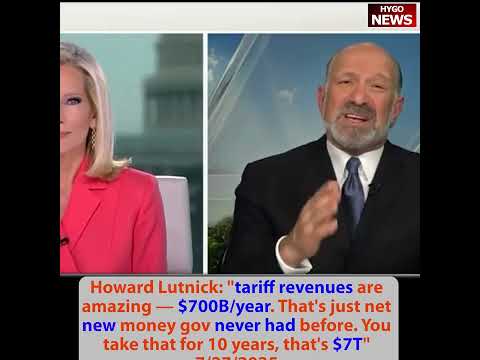
Lutnick: tariff revenues $700B/year, 10 yrs=$7T; EPA reductions $22B grants & $750M staff; CIA
Commerce Secretary Howard Lutnick laid out the administration’s tariff-revenue math at unusually large scale: “$700 billion a year. That’s just net new money the government never had before. So you take that every year for 10 years, that’s $7 trillion.” He added export growth from newly opened foreign markets — Japan, Indonesia, Vietnam — as the additional economic lift. EPA Administrator Lee Zeldin cataloged specific agency-level reductions: staff size dropping from 16,000 to 12,500 ($750 million in savings), $22 billion in grants canceled, $18 million in real estate consolidation, $1 million in canceled media subscriptions, a $4 million Biden-era EPA museum closed. The CIA Director framed the Russia-hoax accountability in criminal-conspiracy terms: “There is no doubt in my mind that the people that we just talked about conspired … Statute of limitations doesn’t start to run until the last act in furtherance of that conspiracy. And Maria, part of why this is so important is the people behind this are still furthering the conspiracy."
"$700 Billion a Year … $7 Trillion”
Lutnick’s framing of the tariff revenue is the operational arithmetic. “So the tariff revenues are amazing, right? $700 billion a year. That’s just net new money the government never had before. So you take that every year for 10 years, that’s $7 trillion.”
$700 billion annualized tariff revenue is the forward-projection the administration has been building toward. Current run rates — earlier figures suggested roughly $5 billion per week, or $260 billion annualized — are still below the $700 billion target. But Lutnick is projecting continued escalation as the August 1 tariff schedule fully kicks in, bilateral deals close, and the compounding effects accumulate.
“Net new money the government never had before” is the specific framing. The tariffs are not replacing other revenue streams. They are additional — revenue that was not previously flowing to the Treasury. That framing is the strongest political argument for tariffs as fiscal policy.
“Every year for 10 years, that’s $7 trillion.” That is the 10-year scoring window that Congressional Budget Office and similar analyses use for fiscal impact. $7 trillion over a decade would cover a substantial portion of the federal deficit, reduce debt service costs, or fund new priorities — depending on allocation.
Market-Opening Growth
“And then what they’re not counting is the way the president is smashing open these markets. You got every market, right? Japan, Indonesia, Vietnam, you name the deal he does. And he opens that market. That’s gonna have export growth, right?”
That is the second-order effect. The tariff revenue is one piece. The export growth from market-opening deals is the additional piece. American agricultural products, industrial goods, and services gaining access to markets that had been protected by foreign tariffs.
“Never before has our ag and our industrials actually had access to these markets.”
That is significant. The bilateral deals — Japan, Indonesia, Vietnam, the pending EU discussion — are specifically opening categories that had been protected. Japanese agricultural protectionism has been a trade irritant for decades. Indonesia’s complex non-tariff barriers have limited U.S. industrial access. The new deals are systematically unwinding those protections.
“You know, we’re meeting later today with the European Union. You know, the president’s goal, get those markets open for Americans to export to them.”
The EU discussion is the big one. Europe’s combined agricultural and industrial market is larger than Japan’s. Opening it to American exports — beef, pork, GMO crops, pharmaceuticals, tech products — would represent the largest market-access win of the cycle.
”That Growth Is Going to Pay for Everything”
“And that growth, that growth is going to pay for everything. It makes Americans richer. And of course, our tax revenues go up the right way by Americans making more money by winning in business.”
That is the virtuous cycle Lutnick is describing. Tariff revenue provides new fiscal resources. Export growth produces higher American incomes. Higher incomes generate higher tax revenues through the existing income tax code. All three revenue streams reinforce each other.
That framing is the counter-argument to the standard Laffer-curve objection (that tariffs reduce economic activity and therefore reduce tax revenue). Lutnick’s argument: specific bilateral deals that open foreign markets more than offset the domestic inefficiency tariffs might create. Net-net, the U.S. economy grows.
EPA Administrator Zeldin’s Cuts
EPA Administrator Lee Zeldin detailed the specific agency-level reductions. “When I came in, our staff size was over 16,000. That number is in the process of going down to 12 and a half thousand. That right there is a savings of about $750 million.”
Staff reductions from 16,000 to 12,500. A ~22% reduction in headcount. $750 million in annual personnel cost savings. That is a substantial shrinkage of the EPA workforce.
The staff reductions reflect the administration’s theory that the EPA has grown beyond its statutory mission. Many of the roles being eliminated were categorized by the administration as non-statutory — climate work, environmental justice programs, DEI coordinators, certain research functions.
“I was just talking about the $22 billion that I canceled in grants. We’re saving $18 million a year in a real estate consolidation, removing personnel from the Reagan building.”
$22 billion in grants canceled. $18 million per year in real estate consolidation from removing personnel from the Reagan Building (one of DC’s most expensive federal real estate locations).
“Just by canceling certain media contracts that we have or closing down an EPA museum that no one visited, we are continuing to find efficiencies.”
$1 million in canceled media subscriptions. A $4 million Biden-era EPA museum closed. These are smaller but symbolically important items — the kind of discretionary spending that accumulates across a federal agency over years.
”We Are Still Able to Fulfill Our Statutory Obligations”
“And everything that I just described, all of that stuff goes away. We are still able to fulfill our statutory obligations and the power of the great American comeback.”
That is the key defensive point. The cuts do not compromise the EPA’s core mission of ensuring clean air, clean water, and regulatory enforcement. The cuts eliminate activities the EPA was doing beyond its statutory mandate.
“We will do everything in our power to deliver clean air, land and water for all Americans, while also being cognizant to what the Trump mandate is.”
The Trump mandate, per Zeldin, is economic consideration. “Last November, voters said that they want an agency like EPA to be cognizant of their economic concerns as well and to apply common sense.”
That is the framing of the 2024 election as including a mandate on environmental regulation. Voters did not vote for zero environmental protection. They voted for environmental protection that does not destroy economic activity — regulations that balance environmental goals with energy affordability, manufacturing competitiveness, and consumer prices.
“That means we’ll help unleash energy dominance, advance cooperative federalism, pursue permitting reform, help make America the AI cap of the world and bring back American auto jobs while we are at it.”
Five specific policy threads: energy dominance, cooperative federalism (working with states rather than overriding them), permitting reform (faster approvals), supporting AI infrastructure (data center power), and restoring American auto manufacturing.
“We will both protect the environment and grow the economy. We choose both. It’s not a binary choice.”
That is Zeldin’s core argument. Environmental protection and economic growth are not in opposition. They can be pursued simultaneously with the right regulatory framework.
CIA Director on the Conspiracy
The CIA Director — context suggests John Ratcliffe — then framed the Russia-hoax accountability in legal-conspiracy terms. “There is no doubt in my mind that the people that we just talked about conspired. They conspired against President Trump. They conspired against the American people.”
“Conspired” is a specific legal term. Conspiracy is the agreement of two or more persons to commit an unlawful act. It is a crime under federal statute. Ratcliffe is explicitly framing the Obama-Clinton-Brennan-Comey-Clapper coordination as conspiracy, not merely institutional misconduct.
“And so I’ll leave it to Pam Bondi and our department of justice, Kashpatel and our FBI to investigate the conspiracy to do what and what charges they’re capable of bringing.”
The procedural path. Ratcliffe is not pursuing prosecutions himself — as CIA Director, he does not have prosecutorial authority. That authority resides with Attorney General Pam Bondi and the FBI under Director Kash Patel. Ratcliffe is, however, providing the intelligence-community assessment that the conduct meets the legal standard for conspiracy.
Statute of Limitations
“But again, I don’t think statute of limitations are going to impact because in the conspiracy, Maria, the statute of limitation doesn’t start to run until the last act in furtherance of that conspiracy.”
That is a legally significant point. Federal conspiracy charges have a statute of limitations — typically five years for most offenses. But the statute does not begin running until the conspiracy ends. If the conspiracy is ongoing, the clock has not started.
“And Maria, part of why this is so important is the people behind this are still furthering the conspiracy. They’re refusing to admit or acknowledge what they did in 2016 and what they did in 2020. It was wrong.”
That is the key claim. The conspiracy, per Ratcliffe, is still ongoing. The original conspirators are continuing the cover-up — refusing to acknowledge what they did, defending the false narrative, attacking the current administration’s efforts to reveal the truth.
If that characterization holds, the statute of limitations has not begun to run. Every day the conspiracy continues is a day the legal clock remains frozen. Prosecutions can be brought at the point the cover-up ends — not at the point the original acts occurred.
”Still Furthering the Conspiracy”
“So I think that’s why this is so important and why I’m excited about what the American people will see very shortly and what’s to continue to come.”
That is Ratcliffe’s forward-looking commitment. More information is coming. The American people will see “very shortly” what has been suppressed for nearly a decade. The declassification campaign that Gabbard initiated is not a single event. It is an ongoing release.
Three Streams, One Administration
Lutnick on revenue. Zeldin on cuts. Ratcliffe on conspiracy. Three different tracks that together capture the administration’s current operational tempo.
Revenue: $700 billion per year, $7 trillion over a decade, plus export growth.
Cuts: $22 billion in grants canceled, 3,500 EPA staff eliminated, real estate consolidation, discretionary program eliminations.
Conspiracy: Obama-era officials facing potential federal conspiracy charges, with the legal clock not yet started because the conspiracy is ongoing.
Each stream reinforces the others. Revenue increases make room for budget flexibility. Cuts reduce the fiscal burden. Conspiracy prosecutions restore accountability. The common theme: the administration is operating aggressively across multiple institutional dimensions simultaneously.
Key Takeaways
- Commerce Secretary Howard Lutnick: “$700 billion a year … for 10 years, that’s $7 trillion” in tariff revenue — plus export growth from “smashing open these markets … Japan, Indonesia, Vietnam.”
- EPA Administrator Lee Zeldin: staff reduced from 16,000 to 12,500 ($750M savings), $22 billion in grants canceled, $18M in real estate consolidation, Biden-era EPA museum closed.
- Zeldin: the EPA will “both protect the environment and grow the economy. We choose both. It’s not a binary choice.”
- CIA Director on Russia-hoax accountability: “There is no doubt in my mind that the people that we just talked about conspired. They conspired against President Trump. They conspired against the American people.”
- On statute of limitations: “The statute of limitation doesn’t start to run until the last act in furtherance of that conspiracy … the people behind this are still furthering the conspiracy.”