 HYGO News
 Lutnick: Japanese bought down tariff rate, loan America choose projects; Bessent not fire Powell
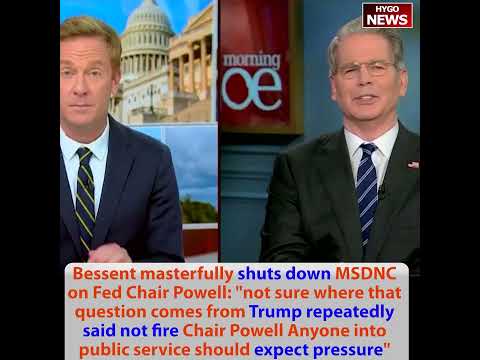
Lutnick: Japanese bought down tariff rate, loan America choose projects; Bessent not fire Powell
Commerce Secretary Howard Lutnick revealed the extraordinary structural mechanism of the Japan trade deal. Japan will finance — equity, loans, and loan guarantees — American strategic manufacturing projects that the U.S. selects. Example: antibiotics. “We don’t make antibiotics in America. So the president says, let’s go make antibiotics in America. The Japanese will finance the project and then we’ll give it to an operator who’ll run it and the profits will be split 90% to the taxpayers of the United States of America and 10% to the Japanese.” $100 billion worth of semiconductor fabs. Pharmaceutical capacity. Other strategic categories. “They basically bought down their tariff rate by this commitment of we will back what you the president want and you America want to build in America.” Treasury Secretary Scott Bessent shut down a question about firing Fed Chair Jerome Powell: “I’m not sure where that question comes from, because President Trump has repeatedly said he’s not going to fire chair Powell.” And Bessent confirmed the inflation posture: “The worst predictions … have not turned out to be the case so far … Amazon CEO … they’re not seeing any price increases.”
The Japan Structural Innovation
Lutnick’s explanation of the Japan deal is the operational reveal. The deal is not merely tariff rates and purchase commitments. It is a structural financing mechanism. “So the Japanese are going to give America the ability to choose the projects, decide the projects and execute the projects.”
America chooses. America decides. America executes. Japan finances.
“So let’s say we want to build generic pharmaceuticals, right? We don’t make antibiotics in America. So the president says, let’s go make antibiotics in America. The Japanese will finance the project and then we’ll give it to an operator who’ll run it and the profits will be split 90% to the taxpayers of the United States of America and 10% to the Japanese.”
That is a specific example with specific economics. Antibiotic manufacturing — a critical national security capability that has been hollowed out of the U.S. — gets financed by Japan, operated by an American company, and produces profits split 90-10 in favor of U.S. taxpayers. Japan takes the credit risk and the 10% profit share. The U.S. gets the capacity, the operator, and the 90% of the profit.
”Bought Down Their Tariff Rate”
“So they basically bought down their tariff rate by this commitment of we will back what you the president want and you America want to build in America that are key to national security concerns, we’ll back that and therefore we’ll be on your side.”
“Bought down their tariff rate” — that is the economic logic. Japan was facing a specific tariff imposition under the Trump tariff regime. Rather than accept the tariff as a cost of doing business, Japan negotiated an alternative: lower tariff rates in exchange for massive financing commitments to U.S. strategic manufacturing.
For Japan, the deal makes sense on multiple grounds:
- Lower tariffs on Japanese exports to the U.S. (maintains market access).
- Direct investment in American manufacturing (generates U.S. political goodwill and economic stability).
- 10% profit share on the underlying manufacturing projects (returns some economic value to Japan on the capital deployed).
- Strategic alignment with the U.S. on national security manufacturing (positions Japan as a key ally in industrial decoupling from China).
For the U.S., the deal is transformative:
- Strategic manufacturing capacity restored (antibiotics, semiconductors, pharmaceuticals).
- Japanese capital deployed without being U.S. taxpayer obligations.
- 90% of profits retained by U.S. taxpayers.
- Industrial policy executed at scale without U.S. federal budget impact.
”Equity, Loans, and Loan Guarantees”
Lutnick clarified that the financing is not just loan guarantees. “The prime minister, Ashiba, says these are loan guarantees. Is it more than that? Of course it’s more than that. It’s equity, loans and loan guarantees. They have to deliver the project.”
That distinction matters. Loan guarantees would mean Japan absorbs the downside risk of U.S. financed projects. Full equity participation means Japan actually deploys capital into the projects as an investor. The Japanese commitment is not a backstop. It is direct capital deployment.
“So we say, let’s build semiconductors. We want to build a hundred billion dollars worth of semiconductor fabs, is what you call them, because we want to make those chips in America. The Japanese will finance that whole project. They’ve got to put that equity, loans, whatever they want to do, they have to deliver the hundred billion.”
$100 billion of semiconductor fabs. That is the scale being discussed for just one industry. Semiconductor fabs — the advanced manufacturing facilities that produce chips — cost anywhere from $10-20 billion each at the cutting edge. $100 billion would fund somewhere between 5 and 10 fabs, all built in the U.S. with Japanese financing.
The Industrial-Policy Implication
What Lutnick is describing amounts to industrial policy at unprecedented scale. The U.S. chooses the priorities — antibiotics, semiconductors, whatever the president determines is strategic. Japan pays for the execution. American operators run the facilities. Profits flow overwhelmingly to U.S. taxpayers.
That model resolves what has been the central problem of American industrial policy: the lack of willing capital. Private capital markets do not efficiently fund long-lead-time strategic manufacturing projects. Federal budget financing for such projects runs into congressional bottlenecks and partisan opposition. The Japanese commitment provides the missing capital, unconditioned on U.S. budget decisions.
If this structure can be replicated with other major trading partners — South Korea, Taiwan, the EU, potentially others — the U.S. could execute a massive industrial rebuild without direct federal taxpayer financing.
Bessent Shuts Down the Powell Question
A reporter pressed Bessent on the Fed chair question. “Should the president just simply say, I’m going to let the Fed chair finish his term? Wouldn’t that supply a degree of comfort and stability to the markets that seem to rattle every time the president suggests the power should we go?”
Bessent’s response was direct. “I’m not sure where that question comes from, because President Trump has repeatedly said he’s not going to fire chair Powell. He might like for him to resign, but he’s not going to fire him. He said that on numerous occasions. I think he may have even said it again yesterday.”
That is the distinction Trump has been drawing. He would like Powell to resign. He is not going to fire him. Those are different operational stances. The market commentary has conflated them, treating Trump’s criticism of Powell as a removal threat when Trump has repeatedly disclaimed actual removal plans.
“The pressure, if that’s the case, then you think the pressure campaign, which is a fairly incessant pressure campaign from the president on the Fed chair, is that a good thing for the stability of the nation’s economy?”
Bessent’s reply. “I think anyone who goes into public service should expect pressure. I get pressure from the president, from the Congress, from constituents. I put pressure on myself. So I think everyone’s used to that. Chair Powell’s been around a long time.”
“Chair Powell’s been around a long time” is Bessent’s shorthand for the idea that Powell is a seasoned official who has handled pressure before. The implicit framing: the Fed chair’s role is not a protected one. The chair is subject to the same kinds of political pressure that every other senior federal official experiences. Powell’s institutional cocoon — the Fed’s historic independence — does not immunize him from the pressure environment that defines senior Washington service.
”The Worst Predictions Have Not Turned Out to Be the Case”
Bessent then addressed the inflation picture directly. “The worst predictions that inflation was going to be fueled by this new terrorist regime have not turned out to be the case so far.”
“Terrorist regime” is clearly Whisper’s garbled rendering of “tariff regime.” Bessent’s substance: the worst inflation predictions — that tariffs would drive significant price increases — have not materialized.
The August Tariff Escalation
The reporter pressed on the upcoming tariff increases. “Are you confident that even as new tariffs go into place on August 1st, on August 12th, that there will not be an effect that Americans are going to see when they try to buy a car or Christmas goods, toys or dolls or anything else?”
Bessent’s response. “I think what we’ve seen so far is that the manufacturers have been eating it, or the exporters have been taking a lot of the price or the tariff adjustment. I think we’re also seeing a lot of the retailers margins got very fat during COVID, so I think some of them are absorbing it.”
That is the structural explanation. Tariff pass-through to consumer prices has been muted because:
- Foreign manufacturers have been absorbing the tariff cost rather than passing it through.
- Foreign exporters have been adjusting their prices downward to remain competitive.
- U.S. retailers, whose margins expanded during COVID-era price-increase cycles, have been absorbing some of the tariff pass-through rather than passing it fully to consumers.
Each of those mechanisms represents a buffer between the tariff policy and consumer prices. The administration is betting those buffers can be sustained through the 2025 tariff escalation.
”Amazon CEO … Not Seeing Any Price Increases”
“I was with the Amazon CEO last week, and he said thus far they’re not seeing any price increases. Thus far, we’ve seen very good inflation numbers this year.”
Amazon’s operational read matters because Amazon has the most real-time, most aggregated view of consumer pricing across millions of product categories. If the Amazon CEO — Andy Jassy — tells the Treasury Secretary that Amazon is not seeing price increases, that is a significant piece of corroborating data for the broader inflation argument.
The alternative scenarios — price increases concentrated in specific categories, price increases timed to holiday shopping season, price increases on specific imported product categories — remain possible. But the aggregate signal, from the retailer best positioned to see it, is that consumer price increases have not materialized at the scale critics predicted.
The Japan Deal and the Fed Critique
Separately, the Japan deal and the Fed critique are linked in ways the administration has been making explicit. The Japan deal provides the capital financing for American manufacturing capacity without requiring Fed rate cuts, federal subsidies, or budget appropriations. The Fed critique argues that lower rates should further accelerate the broader capital-allocation environment.
Together, they represent the administration’s theory of industrial policy at scale: private-international financing for strategic categories (via bilateral trade deals), combined with lower domestic rates (to reduce the cost of all other capital investment), combined with tariff revenue (to maintain fiscal balance and reduce taxes). Three levers. Each working toward the same reshoring and economic-strength objective.
Key Takeaways
- Commerce Secretary Howard Lutnick: the Japan deal provides “equity, loans and loan guarantees” for U.S. strategic manufacturing — “90% to the taxpayers of the United States of America and 10% to the Japanese.”
- Examples: antibiotic manufacturing (“We don’t make antibiotics in America”), $100 billion in semiconductor fabs, plus other strategic categories the president selects.
- “They basically bought down their tariff rate by this commitment of we will back what you the president want and you America want to build in America that are key to national security concerns.”
- Treasury Secretary Scott Bessent shut down Fed-firing speculation: “President Trump has repeatedly said he’s not going to fire chair Powell. He might like for him to resign, but he’s not going to fire him.”
- Bessent on tariffs: “The worst predictions that inflation was going to be fueled by this new [tariff] regime have not turned out to be the case … Amazon CEO … they’re not seeing any price increases.”