 HYGO News
 'Look it was a different time then' buy oil at $70 instead of $24 in 2020, Dems blocked Trump ReFill
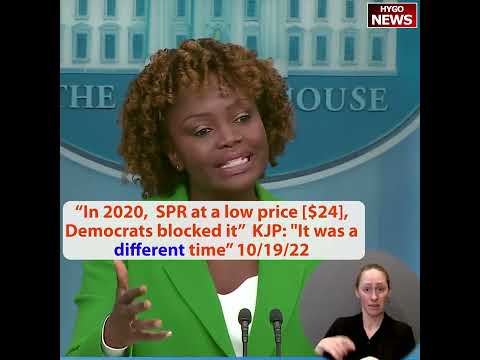
KJP Stumbles Through Question on Why Democrats Blocked Trump From Buying Oil at $24 but Biden’s $70 Plan Is “a Good Deal” — “It Was a Different Time”
On 10/19/2022, a reporter asked White House Press Secretary Karine Jean-Pierre to explain why Democrats blocked President Trump from filling the Strategic Petroleum Reserve at roughly $24 per barrel in 2020, calling it a “bailout for big oil,” but now President Biden’s plan to refill at $70 per barrel was “a good deal for taxpayers.” The exchange became a masterclass in miscommunication as KJP initially misunderstood the question, needed it repeated three times, then said Trump was “trying to sell it at $20 per barrel” before being corrected that he was trying to buy it. Her final answer — “it was a different time then” and “the reserve was close to full capacity” — failed to address the core question of why buying oil at three times the price was a better deal for taxpayers.
Three Attempts to Ask One Question
The reporter’s question was straightforward, but KJP needed three attempts to understand it. “Back in 2020, when Congress was debating funding for replenishing the SPR, Democrats blocked it, saying it was a bailout for big oil,” the reporter said. “Why is it a good deal for taxpayers now?”
KJP began answering an entirely different question. “Well, right now we are dealing — again, I laid out what the Strategic Petroleum was created for,” KJP said — launching into an explanation of why the SPR was being tapped rather than why refilling at $70 was better than the $24 Democrats rejected.
The reporter interjected. “I was referring to the purchasing of the oil at $70 per barrel to replenish it,” the reporter clarified.
KJP laughed. “Oh, I’m sorry, I thought you were meaning like why would we tap,” KJP said.
“No, no, no — I mean the replenishing at a lower price,” the reporter said.
“So can you say your question one more time, so I hear it properly?” KJP asked — making it the third time the reporter would need to explain what was, in its first iteration, a perfectly clear question.
”When Donald Trump Was Trying to Sell It”
When KJP finally grasped the question, she got the basic facts wrong. “Yeah, I know exactly what you’re talking about. You’re talking about when Donald Trump was trying to sell it at $20 per barrel,” KJP said.
“To buy it, I guess,” the reporter corrected.
“Yeah, to buy it,” KJP acknowledged.
The correction was more than a verbal slip. The confusion between buying and selling the SPR reflected a fundamental unfamiliarity with the 2020 episode the reporter was asking about. Trump had proposed purchasing cheap oil to fill the reserve during the pandemic price crash — the exact opposite of selling. KJP’s initial characterization suggested either she didn’t know the history or was working from talking points that didn’t address the actual question.
”It Was a Different Time”
KJP’s substantive answer — such as it was — offered two defenses. “Look, it was a different time then. It was not the same situation that we are currently in,” KJP said. “The reserve was close to full capacity at that time. And so, there was no reason to make that type of repurchase.”
Both arguments had significant problems.
The “different time” defense was accurate but unhelpful. Of course 2020 was a different time — oil was at $24 per barrel because the pandemic had cratered demand. The “different time” meant oil was spectacularly cheap, which is precisely why filling the reserve would have been a spectacular deal for taxpayers. Saying “it was a different time” as if that explained why the cheaper option was worse was the opposite of a coherent argument.
The “close to full capacity” defense was factually misleading. In March 2020, the SPR held approximately 635 million barrels against a capacity of roughly 714 million barrels — meaning there was room for approximately 79 million additional barrels. Trump’s proposal was to purchase 77 million barrels to fill the reserve to near capacity. The reserve was not “close to full” in any meaningful sense — it was at 89% capacity with room for a substantial purchase.
Moreover, even if the reserve had been at 95% capacity, purchasing oil at $24 to fill the remaining 5% would still have been dramatically cheaper per barrel than the $70 Biden was now proposing. The capacity argument didn’t change the price comparison.
The Math That Mattered
The reporter’s question rested on simple arithmetic that KJP never addressed:
- 2020: Trump proposed buying oil at approximately $24 per barrel. Democrats blocked it as a “bailout for big oil.”
- 2022: Biden proposed buying oil at $70 per barrel. Biden called it “a good deal for taxpayers.”
The price difference was $46 per barrel — nearly triple the 2020 price. If the government planned to purchase, say, 100 million barrels to refill the reserve, the cost at $24 would have been $2.4 billion. At $70, the same purchase would cost $7 billion — a difference of $4.6 billion in taxpayer money.
The “bailout for big oil” framing that Democrats used in 2020 made no sense in 2022. If purchasing oil at $24 was a bailout for big oil, then purchasing the same oil at $70 was an even larger bailout — oil companies would receive nearly three times as much revenue per barrel. The only consistent position would have been to oppose both purchases, but Biden’s plan required supporting the more expensive one while having rejected the cheaper alternative.
The CARES Act Fight
The 2020 episode was well-documented. During negotiations over the CARES Act in March 2020, Trump and Republicans proposed including $3 billion to purchase oil for the SPR while prices were at historic lows. Senate Democrats, led by Chuck Schumer, objected, calling it a bailout for oil companies. The provision was removed from the final bill.
At the time, Schumer said: “We were able to kill a bailout slush fund for big oil and instead secured more money for our hospitals.” The framing characterized helping American oil producers during a crisis as illegitimate — the same producers Biden would later beg to increase production when prices spiked.
The irony was compounded by the timeline: Democrats blocked cheap oil purchases in 2020, Biden’s policies then contributed to the price surge by discouraging domestic production, Biden then drained the reserve to address the price surge he helped create, and finally proposed refilling the reserve at three times the price Democrats had rejected — all while calling his plan a “good deal for taxpayers.”
The Briefing Room Pattern
The exchange illustrated a recurring KJP briefing room problem: the inability to address historical comparisons that made the administration look inconsistent. When reporters asked questions that required acknowledging past Democratic positions that contradicted current ones, KJP’s responses typically fell into three categories: misunderstanding the question (buying three attempts in this case), getting basic facts wrong (confusing buying and selling), or offering explanations that didn’t address the actual contradiction (“it was a different time”).
The cumulative effect was a press secretary who appeared unprepared for predictable questions about publicly available facts.
Key Takeaways
- KJP needed three attempts to understand a reporter’s question about why Democrats blocked a $24/barrel SPR purchase in 2020 but Biden’s $70/barrel plan was “a good deal.”
- She initially confused buying and selling, saying Trump “was trying to sell it at $20 per barrel” before being corrected.
- Her defense — “it was a different time” and “the reserve was close to full” — didn’t address why paying three times more per barrel was better for taxpayers.
- Democrats called the 2020 purchase a “bailout for big oil” at $24/barrel, then Biden proposed buying from the same industry at $70/barrel.
- The price difference meant the same refill volume would cost taxpayers roughly $4.6 billion more at Biden’s proposed price.
Transcript Highlights
The following is transcribed from the video audio (unverified — AI-generated from audio).
- In 2020, Democrats blocked funding for replenishing the SPR, saying it was a bailout for big oil. Why is it a good deal for taxpayers now?
- I was referring to the purchasing of the oil at $70 per barrel to replenish it.
- Oh, I’m sorry, I thought you were meaning like why would we tap.
- So can you say your question one more time so I hear it properly?
- You’re talking about when Donald Trump was trying to sell it at $20 per barrel. — To buy it, I guess. — Yeah, to buy it.
- It was a different time then. The reserve was close to full capacity. There was no reason to make that type of repurchase.
Full transcript: 203 words transcribed via Whisper AI.