 HYGO News
 Leavitt: Foreign Leader Said Trump Win Was 'Like Lights Turned On in a Dark Room'; Medicaid Work Requirement 20 Hours (Clinton Era Standard); Qatar Plane 'Not Personal Gift -- Correct Your Stories'; OBBB Saves $1.6T
Leavitt: Foreign Leader Said Trump Win Was “Like Lights Turned On in a Dark Room”; Medicaid Work Requirement 20 Hours (Clinton Era Standard); Qatar Plane “Not Personal Gift — Correct Your Stories”; OBBB Saves $1.6T
Press Secretary Karoline Leavitt’s post-trip briefing delivered the administration’s framing of the Middle East results and several domestic priorities in May 2025. A foreign leader had told her about Trump’s 2024 victory: “When President Trump won the election, it was like the lights turned on in a dark room. For the past four years to the rest of the world, America was dark. We were unresponsive. We did not pick up the phone. We did not return calls.” Trump and Melania would sign the TAKE IT DOWN Act against digital exploitation. On Medicaid: “We want to see able-bodied Americans at least working 20 hours per week — these are common-sense provisions introduced by former Democrat President Clinton.” On the Qatar plane: “This is not a personal donation or a gift to President Trump. Everyone who wrote that last week should go and correct their stories — this is a donation to the United States Air Force.” On the One Big Beautiful Bill: “This bill does not add to the deficit. CEA says it will save $1.6 trillion — the largest savings for any legislation in our nation’s history."
"Like Lights Turned On in a Dark Room”
Leavitt opened with a diplomatic anecdote summarizing the Middle East trip.
“I will summarize the president’s trip with an anecdote that I heard directly from a member of one of the foreign delegations,” Leavitt said.
She described the conversation: “I asked him how hopeful their country was when they learned President Trump won the election.”
She quoted the response: “And he told me when President Trump won the election, it was like the lights turned on in a dark room.”
She extended the metaphor: “For the past four years to the rest of the world, America was dark. We were unresponsive. We did not pick up the phone. We did not return calls.”
She stated the change: “All of that has changed under the leadership of this president. And I think the world saw that last week with this historic and wildly successful trip.”
The “dark room” metaphor was politically powerful because it captured a specific criticism of the Biden administration that was broadly shared among America’s allies and partners. The complaint was not just policy disagreement but rather procedural failure: the Biden administration had been unresponsive to foreign capitals’ requests for meetings, consultations, and basic diplomatic engagement.
This pattern had been documented extensively in diplomatic reporting throughout Biden’s term. Foreign ambassadors complained that their calls were not returned. Foreign leaders reported that meetings they had requested had been deferred for months or canceled. Foreign ministries noted that routine diplomatic consultations had become difficult to schedule. The pattern had affected allies as diverse as Japan, France, Saudi Arabia, and India.
The “lights turned on” imagery also captured the contrast with Trump’s approach. Trump administration officials had been aggressively engaged with foreign counterparts from day one. The President himself had made phone calls, conducted meetings, and traveled abroad at a pace that contrasted dramatically with Biden’s declining availability in his final year.
The TAKE IT DOWN Act
Leavitt then previewed the afternoon’s legislative signing.
“This afternoon in the Rose Garden, President Trump, alongside First Lady Melania Trump, will sign the Take It Down Act into law,” Leavitt said.
She credited the First Lady: “First Lady Melania Trump was instrumental in getting this important legislation passed.”
She described the substance: “The Take It Down Act will protect victims of digital exploitation, hold internet platforms accountable by requiring them to remove such imagery from their platforms, and provide justice for victims by allowing prosecutors to go after those who publish non-consensual explicit images online.”
She described Melania’s process: “The First Lady met with members in the House and the Senate, survivors and their families, and advocates throughout the process to get this bill across the finish line.”
The TAKE IT DOWN Act (Tools to Address Known Exploitation by Immobilizing Technological Deepfakes on Websites and Networks Act) was bipartisan legislation that had been in development since 2024. The bill had two main provisions:
Criminal penalties: Federal criminal penalties for publishing non-consensual intimate imagery, including AI-generated “deepfake” intimate imagery. The penalties would apply to both real images shared without consent and fabricated images created using AI.
Platform obligations: Requirements that internet platforms establish notice-and-takedown procedures for non-consensual intimate imagery. Platforms would be required to remove reported imagery within 48 hours of notification.
Melania’s role in advocating for the bill reflected her consistent focus on online harms to children and teenagers. Her “Be Best” initiative during Trump’s first term had focused significantly on cyberbullying and online exploitation. The TAKE IT DOWN Act extended these concerns to the specific problem of non-consensual intimate imagery, which had become increasingly serious with the proliferation of AI-based image generation tools.
The bipartisan support for the bill was notable. In an era of intense partisan polarization, legislation protecting victims of digital sexual exploitation had generated agreement across the political spectrum. Conservative advocates emphasized the protection of families and children. Progressive advocates emphasized women’s dignity and bodily autonomy. Both could support the same legislation.
Medicaid: 20 Hours, Clinton Standard
Leavitt addressed the Medicaid work requirement controversy.
“So the president wants to preserve and protect Medicaid for Americans who this program was intended for,” Leavitt said. “The most vulnerable in our society, pregnant women, low-income families, seniors, those who truly need these benefits.”
She stated the criterion: “And it should be going to people who physically cannot work.”
She described the proposed standard: “We want to see able-bodied Americans at least working 20 hours per week, whether that’s part-time or full-time, whether that’s even looking for work or volunteering for 20 hours a week if they are receiving Medicaid.”
She characterized them as common sense: “These are common-sense provisions. These are common-sense changes that were actually introduced by former Democrat President Clinton. They’ve been supported by every Democrat president since, including the previous president, Joe Biden.”
The Clinton reference was historically precise. The 1996 Personal Responsibility and Work Opportunity Reconciliation Act — signed by Clinton and passed with bipartisan support — had established work requirements for welfare (TANF) receipt. The principle underlying Clinton’s welfare reform — that able-bodied adults receiving public assistance should be required to work, seek work, or engage in qualifying activities — was exactly what Trump’s Medicaid work requirement would extend to Medicaid for able-bodied adults.
Democratic opposition to Medicaid work requirements had frequently characterized them as cruel or punitive. Leavitt’s framing inverted this: if 20-hour weekly work requirements were “cruel” for Medicaid, they were equally “cruel” for TANF under the 1996 welfare reform, which Clinton signed and celebrated. Democrats could not consistently support one while opposing the other.
The specific requirements Leavitt described were also notably flexible. The 20-hour standard could be met by:
- Part-time employment
- Full-time employment (obviously)
- Job searching
- Volunteering
This flexibility meant that almost any able-bodied adult could meet the requirement with modest effort. The requirement would primarily affect people who were able to work but unwilling to engage in any productive activity at all — a relatively small subset of Medicaid recipients.
”$1.6 Trillion Saved — Largest in History”
Leavitt addressed the deficit question on the One Big Beautiful Bill.
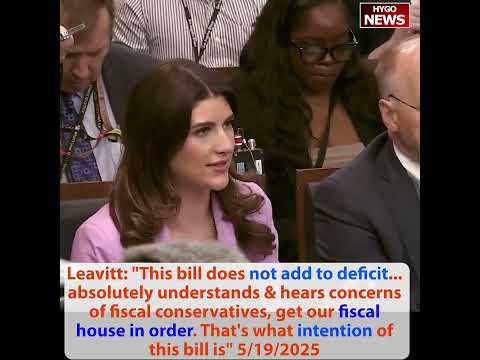
“This bill does not add to the deficit,” Leavitt said. “In fact, according to the Council of Economic Advisors, this bill will save $1.6 trillion.”
She extended the context: “And the president absolutely understands and hears the concerns of fiscal conservatives and of Americans who want to get our fiscal house in order. That’s what the intention of this bill is.”
She made the historical comparison: “There’s $1.6 trillion worth of savings in this bill. That’s the largest savings for any legislation that has ever passed Capitol Hill in our nation’s history. The next bill that even comes close was $800 billion. That’s less than half of the savings that we see in the one big, beautiful bill.”
She stated the goals: “And so the goal of this bill is to produce economic growth, to cut taxes, and to get our fiscal house in order. And this is the right step in the right direction towards doing that.”
The $1.6 trillion savings claim was based on CEA analysis that included:
- Direct spending reductions in various federal programs
- Revenue increases from economic growth produced by tax cuts
- Savings from work requirements and eligibility reforms
- Reductions in Medicaid and other entitlement growth rates
The comparison to previous legislation was historically significant. The $800 billion previous record would have been a specific piece of deficit reduction legislation (possibly referring to the 2011 Budget Control Act or similar). The $1.6 trillion claim, if accurate, would make the One Big Beautiful Bill the most fiscally significant single piece of legislation in American history for deficit reduction purposes.
Critics pointed out that “savings” in CEA analysis often relied on dynamic scoring assumptions about economic growth that were not always realized. Static scoring from the Congressional Budget Office typically produced lower savings estimates than dynamic CEA analysis. The actual deficit impact would depend on whether the tax cuts produced the growth CEA projected, which was uncertain.
The Qatar Plane: “Correct Your Stories”
Leavitt concluded with pointed criticism of media coverage of the Qatar gift.
“I’m glad you brought up this question because I was watching the American press spew a lot of misinformation about the plane donation last week when we were abroad,” Leavitt said.
She laid out the factual basis: “Let’s be very clear. The government of Qatar, the Qatari family, has offered to donate this plane to the United States Air Force, where that donation will be accepted according to all legal and ethical obligations.”
She described the process: “It will be retrofitted to the highest of standards by the Department of Defense and the United States Air Force.”
She made the direct correction: “This plane is not a personal donation or a gift to the President of the United States. And everyone who wrote that last week should go and correct their stories because this is a donation to our country and to the United States Air Force.”
She deflected specific operational questions: “As for a timeline, because it is the United States Air Force that is accepting the plane, I would defer you to them for specifics because the President, frankly, has nothing to do with it. That is the United States Air Force’s project to take on.”
The factual correction Leavitt was demanding was significant. Much of the week’s media coverage had framed the Qatar gift as a “$400 million jet to Trump” or similar personal gift framing. Leavitt’s correction was that the plane was being donated to the United States government — specifically the Air Force — rather than to Trump personally. The distinction had legal implications: personal gifts to presidents from foreign governments raised constitutional emoluments issues, while gifts to the United States government were routine and accepted under standard procedures.
The “everyone who wrote that last week should go and correct their stories” demand was aggressive but defensible. If the coverage had characterized the gift incorrectly, the correct journalistic response was indeed to issue corrections. The fact that corrections were not issued suggested either that the coverage had been substantially correct (and Leavitt’s framing was the spin), or that outlets were unwilling to correct politically useful but factually inaccurate framing.
Key Takeaways
- Foreign leader to Leavitt: “Trump win was like lights turned on in a dark room. For four years, America was dark, unresponsive.”
- TAKE IT DOWN Act signing: Melania “instrumental” — protects victims of digital exploitation, AI deepfakes.
- Medicaid work requirement: 20 hours/week able-bodied — “Clinton-era standard, supported by every Democrat president since.”
- OBBB saves $1.6 trillion (CEA) — “largest savings for any legislation in our nation’s history, next closest was $800B.”
- Qatar plane: “Not personal gift to Trump. Donation to US Air Force. Everyone who wrote otherwise should correct their stories.”