 HYGO News
 Leavitt: US Institute of Peace Bureaucrats 'Barricaded Themselves' to Block DOGE; Activist Judges 'Slow Roll' Trump Agenda
Leavitt: US Institute of Peace Bureaucrats “Barricaded Themselves” to Block DOGE; Activist Judges “Slow Roll” Trump Agenda
Press Secretary Karoline Leavitt used a March 2025 briefing to expose what she called a “resistance from bureaucrats who don’t want to see change.” She detailed how staff at the United States Institute of Peace had physically barricaded themselves inside the building, disabled telephone lines, internet connections, and IT infrastructure, and contacted police to prevent DOGE personnel and political appointees from entering. Leavitt also cited falling gas prices across 34 states and attacked activist judges for issuing injunctions against deportations, federal employee firings, and military readiness decisions, calling it “ridiculous lawfare.”
The USIP Barricade: “A Little Bit Wild”
The exchange began when a reporter laid out the dramatic sequence of events at the United States Institute of Peace.
“This is a little bit wild,” the reporter said. “I understand the old president refused to leave after he was removed from his position. He barricaded himself in his offices, had to be escorted out by police, left the building without Wi-Fi, telephones, elevators, and more, and is now telling media that DOGE broke in and illegally removed him.”
Leavitt was ready with the administration’s account: “I’m really glad you brought this up, Mary. We were made aware of this story by individuals at DOGE, at Elon Musk’s team, and also at the State Department, who were unable to access this building.”
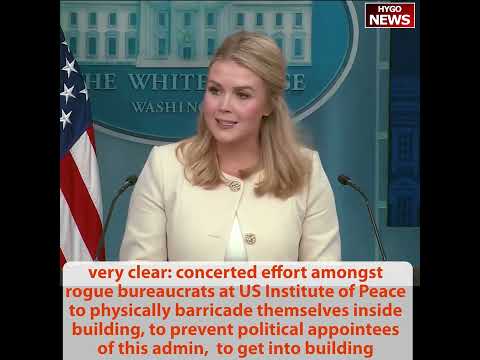
She then described what the administration had found: “And it became very clear that there was a concerted effort amongst the rogue bureaucrats at the United States Institute of Peace to actually physically barricade themselves essentially inside of the building to prevent political appointees of this administration, who work at the direction of the President of the United States, to get into the building.”
The details were specific and damning. “Staff contacted the NPD in an attempt to prevent DOGE personnel from entering,” Leavitt said. “They barricaded the doors. They also disabled telephone lines, internet connections, and other IT infrastructure within the building. They distributed flyers internally, encouraging each other to basically prevent these individuals from accessing the building.”
Leavitt credited the Daily Caller for breaking the story accurately: “There was a piece in the Daily Caller — thank you for sharing the truth on this — about what happened."
"This Is What DOGE Is Facing”
Leavitt used the USIP incident as a case study for the broader resistance the administration was encountering.
“I use this to say this is what DOGE and this administration is facing,” Leavitt said. “It’s a resistance from bureaucrats who don’t want to see change in this city.”
The characterization was pointed. The staff at USIP had not filed lawsuits, organized protests, or written opinion pieces. They had physically occupied a government building, sabotaged its infrastructure, and called police to prevent presidentially appointed officials from entering. In Leavitt’s framing, this was not civil disobedience or legitimate dissent — it was bureaucratic insurrection.
“President Trump was elected on an overwhelming mandate to seek change and implement change,” Leavitt said. “And this is unacceptable behavior.”
The USIP incident was particularly useful for the administration’s narrative because the United States Institute of Peace was not a well-known agency to most Americans. Its very obscurity made it a perfect example of the kind of government entity that existed without clear public accountability, employed staff who viewed their positions as permanent regardless of who occupied the White House, and reacted to oversight with hostility rather than cooperation.
The fact that the departing president of the institute had to be “escorted out by police” after being removed from his position — and then told media that DOGE had “illegally removed him” — captured the inversion of authority that the administration was confronting. Officials who served at the pleasure of the president were behaving as though the president served at their pleasure.
Gas Prices: 34 States Under $3
Leavitt transitioned to economic news, delivering data points that reinforced the administration’s narrative of improving conditions.
“Gas prices across the U.S. have fallen for the fourth straight week,” she said. “34 states now seeing gas under $3 a gallon.”
When a reporter asked whether a limited ceasefire with Ukraine regarding oil refineries and energy would affect domestic gas prices, Leavitt connected the specific question to the broader energy strategy.
“It’s certainly the President’s hope that gas prices will continue to fall, and he’s working every single day to ensure that they do,” Leavitt said. “As you just mentioned, there’s been very encouraging data. Inflation is cooling and gas prices are falling.”
She then laid out the institutional framework: “The President has established a National Energy Dominance Council, and it’s ultimately the President’s goal — and this administration is working hard on it every single day — to increase our energy production right here in the United States of America, to have a Trump energy boom like we saw in our first term.”
Leavitt connected energy policy to the broader economic picture: the energy boom “will not only lead to lower fuel prices here at home, but also lessen the rate of inflation that was created by the previous administration.”
The “National Energy Dominance Council” was a deliberate escalation in language from the traditional “energy independence” framing. Independence meant not relying on foreign energy; dominance meant becoming the world’s leading energy producer and exporter. The distinction reflected the administration’s ambition to use American energy not just as a domestic economic tool but as a geopolitical weapon.
Activist Judges: “Ridiculous Lawfare”
Leavitt saved her most forceful argument for the judicial resistance the administration was facing.
“It’s a clear effort by these judges to slow roll this President’s agenda,” she said.
She then cataloged the specific injunctions to illustrate the breadth of judicial overreach: “And if you just look at the injunctions that this President has faced — deporting foreign terrorists from our homeland, hiring and firing of executive branch employees, which when the President is the executive of the executive branch.”
The third example was the most provocative: “You also see an injunction by a partisan activist judge when it comes to the Secretary of Defense trying to determine the readiness of our troops and the qualifications of our troops and our armed forces.”
Leavitt posed the constitutional question in its starkest form: “Does a single district court judge really have more authority over the commander in chief and the Secretary of Defense to determine who should serve in our United States armed forces? Absolutely not.”
She concluded: “Anyone who has taken a basic civics lesson can understand that. It’s ridiculous lawfare that we are witnessing.”
The argument was structured to build from the most obviously defensible position (deporting terrorists) through a moderate one (the president’s hiring and firing authority) to the most constitutionally potent (military readiness). By the time Leavitt reached the military example, the pattern was clear: judges were not just blocking policy preferences — they were inserting themselves into core executive and commander-in-chief functions that the Constitution assigned exclusively to the president.
Bureaucratic Resistance Meets Judicial Resistance
The briefing’s three threads — the USIP barricade, falling gas prices, and judicial injunctions — painted a picture of an administration making tangible progress on the economy while fighting simultaneous resistance from bureaucrats who physically blocked their offices and judges who legally blocked their policies.
The juxtaposition was deliberate. The USIP incident showed what happened when unelected officials decided to resist democratically elected authority with physical obstruction. The judicial injunctions showed what happened when unelected judges decided to resist with legal obstruction. And the gas price data showed what happened when the administration was allowed to implement its agenda: prices fell, conditions improved, and the public benefited.
Leavitt’s message was that the administration would prevail on all three fronts. The barricaded bureaucrats would be removed. The activist judges would be overruled. And the energy policies would continue producing results. The only question was how much time and taxpayer money would be wasted by those attempting to prevent the president from governing.
Key Takeaways
- Leavitt revealed that USIP staff barricaded themselves inside the building, disabled phones and internet, distributed flyers, and called police to prevent DOGE personnel and political appointees from entering.
- She called the resistance “unacceptable behavior” from “rogue bureaucrats who don’t want to see change.”
- Gas prices fell for the fourth straight week, with 34 states under $3/gallon; Leavitt cited the National Energy Dominance Council as the framework for a “Trump energy boom.”
- She cataloged judicial injunctions blocking deportations, federal employee firings, and military readiness decisions, calling it a “clear effort by activist judges to slow roll this President’s agenda.”
- Leavitt asked: “Does a single district court judge really have more authority over the commander in chief to determine who should serve in our armed forces? Absolutely not.”