 HYGO News
 Leavitt: 'Trump Punches Back Harder' -- 104% China Tariffs at Midnight; 'Phones Ringing Off the Hook'; No Delay
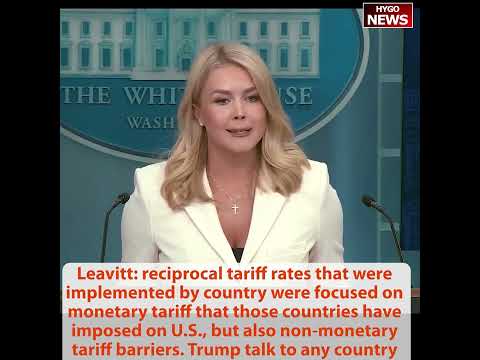
Leavitt: “Trump Punches Back Harder” — 104% China Tariffs at Midnight; “Phones Ringing Off the Hook”; No Delay
Press Secretary Karoline Leavitt announced in April 2025 that 104% tariffs on China would take effect at midnight, declaring: “It was a mistake for China to retaliate. When America is punched, this president punches back harder.” She relayed Trump’s message that “if China reaches out to make a deal, he’ll be incredibly gracious” but that “he believes China has to make a deal.” Leavitt confirmed that 70+ countries were calling to negotiate — “the phones have been ringing off the hook” — that the tariff rates accounted for both monetary and non-monetary barriers, and that Trump was “not considering an extension or delay."
"Punches Back Harder”
Leavitt addressed the question of what had triggered the escalation to 104%.
“I just spoke to the president about this,” Leavitt said. “He believes that China wants to make a deal with the United States. He believes China has to make a deal with the United States.”
She described the dynamic: “It was a mistake for China to retaliate. The president, when America is punched, he punches back harder. That’s why there will be 104% tariffs going into effect on China tonight at midnight.”
China had responded to the Liberation Day tariffs with retaliatory tariffs of its own on American goods. The Trump administration’s response was not proportional — it was escalatory. The 104% rate was designed to be so punitive that continuing the retaliatory cycle would be economically devastating for China, which depended on the American consumer market far more than the United States depended on Chinese products.
Leavitt relayed Trump’s personal message: “The president believes that Xi and China want to make a deal. They just don’t know how to get that started.”
Then the olive branch: “And the president also wanted me to tell all of you that if China reaches out to make a deal, he’ll be incredibly gracious. But he’s going to do what’s best for the American people.”
The combination of maximum pressure and open negotiation was the administration’s signature diplomatic approach. The 104% tariff was the stick; the promise of “incredible graciousness” was the carrot. China’s leadership could choose between escalation that would cripple its export economy or negotiation that could produce a workable trade relationship. Trump was offering both options and making clear which one he preferred.
Monetary and Non-Monetary Barriers
When a reporter asked about the methodology behind country-specific tariff rates — particularly for smaller nations like Madagascar and Bangladesh — Leavitt provided the most detailed explanation yet.
“The reciprocal tariff rates that were implemented by country were focused on the monetary tariff that those countries have imposed on the United States, but also the non-monetary tariff barriers,” she said. “And the regulations, if you will, that have been put into effect over the years, making it harder for America to export to these countries.”
She emphasized the rigor: “These were very carefully crafted numbers.”
She noted the baseline: “There was also a 10 percent baseline tariff across the board.”
The distinction between “monetary” tariffs (the explicit percentage charged on imports) and “non-monetary” barriers (regulations, quotas, standards, bureaucratic obstacles, and other practices that effectively blocked American products) was critical to understanding why some country-specific rates appeared disproportionate. A country might charge a low official tariff but maintain regulatory barriers that made American products effectively impossible to sell in its market. The reciprocal tariff calculation factored in both forms of trade restriction.
”Phones Ringing Off the Hook”
Leavitt described the diplomatic dynamic the tariffs had created.
“Moving forward, the president will talk to any country that picks up the phone to call,” she said. “And I can tell you, the phones have been ringing off the hook, wanting to talk to this administration, this president and his trade team, to try to strike a deal.”
She explained the leverage: “And it’s because the world knows that they need the United States of America. They need our markets. They need our consumer. The president has a lot of leverage on his side because he has the best economy and the best country in the world that he leads, and he knows that.”
Leavitt concluded: “And it’s about dang time we finally have a president who uses that economic leverage to benefit American workers. And that’s what the president is trying to do.”
The “phones ringing off the hook” detail was the most important indicator of the tariff strategy’s success. The purpose of the tariffs was not to collect revenue or punish trading partners permanently — it was to force negotiations. If every country was calling to negotiate, the tariffs were working exactly as designed. The pain of the tariffs was creating the urgency for deals that would produce a fairer trading system.
Reconciliation and the Legislative Agenda
Leavitt pivoted to domestic politics, connecting the tariff agenda to the congressional legislative calendar.
“The president will be meeting with Republican lawmakers today here at the White House to talk to them about the framework that the Senate passed,” she said. “The president was very quick to put out a statement about his support for the reconciliation package that the Senate passed, and he is counting on House Republicans to pass it.”
She described the mandate: “The Republicans received an overwhelming mandate from the American public to govern. We have an extraordinary opportunity.”
Leavitt listed the reconciliation bill’s priorities: “Tax cuts, securing the border, deregulation, unleashing the might of American energy. These are good things for the American people. The president wants to see this get done, and that’s why he’s engaging with lawmakers today.”
The meeting with Republican lawmakers during the tariff turmoil served a dual purpose. It demonstrated that the president was not consumed by the trade war to the exclusion of domestic legislation. And it applied presidential pressure on House Republicans who might be wavering on the reconciliation bill due to market anxiety.
”Not Considering an Extension or Delay”
The most watched question was whether the administration might pause or delay the tariffs in response to market pressure.
Leavitt was unequivocal: “He said he’s not considering an extension or delay. I spoke to him before this briefing. That was not his mindset. He expects that these tariffs are going to go into effect.”
She then reframed the reporter’s observation: “You said something very important in your question — you said the president has captivated the attention of the world. Absolutely he has.”
Leavitt concluded: “And it’s about time we have a president in the Oval Office who is putting the world on notice and is putting the American people first, and again, is using the leverage of the United States to negotiate good trade.”
The “not considering an extension or delay” statement was the most market-relevant line in the briefing. Investors and foreign governments who hoped the administration would blink in the face of market turbulence received their answer: the tariffs were proceeding as announced. There would be no pause, no delay, no modification in response to market pressure. The only path to tariff relief was negotiation — and the negotiation had to address the trade deficit.
Key Takeaways
- 104% tariffs on China taking effect at midnight: “It was a mistake for China to retaliate. Trump punches back harder.”
- Trump’s message to China: “If they reach out to make a deal, he’ll be incredibly gracious. They just don’t know how to get that started.”
- 70+ countries calling to negotiate: “The phones have been ringing off the hook.”
- Tariff rates accounted for both monetary tariffs and “non-monetary barriers and regulations” — “very carefully crafted numbers.”
- Trump “not considering an extension or delay” — expects tariffs to go into effect as announced; meeting with House Republicans on reconciliation bill.