 HYGO News
 Leavitt: Trump ended conflicts between Thailand & Cambodia well past time awarded Nobel Peace Prize
Leavitt: Trump ended conflicts between Thailand & Cambodia well past time awarded Nobel Peace Prize
Press Secretary Karoline Leavitt delivered the administration’s six-month ledger — peace deals and economic wins. Trump has now ended conflicts between: Thailand-Cambodia, Israel-Iran, Rwanda-DRC, India-Pakistan, Serbia-Kosovo, and Egypt-Ethiopia. “On average about one peace deal or ceasefire per month during his six months in office. It’s well past time that President Trump was awarded the Nobel Peace Prize.” On the economy: “real GDP growth in the second quarter increased at a 3.0 percent annual rate, significantly above expectations.” Government spending declined, private-sector investment grew. Core inflation has come in below market expectations for five straight months. And the fiscal win: “customs and tariff revenues have already totaled more than $150 billion since President Trump took office, leading to the first June budget surplus in nearly a decade.” Reciprocal tariffs taking effect August 1 will push the number higher.
”On the Peace Front”
Leavitt opened with the peace-deal catalog. “On the peace front, President Trump helped deliver an immediate and unconditional ceasefire between Thailand and Cambodia. The two countries were engaged in a deadly conflict that had displaced more than 300,000 people until President Trump stepped in to put an end to it.”
300,000 displaced. That is the scale of the Thailand-Cambodia border conflict before Trump’s intervention. Regional wars often produce refugee populations of that magnitude before international attention crystallizes. Trump’s direct engagement apparently produced rapid resolution.
“The president spoke directly on the phone with the acting prime minister of Thailand and the prime minister of Cambodia to inform both leaders that unless they brought their conflict to an end, there would be no trade discussions or agreements with the United States.”
That is the specific mechanism. Trade as peace leverage. Both countries wanted trade access to the U.S. market. Trump conditioned that access on ending the conflict.
“Almost immediately afterward, a peace was brokered that will save thousands of lives and allowed for trade negotiations with these countries to resume, and they have.”
“Almost immediately afterward.” That is the pace. From leaders’ phone calls to ceasefire announcement. The speed reflects two things: first, the trade leverage was decisive; second, the underlying conflict had not escalated to the point that the leaders were personally invested in continuing it.
The Six-Conflict Catalog
“The president has now ended conflicts between Thailand and Cambodia, Israel and Iran, Rwanda and the Democratic Republic of the Congo, India and Pakistan, Serbia and Kosovo, and Egypt and Ethiopia.”
Six conflicts. Each is a specific bilateral conflict that had the potential to escalate into broader regional war:
- Thailand-Cambodia: border dispute with cultural-heritage flashpoints (temple complex disputes)
- Israel-Iran: nuclear confrontation with potential for regional war
- Rwanda-DRC: eastern DRC fighting with M23-Rwandan backing and Congolese government response
- India-Pakistan: Kashmir tensions with potential nuclear escalation
- Serbia-Kosovo: Balkans tension with NATO peacekeeping implications
- Egypt-Ethiopia: Nile dam dispute with potential water-war consequences
Each represents a different region, different conflict dynamics, different potential casualty scale. The common thread: American leverage was used to de-escalate.
“This means President Trump has brokered on average about one peace deal or ceasefire per month during his six months in office.”
One peace deal per month. That is the pace. If it continues through the full term, Trump will end 48+ conflicts during his second term. Whether that pace is sustainable depends on the supply of conflicts the U.S. can effectively leverage.
”Well Past Time for Nobel”
“It’s well past time that President Trump was awarded the Nobel Peace Prize.”
Leavitt’s explicit call. The Norwegian Nobel Committee awards the Nobel Peace Prize annually. Trump has received three nominations during the second term alone. The committee has awarded the prize historically to leaders with lesser specific deliverables than six conflicts ended in six months.
The Nobel Peace Prize has been politically contested for years. Barack Obama received the 2009 prize in his first year before meaningful deliverables. Various later awards have been to individuals whose subsequent conduct complicated the Nobel narrative. Trump’s candidacy would test whether the Nobel Committee applies consistent criteria or whether political considerations override achievement measures.
”Rebuilding the Greatest Economy”
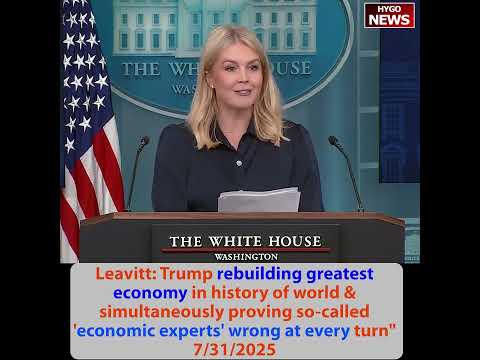
Leavitt pivoted to the economic ledger. “What we are watching is President Trump rebuilding the greatest economy in the history of the world and simultaneously proving the so-called economic experts wrong at every turn.”
“Greatest economy in the history of the world.” That is the superlative framing. The administration’s economic story: the U.S. economy is not merely recovering or strong. It is the greatest economy ever.
That framing is contestable in absolute terms. Inflation-adjusted GDP is at historic highs, but so is inflation-adjusted debt, inflation-adjusted consumer-goods prices, and other metrics. Whether the current economy is “the greatest in history” depends on which specific metric dominates the assessment.
“Proving the so-called economic experts wrong at every turn.” That is the specific narrative the administration is selling. The pre-tariff predictions that tariffs would drive inflation, slow growth, produce recession — those predictions were made by credentialed economists at major institutions. Those predictions have not materialized. The administration is cataloguing that forecasting failure as validation.
”EU Deal Impossible”
“Media pundits set a trade deal with the EU, this monumental and beneficial to America would be impossible, but President Trump made it happen.”
That is a specific claim. Before the EU deal was signed, media commentary suggested a deal on the terms Trump was seeking would be impossible. Europe would not accept 15% tariffs. Europe would not commit $750 billion in energy purchases. Europe would not accept zero-tariff U.S. market access. Those predictions were wrong.
“President Trump made it happen” reflects the administration’s reading that Trump’s personal direct diplomacy with von der Leyen was the decisive factor. Other diplomatic channels had been working for months without closing the deal. Trump’s direct engagement closed it.
”Recession This Summer”
“The so-called economic experts repeatedly said that the American economy would be in a recession this summer. Well, summer is here, it’s almost over, and that recession does not exist.”
Summer 2025 recession predictions were made by multiple prominent economists during early 2025. Those predictions cited tariff impacts, rate pressures, and consumer-spending concerns. The predictions were wrong.
“Yesterday, in fact, real GDP growth in the second quarter increased at a 3.0 percent annual rate, significantly above expectations.”
Q2 GDP at 3.0%. Not recession. Strong growth.
”Driven by Private Sector”
“President Trump’s America First policies are driving economic growth, as he always said they would, and this growth is being driven by the private sector, not the government.”
“Driven by the private sector, not the government” is the causal framing. During the Biden years, the U.S. economy was supported by substantial federal stimulus spending — the CARES Act, the American Rescue Plan, the Infrastructure Act, the CHIPS Act, the Inflation Reduction Act. Federal spending contributed materially to headline GDP growth.
Under Trump, federal spending is declining. “Federal government spending fell for a second straight quarter, while real business fixed investment rose by nearly 2 percent following its first quarter surge.”
That shift — declining government spending, rising private investment — represents the structural transition the administration has been pushing. Growth not sustained by federal borrowing. Growth sustained by private sector investment.
“President Trump is right-sizing government spending, reversing the damage done by the Biden administration in allowing the private sector to flourish.”
“Right-sizing government spending” is the administration’s framing for the spending cuts DOGE and other initiatives have implemented. Not merely austerity. Right-sizing — bringing spending in line with the country’s actual needs rather than the expanded envelope inherited from the Biden years.
”Consumer Spending Growth Accelerated”
“The same so-called experts claimed that President Trump’s tariffs would spike inflation and hurt American consumers, but consumer spending growth just accelerated and inflation remains right on track.”
Consumer spending accelerated. Inflation on track. Two data points that contradict the pre-tariff predictions. If tariffs were hurting consumers, spending would decline. If tariffs were driving inflation, prices would spike. Neither is occurring.
“For the past five straight months, core inflation has come in below market expectation and remains in line with the Fed’s 2 percent inflation target.”
Five straight months of core inflation below expectations. That is a sustained pattern. One or two months could be noise. Five consecutive months indicates a durable shift in the underlying inflation dynamic.
”$150 Billion Since Trump Took Office”
“Meanwhile, customs and tariff revenues have already totaled more than $150 billion since President Trump took office, leading to the first June budget surplus in nearly a decade.”
$150 billion in customs/tariff revenue in the first six months. That is a massive fiscal win. Annualized, approaching $300 billion. At the run rate Trump is projecting (with the August 1 expansion), the annual total could exceed $500 billion or more.
“First June budget surplus in nearly a decade.” That is the fiscal result. Monthly budget surpluses have been rare in the past decade — the federal budget has been in deficit nearly every month. June 2025 produced a surplus. That is a landmark fiscal marker.
“Those revenues will skyrocket even further, starting tomorrow, when new reciprocal tariff rates take effect.”
August 1, 2025 tariff activation. Reciprocal tariff rates on countries that have not negotiated bilateral deals. Revenue growth from that activation will compound across the rest of the fiscal year.
”Restoring America’s Economic Sovereignty”
“President Trump is restoring America’s economic sovereignty by reducing our reliance on foreign countries, boosting investment in the U.S. to the tune of trillions of dollars, and creating hundreds of thousands of high-paying jobs for the American people.”
Three specific outcomes. Reduce foreign reliance. Boost U.S. investment. Create high-paying jobs.
“Economic sovereignty” is the frame. The U.S. economy has been structured to depend on foreign supply chains (semiconductors, pharmaceuticals, rare earths, critical minerals, manufactured goods). That dependence is strategic vulnerability. The administration is reducing the vulnerability by reshoring.
“Trillions of dollars” of investment. That maps to the $15 trillion cumulative investment figure the administration has been citing. Some of that figure is aspirational. Some is already being deployed. All of it is directionally consistent with the reshoring story.
”The American Economy Will Boom Like Never Before”
“With America finally put first on trade and the largest middle-class tax cuts in history and other pro-growth provisions of the one big beautiful bill beginning to take effect, the American economy will boom like never before over the course of the next three and a half years, thanks to the President’s vision.”
“Boom like never before over the course of the next three and a half years.” The remaining time in the second term.
The catalog of what is producing the projected boom:
- America First trade (tariffs, bilateral deals, rebalancing)
- Largest middle-class tax cuts in history (No Tax on Tips/Overtime/Social Security plus 2017 extension)
- Other pro-growth provisions (deregulation, permitting reform, energy abundance, AI acceleration)
If the projected boom materializes, the 2026 midterms and 2028 presidential cycle will be fought on favorable economic terrain for Republicans. If the boom does not materialize, the opposition’s “mirage” framing gains ground.
The Two Ledgers
Peace deals. Economic wins. Leavitt has presented both ledgers in a single briefing.
Peace: six conflicts ended in six months. One per month pace.
Economy: 3.0% GDP growth. Core inflation below expectations for five months. $150 billion tariff revenue. First June surplus in a decade.
Those are the specific achievements the administration is presenting for public judgment. The 2026 midterms will test whether the public accepts the ledger as compelling.
Key Takeaways
- Leavitt counted six conflicts ended in six months: Thailand-Cambodia, Israel-Iran, Rwanda-DRC, India-Pakistan, Serbia-Kosovo, Egypt-Ethiopia — “one peace deal or ceasefire per month.”
- “It’s well past time that President Trump was awarded the Nobel Peace Prize.”
- Q2 GDP at 3.0% annualized — “significantly above expectations” — driven by private-sector investment while government spending fell for second straight quarter.
- Core inflation “below market expectation” for five consecutive months — “right on track” with the Fed’s 2% target.
- “$150 billion in customs and tariff revenues since President Trump took office, leading to the first June budget surplus in nearly a decade” — with reciprocal tariff escalation starting August 1.