 HYGO News
 Leavitt: Afghan Protections 'Expired -- We Didn't End Them'; Harvard 'Put Themselves in Position to Lose Funding'; 18 Countries Want Trade Deals
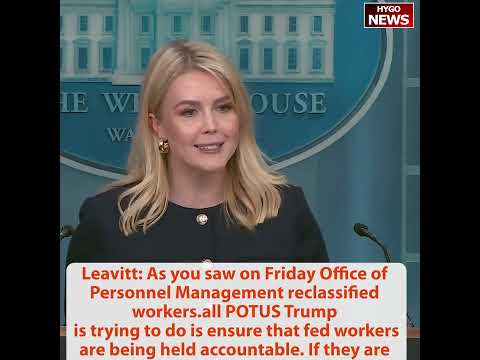
Leavitt: Afghan Protections “Expired — We Didn’t End Them”; Harvard “Put Themselves in Position to Lose Funding”; 18 Countries Want Trade Deals
Press Secretary Karoline Leavitt addressed multiple policy fronts in an April 2025 briefing. On Afghan temporary protections, she corrected the media’s framing: “We didn’t end that proactively. It expired. The previous administration illegally paroled hundreds of thousands of people and gave them temporary protective status — which is a temporary status, not a permanent status.” On Harvard’s federal funding, Leavitt was blunt: “It’s Harvard who has put themselves in the position to lose their own funding by not obeying federal law. If you want federal dollars, obey federal law.” She announced 18 trade proposals from over 100 countries, said the China deal was “moving in the right direction,” confirmed Trump would attend Pope Francis’s funeral in Rome, and explained the OPM reclassification of federal workers to hold “rogue bureaucrats engaging in corruption” accountable.
Afghan Protections: “It Expired”
A reporter opened with a question designed to put the administration on the defensive.
“The administration ended some temporary protections for Afghans, including several hundred Christians who have been punished by the Taliban,” the reporter said. “Is the president considering any exceptions for Afghans who could face death or torture if they return to their home country?”
Leavitt rejected the premise: “Let’s just be clear about one thing. We didn’t end that proactively. It expired.”
She assigned responsibility: “It’s because the previous administration illegally paroled hundreds of thousands of people into the country and then gave them temporary protective status, which again is a temporary status. It’s not a permanent status in this country.”
She outlined the legal path: “And if there are individuals here who came in through the Biden administration who want to claim asylum, there is a legal process to do that and those cases will be adjudicated by a judge on a case-by-case basis.”
She stated the principle: “We have a legal immigration process in this country for a reason and all this administration is trying to do is effectuate that.”
The exchange illustrated a media tactic that the administration had become adept at countering. The reporter’s question was framed to make Trump appear to be revoking protections from vulnerable people — Afghan Christians persecuted by the Taliban. Leavitt’s response reframed the reality: the Biden administration had created a temporary program, temporary programs expire, and the expiration was built into the program’s design.
The word “temporary” was doing the work that the media refused to acknowledge. Temporary Protected Status was, by definition, temporary. It was not a path to permanent residency, not a guarantee of indefinite stay, and not a backdoor to citizenship. The Biden administration had used TPS as a de facto amnesty mechanism — granting temporary status to hundreds of thousands of people with the implicit understanding that no future administration would have the political will to let it expire. The Trump administration was demonstrating that political will.
For Afghans with legitimate asylum claims, Leavitt made clear that the legal process remained available. Individual cases would be adjudicated by judges on their merits. What would not continue was the blanket protection that treated temporary status as permanent.
Harvard: “Obey Federal Law”
Leavitt addressed the Harvard funding controversy with the administration’s standard formulation.
“The president has made it quite clear that it’s Harvard who has put themselves in the position to lose their own funding by not obeying federal law,” Leavitt said.
She broadened the principle: “And we expect all colleges and universities who are receiving taxpayer funds to abide by federal law. It’s quite simple.”
She added the enforcement posture: “And the president made it clear he’s not going to tolerate violations of federal law. He’s not going to tolerate illegal harassment, and so we will be responding to the lawsuit in court.”
She delivered the bottom line: “And again, it’s quite simple. If you want federal dollars, obey federal law.”
The Harvard case had become a defining confrontation of Trump’s second term. Harvard received billions in federal funding — through research grants, student financial aid, and various government contracts. The administration’s position was that this funding came with conditions, including compliance with federal civil rights law, cooperation with government oversight, and adherence to non-discrimination requirements.
Harvard’s response had been to sue, arguing that the administration was retaliating against the university for its political positions. Leavitt’s rebuttal was devastatingly simple: no one was forcing Harvard to take federal money. If Harvard wanted to operate free from federal conditions, it could decline federal funding. If it wanted the money, it had to follow the rules.
The “if you want federal dollars, obey federal law” formulation was applicable far beyond Harvard. It established a principle that every institution receiving taxpayer money — universities, hospitals, nonprofits, state agencies — was expected to comply with federal law as a condition of that funding. The principle was not novel; it was how government grants had always worked. What was novel was an administration willing to enforce it.
OPM Reclassification
Leavitt explained the Office of Personnel Management’s reclassification of federal workers.
“The Office of Personnel Management reclassified workers,” she said. “They’re now called Schedule Policy/Career.”
She stated the purpose: “And all the president is trying to do is ensure that federal workers are being held accountable for corrupt behavior. If they are engaging in corruption as a government worker, they should no longer have their job.”
She framed it as common sense: “I think that’s pretty common sense.”
She described the vision: “He also believes that bureaucrats should be acting in accordance with the will of the American public who duly elected this president. Not just this president, but all future presidents.”
She stated the standard: “If you work for the government, you should be adhering to the will of the American public and advancing the administration’s goals and interests. And if you are not doing that, then you should go find another job whose interests you align with.”
She summarized the effect: “The president in this move and Office of Personnel Management — it will make it easier to get rid of rogue bureaucrats who are engaging in corruption.”
The OPM reclassification addressed one of the most persistent problems in federal governance: the inability to fire underperforming or insubordinate government employees. Under existing civil service protections, federal workers enjoyed job security that was virtually unmatched in any other sector. Employees who actively undermined their agency’s mission, refused to implement presidential directives, or engaged in corrupt behavior could remain in their positions for years while termination proceedings crawled through administrative processes.
The Schedule Policy/Career reclassification was designed to create a framework in which political accountability extended deeper into the federal workforce. The argument was not that all federal employees should be political appointees, but that employees in policy-influencing positions should be accountable to the elected leadership of the government.
China Trade Deal and Pope Francis Funeral
Leavitt delivered two additional announcements from the president.
On trade: “I asked the president about this before coming out here. And he wanted me to share that we’re doing very well in respect to a potential trade deal with China.”
She provided the broader context: “There have now been 18 proposals in more than 100 countries around the world who are wanting to make a deal with the United States of America.”
She offered the assessment: “We feel everyone involved wants to see a trade deal happen and the ball is moving in the right direction.”
On Pope Francis: “The thoughts and prayers of the entire White House remain with all of the Catholics around the world. As a mark of respect for his memory, President Trump ordered flags be flown at half-staff.”
She confirmed the travel: “He will be traveling to attend his funeral in Rome. The president will depart from Washington on Friday morning and return to the United States on Saturday evening following the funeral service.”
The 18 trade proposals from over 100 countries confirmed that the post-Liberation Day tariff strategy was generating exactly the engagement the administration had intended. Countries were not retaliating in isolation; they were coming to the table to negotiate. The “ball is moving in the right direction” assessment suggested that multiple deals were progressing simultaneously.
Key Takeaways
- Leavitt on Afghan protections: “We didn’t end them proactively. They expired. Temporary status is temporary — not permanent.”
- On Harvard: “If you want federal dollars, obey federal law. Harvard put themselves in the position to lose funding.”
- OPM reclassified federal workers to make it easier to remove “rogue bureaucrats engaging in corruption.”
- Trade update: 18 proposals from 100+ countries; China deal “moving in the right direction.”
- Trump confirmed to attend Pope Francis’s funeral in Rome, departing Friday and returning Saturday.