 HYGO News
 Leavitt: 70 Countries Calling to Negotiate Since Liberation Day; 'Tailor-Made Deals'; Supreme Court Alien Enemies Act Victory
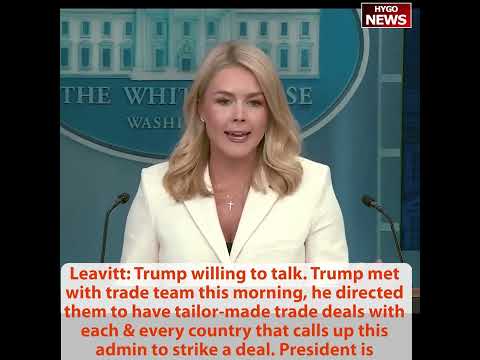
Leavitt: 70 Countries Calling to Negotiate Since Liberation Day; “Tailor-Made Deals”; Supreme Court Alien Enemies Act Victory
Press Secretary Karoline Leavitt delivered an April 2025 briefing announcing that “nearly 70 countries have already reached out to the president to begin a negotiation” since Liberation Day. She said countries were “falling over themselves to reform their unfair trade practices” and that Trump had directed his trade team to “have tailor-made trade deals with each and every country that calls.” On China, she warned: “Countries who have chosen to retaliate are making a mistake. President Trump has a spine of steel, and he will not break.” Separately, she announced a “massive legal victory” at the Supreme Court upholding the Alien Enemies Act deportations.
”Nearly 70 Countries”
Leavitt opened with the number that validated the Liberation Day strategy.
“In total, since the Liberation Day announcement, nearly 70 countries have already reached out to the president to begin a negotiation,” she said.
She described the dynamic: “Countries are falling over themselves to reform their unfair trade practices and free-open their markets to our country.”
She explained why: “Because these countries greatly respect President Trump and the sheer power of the American market.”
Leavitt then articulated the realization driving the negotiations: “These countries realize they’ve gotten filthy rich over the past few decades by imposing substantial tariffs on American-made products and ridiculous non-monetary barriers to block out American industry.”
Her verdict: “The jig is up. Past American presidents sat by and let this happen, but President Trump stood up for our country, and he is saying no more.”
The 70-country figure was the most significant vindication of the tariff strategy. When the tariffs were announced, critics predicted economic isolation — that the United States would be cut off from the global economy. Instead, 70 nations were actively seeking deals with the United States. The tariffs had not isolated America; they had made America the center of a global negotiation in which every country was competing for access to the world’s largest consumer market.
”Bring Us Your Best Offers”
Leavitt outlined the administration’s negotiating framework.
“The president’s message has been simple and consistent from the beginning,” she said. “To countries around the world: bring us your best offers, and he will listen.”
The condition: “Deals will only be made if they benefit American workers and address our nation’s crippling trade deficits.”
The leverage: “America does not need other countries as much as other countries need us. And President Trump knows this. He’s going to use the leverage of our markets and our country to the advantage of the people he was sworn in to represent.”
The framework was clear and non-negotiable. Countries could propose deals, but those deals had to address the trade deficit — not merely adjust tariff schedules or promise future reforms but actually reduce the imbalance between American imports and exports. Cosmetic agreements that left the underlying deficit intact would not be accepted.
China: “A Spine of Steel”
Leavitt contrasted the negotiation-ready countries with China’s retaliatory posture.
“On the other hand, countries like China who have chosen to retaliate and try to double down on their mistreatment of American workers are making a mistake,” she said.
The declaration: “President Trump has a spine of steel, and he will not break, and America will not break under his leadership.”
She outlined the non-negotiable principles: “He is guided by a firm belief that America must be able to produce essential goods for our own people and export them to the rest of the world. A strong America cannot be solely dependent on foreign countries for our food, medicines, and critical minerals. And America must always maintain a robust defense supply chain.”
Leavitt connected trade to security: “Reprioritizing and strengthening our manufacturing industry are essential national and economic security issues of the utmost importance to President Trump.”
She acknowledged the dual reality: “Both things can be true at the same time, and it is a non-negotiable position that the United States has faced a national security and economic crisis because of the unfair trade practices by countries around the world.”
The “spine of steel” language was designed for a Chinese audience as much as a domestic one. Beijing’s strategy in trade wars had historically been to inflict enough economic pain that the opposing government reversed course. Leavitt was signaling that this president would not follow that pattern. The 104% tariff on China was not a negotiating bluff; it was a reflection of presidential resolve that would not be weakened by market fluctuations or political pressure.
”Tailor-Made Trade Deals”
Leavitt revealed that Trump had given specific instructions to his trade team.
“I have maintained this position — the entire administration has always said that President Trump is willing to pick up the phone and talk,” she said. “And the president met with his trade team this morning, and he directed them to have tailor-made trade deals with each and every country that calls up this administration to strike a deal.”
She described the approach: “Each and every one of these trade deals should be tailored and unique, based on that country’s markets, based on that country’s exports, the imports here in the United States of America. What makes the most sense for the American worker and for our industry?”
The “tailor-made” approach meant that the administration was not pursuing a one-size-fits-all trade framework. Each country would negotiate a bilateral deal that reflected its specific trade relationship with the United States. Japan’s deal would be different from Vietnam’s, which would be different from the EU’s. The reciprocal tariffs had created the incentive; the bilateral negotiations would create the solutions.
This approach gave the administration maximum flexibility. Rather than being constrained by a multilateral framework — like the WTO rules that had been manipulated for decades — each deal could be crafted to address the specific imbalances and barriers that characterized each country’s trade with the United States.
Supreme Court: Alien Enemies Act Victory
Leavitt closed with a legal victory on an entirely different front.
“Last night, the Supreme Court delivered a massive legal victory to the Trump administration and allowed us to continue removing foreign terrorist invaders under the Alien Enemies Act,” she said.
She characterized the ruling: “This was a smackdown to a rogue, left-wing, low-level district court judge who has relentlessly tried to stop President Trump from using his core constitutional powers as head of the executive branch and as commander-in-chief.”
Leavitt stated the principle: “The highest court in the land made it clear that the president of the United States has the power to protect our homeland.”
The Supreme Court victory on the Alien Enemies Act was the judicial vindication the administration had been seeking. After months of lower court injunctions blocking the deportation of designated foreign terrorists, the Supreme Court had affirmed the president’s authority. The ruling validated the administration’s legal strategy of fighting through the courts rather than complying with what it considered unconstitutional lower court orders.
Key Takeaways
- Nearly 70 countries reached out to negotiate since Liberation Day: “Countries are falling over themselves to reform their unfair trade practices.”
- Trump directed his trade team to create “tailor-made deals” with each country, tailored to specific markets, exports, and what benefits American workers.
- On China’s retaliation: “President Trump has a spine of steel, and he will not break. America will not break under his leadership.”
- Non-negotiable position: America must produce its own food, medicines, and critical minerals — “essential national and economic security issues.”
- Supreme Court delivered a “massive legal victory” upholding Alien Enemies Act deportations — “a smackdown to a rogue district court judge.”