 HYGO News
 Leavitt: SCOTUS Says 'Facilitate, Not Effectuate' Return; CPI Drops Massively; 'Phones Ringing Off the Hook' From Allies
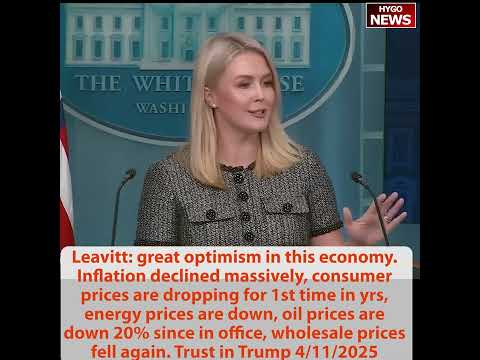
Leavitt: SCOTUS Says “Facilitate, Not Effectuate” Return; CPI Drops Massively; “Phones Ringing Off the Hook” From Allies
Press Secretary Karoline Leavitt delivered an April 2025 briefing covering the Supreme Court deportation ruling, falling inflation, and the flood of allied nations seeking trade deals. On the Court’s ruling about deported individuals, Leavitt drew a critical distinction: “The Supreme Court made very clear that it’s the administration’s responsibility to facilitate the return, not to effectuate the return.” She cited a CPI report showing “inflation declined massively, consumer prices dropping for the first time in years, oil prices down 20% since this president took office.” When a reporter asked why allies would cooperate “if we’re treating friend and foe alike,” Leavitt shot back: “The phones are ringing off the hooks. They need the United States of America."
"Facilitate, Not Effectuate”
Leavitt addressed the Supreme Court’s ruling on the deportation case with precise legal language.
“The Supreme Court made their ruling last night very clear that it’s the administration’s responsibility to facilitate the return, not to effectuate the return,” she said. “I believe the Department of Justice just filed another brief in the lower court. I would defer you to that for any updates.”
The distinction between “facilitate” and “effectuate” was legally significant. “Facilitate” meant the administration was obligated to make reasonable efforts to enable the return of individuals who had been deported — such as contacting the receiving country, arranging logistics, and removing administrative barriers. “Effectuate” would have meant the administration was required to guarantee the actual physical return of every individual — a much higher standard that would have required compelling foreign governments to release individuals they were holding.
The administration’s interpretation of the ruling was that it had complied by taking facilitative steps without being required to achieve a specific outcome. The lower courts were continuing to litigate the specifics, but the Supreme Court’s language gave the administration the narrower obligation it had argued for.
Economic Optimism: CPI, Oil, and Wholesale Prices
Leavitt pivoted to the economic data with a comprehensive catalog of positive indicators.
“I think there’s great optimism in this economy, great optimism for the American people, a lot of reason for people to feel optimistic,” she said.
She acknowledged the transition: “The president is trying to renegotiate the global trade agenda that has ripped off the American people for far too long. As he said, this is going to be a period of transition. He wants consumers to trust in him, and they should trust in him. Look at what he did in his first term.”
Then the data: “Yesterday, the CPI report — inflation declined massively. Consumer prices are dropping for the first time in years. Energy prices are down. In fact, oil prices are down 20 percent since this president took office. Wholesale prices fell again.”
She listed the investment: “There have been trillions of dollars in investments into this country. Every day the president is signing executive orders to cut regulation, especially when it comes to the Environmental Protection Agency, our energy industry. That’s going to unleash the economic boom in this country that we saw in the president’s first term.”
Leavitt concluded: “So trust in President Trump. He knows what he’s doing. This is a proven economic formula.”
The CPI data was the strongest counter to the tariff-anxiety narrative. While markets had been volatile since Liberation Day, the actual consumer price data showed prices falling — not rising. The 20% decline in oil prices since inauguration was particularly significant because energy costs fed into the price of virtually every other product and service. Falling oil meant falling transportation costs, which meant falling grocery prices, which meant declining inflation across the board.
Biden Health “Cover-Up”
When asked about presidential health transparency, Leavitt used the question to attack the Biden administration’s record.
“I can tell you there was certainly a lack of transparency from the former president, from the entire former administration,” she said. “And frankly, a lot of people in this room, when it came to the health and the competence of the former president of the United States, Joe Biden.”
She escalated: “There was one of the greatest cover-ups and, frankly, political scandals this nation has ever seen. It’s been unraveled in some recent books that are being written by journalists who engaged in that cover-up and scandal, which is quite ironic.”
She contrasted the two administrations: “But this president is clearly committed to transparency. You in this room see him and hear from him on a daily basis. You in this room know from covering him — it’s hard to keep up with him. He is a machine working around the clock every single day.”
She noted that Trump was undergoing his annual physical and that “the physician after today’s physical will provide an update on the report in the effort of transparency.”
The contrast was effective. Biden’s health had been a subject of increasing concern throughout 2024, culminating in his withdrawal from the presidential race after a debate performance that appeared to confirm cognitive decline. The journalists who had spent years dismissing questions about Biden’s fitness were now writing books acknowledging what they had denied. Leavitt’s accusation that “people in this room” had participated in the cover-up was directed at the very reporters she was briefing.
”Why Would Allies Work With Us?”
The most contentious exchange came from a reporter who challenged the tariff strategy’s diplomatic logic.
“Why would any of our allies work with us to isolate China in a trade war if we’re treating friend and foe alike?” the reporter asked.
Leavitt’s response was to point to the empirical evidence: “You’ll have to talk to our allies who are reaching out to us. The phones are ringing off the hooks. They’ve made it very clear they need the United States of America. They need our markets. They need our consumer base.”
She provided the specific examples: “You saw Prime Minister Benjamin Netanyahu in the Oval Office with the president, saying that he was going to bring down all of their monetary tariffs and their non-monetary tariff trade barriers as well. We’ve heard from South Korea. We’ve heard from Japan. The president has spoken to Vietnam. We have Italy coming to the White House next week.”
She stated the underlying principle: “There’s a reason for that, Sean. And it’s because they need the United States of America and our business model and our markets to survive. And the president is using that leverage to our advantage.”
The reporter’s question reflected a common criticism of the tariff approach: that applying tariffs to allies and adversaries alike would undermine the coalition-building needed to confront China. Leavitt’s answer was that the theoretical concern was contradicted by the actual behavior of allies. Japan, South Korea, Israel, Italy, Vietnam, and dozens of other countries were actively seeking deals — not pulling away. The tariffs had not alienated allies; they had brought them to the negotiating table.
The distinction between “treating friends and foes alike” and “creating incentives for fair trade with everyone” was the core of the administration’s argument. Friends who traded fairly would get favorable deals. Foes who retaliated would face escalating tariffs. The system differentiated based on behavior, not rhetoric.
Key Takeaways
- Leavitt drew a legal distinction on the SCOTUS deportation ruling: “Facilitate the return, not effectuate the return.”
- CPI showed “inflation declined massively, consumer prices dropping for the first time in years, oil down 20% since inauguration.”
- On Biden’s health: “One of the greatest cover-ups this nation has ever seen,” now being admitted in books by journalists who participated.
- When asked why allies would cooperate: “The phones are ringing off the hooks — Japan, South Korea, Vietnam, Italy, Israel all coming to negotiate.”
- Leavitt: “They need the United States. They need our markets. The president is using that leverage to our advantage.”