 HYGO News
 Leavitt: The Real 'Constitutional Crisis' Is Liberal Judges Blocking Trump; Inflation Worse Than Expected
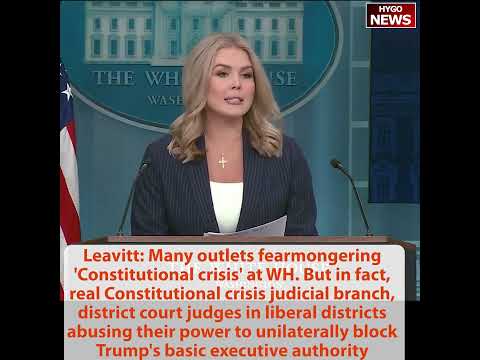
Leavitt: The Real “Constitutional Crisis” Is Liberal Judges Blocking Trump; Inflation Worse Than Expected
In a February 2025 White House briefing, Press Secretary Karoline Leavitt opened with a prepared statement accusing media outlets of “fearmongering the American people into believing there is a constitutional crisis taking place here at the White House” and then turned the accusation around, declaring that the real constitutional crisis was taking place “within our judicial branch, where district court judges in liberal districts across the country are abusing their power to unilaterally block President Trump’s basic executive authority.” Leavitt also addressed January inflation numbers that came in “worse than expected,” announced the release of an American hostage from Belarus, and previewed the president’s reciprocal tariff policy.
”An Extremely Dishonest Narrative”
Leavitt did not wait for questions to address the media framing she found objectionable. “Before I take questions, I would like to address an extremely dishonest narrative that we’ve seen emerging over the past few days,” she said. “Many outlets in this room have been fearmongering the American people into believing there is a constitutional crisis taking place here at the White House. I’ve been hearing those words a lot lately.”
The phrase “constitutional crisis” had been deployed by Democratic politicians and media commentators in response to Vice President JD Vance’s public statements questioning whether federal judges had the authority to block executive actions, and to Speaker Mike Johnson’s call for courts to “step back.” Leavitt’s strategy was not to defend against the accusation but to redirect it entirely.
“But in fact, the real constitutional crisis is taking place within our judicial branch, where district court judges in liberal districts across the country are abusing their power to unilaterally block President Trump’s basic executive authority,” Leavitt said. “We believe these judges are acting as judicial activists rather than honest arbiters of the law.”
She then cited a specific statistic that illustrated the pace of judicial intervention: “They have issued at least 12 injunctions against this administration in the past 14 days, often without citing any evidence or grounds for their lawsuits.”
The number was striking. Twelve injunctions in fourteen days meant that federal judges were blocking Trump administration actions at nearly one per day. Leavitt characterized the pattern not as legitimate judicial review but as a coordinated political campaign. “This is part of a larger concerted effort by Democrat activists and nothing more than the continuation of the weaponization of justice against President Trump,” she said.
”77 Million Americans Voted to Elect This President”
Leavitt then framed the judicial confrontation in democratic terms, invoking the mandate of Trump’s election victory against the authority of individual district court judges.
“Quick news flash to these liberal judges who are supporting their obstructionist efforts: 77 million Americans voted to elect this president,” Leavitt said. “And each injunction is an abuse of the rule of law and an attempt to thwart the will of the people.”
The argument was straightforward: a president elected with 77 million votes was being stymied by individual district court judges, appointed for life, who were issuing nationwide injunctions that blocked policies supported by a democratic majority. The tension between judicial authority and democratic legitimacy was one of the most significant constitutional questions of the early second term.
Leavitt was careful, however, to establish that the administration would operate within legal channels. “As the president clearly stated in the Oval Office yesterday, we will comply with the law in the courts, but we will also continue to seek every legal remedy to ultimately overturn these radical injunctions and ensure President Trump’s policies can be enacted,” she said.
The statement threaded a needle: the administration would not defy court orders outright, but it would aggressively appeal them and publicly challenge their legitimacy. The strategy was to win in the courts of law while simultaneously winning in the court of public opinion.
Inflation: “Worse Than Expected”
Leavitt then pivoted to economic news that reinforced the administration’s narrative about inheriting a damaged economy from Biden.
“We did receive those numbers and they were worse than expected, which tells us that the Biden administration indeed left us with a mess to deal with,” Leavitt said. “It’s far worse than I think anybody anticipated, because unfortunately, the previous administration was not transparent about where the economy truly was.”
She pointed to the credibility gap created by Biden-era officials who had characterized inflation as temporary. “We know people at this very podium told the American people that inflation was transitory and that it would go away. That was not the case,” Leavitt said, referencing the widely criticized “transitory” framing that Biden officials had used throughout 2021 and into 2022 as inflation surged to 40-year highs.
Leavitt then cited specific data: “The last report of the Biden administration as revealed today shows that inflation is still about 4.5% higher over the past three months. This is an indictment on the Biden administration’s mismanagement of the inflation crisis and their lack of transparency in addressing it.”
The inflation data served a dual purpose for the administration. It validated Trump’s campaign messaging about the Biden economy, and it set expectations for the incoming team by establishing that the economic situation was worse than publicly acknowledged. By framing the inflation numbers as a “mess” inherited from Biden, Leavitt was preemptively addressing any economic challenges that might emerge in the early months of the Trump presidency.
American Released from Belarus
In a shift to positive news, Leavitt confirmed a diplomatic achievement: the release of an American citizen and two other individuals from Belarus.
“It speaks to President Trump’s dealmaking ability, and we can confirm the safe release of one American and two individuals from Belarus, one of whom worked for Radio Liberty,” Leavitt said. “Out of respect for the privacy of these individuals, at their request, we have no further details to announce on their identities.”
The release came on the heels of Marc Fogel’s return to America the previous night, marking the latest in a series of hostage releases that the Trump administration had secured since taking office. The administration had made the return of detained Americans a signature priority, and each release provided concrete evidence of results.
Leavitt connected the release to the broader narrative of Trump’s deal-making approach to foreign policy. “It’s a remarkable victory on the heels of Marc Fogel returning to America last night,” she said. The rapid pace of hostage releases — multiple Americans freed within weeks of inauguration — contrasted with the prolonged negotiations that had characterized the Biden administration’s approach.
Reciprocal Tariffs: “The Golden Rule”
Leavitt previewed Trump’s upcoming reciprocal tariff announcement with a characteristically simple framing that distilled complex trade policy into a principle everyone understood.
“It’s very simple logic as to why the President wants to impose reciprocal tariffs,” Leavitt said. “It’s the golden rule, which we all learned when we were growing up in school. Treat others the way you want to be treated. And far too many nations around this world have been ripping off the United States of America for far too long.”
The “golden rule” framing was effective because it reduced the tariff argument to basic fairness. If another country charged 25% tariffs on American goods, the United States would charge the same rate in return. The reciprocity principle was easy to explain and difficult to argue against in the abstract, even if the economic details were more complex.
Leavitt noted that the details would come directly from the president: “I do believe it will come before the Prime Minister’s visit tomorrow, and I will let the President discuss the details on the reciprocal tariff front.”
Key Takeaways
- Leavitt accused media outlets of “fearmongering” about a constitutional crisis at the White House and declared the real crisis was “district court judges in liberal districts” issuing 12 injunctions in 14 days against the administration.
- She invoked Trump’s 77-million-vote mandate against the authority of individual federal judges, calling each injunction “an abuse of the rule of law and an attempt to thwart the will of the people.”
- January inflation numbers came in “worse than expected,” which Leavitt called “an indictment on the Biden administration’s mismanagement” and evidence that the economy was “far worse than anybody anticipated.”
- The White House confirmed the release of one American and two individuals from Belarus, including a Radio Liberty employee, marking the latest in a series of hostage releases since Trump took office.
- Leavitt previewed reciprocal tariffs using “the golden rule” framing, arguing that “far too many nations around this world have been ripping off the United States of America for far too long.”