 HYGO News
 Leavitt: Student Loan Collections Resume May 5 -- '$1.6 Trillion, Fewer Than 4 in 10 Repaying'; 18 Trade Proposals, 34 Countries This Week
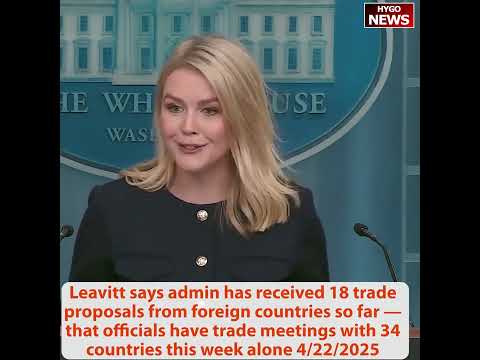
Leavitt: Student Loan Collections Resume May 5 — “$1.6 Trillion, Fewer Than 4 in 10 Repaying”; 18 Trade Proposals, 34 Countries This Week
Press Secretary Karoline Leavitt delivered a briefing in April 2025 covering student loan enforcement, trade negotiations, and pharmaceutical investments. On student loans: “No student loan has been referred to collections since March of 2020. That comes to an end. On May 5th, the Department of Education will resume involuntary collections for borrowers with defaulted federal student loans.” She cited the scale: “The student loan portfolio is nearly $1.6 trillion. But fewer than four out of 10 borrowers are in repayment.” On trade, Leavitt revealed 18 formal proposals from foreign countries and confirmed the trade team was meeting with 34 countries that week alone. She also announced that a Swiss pharmaceutical company would invest $50 billion in the U.S. and Regeneron would pay Fujifilm over $3 billion to manufacture medicines domestically.
Student Loan Collections Resume
Leavitt opened the briefing with the policy announcement that would affect millions of borrowers.
“The Trump administration has announced we will put an end to Joe Biden’s illegal student loan bailout attempts,” Leavitt said.
She laid out the timeline: “No student loan has been referred to collections since March of 2020. That comes to an end. On May 5th, the Department of Education will resume involuntary collections for borrowers with defaulted federal student loans.”
She described the scale of the problem: “The student loan portfolio controlled by the federal government is nearly $1.6 trillion. But fewer than four out of 10 borrowers are in repayment.”
She delivered the assessment: “This is unsustainable, unfair, and a huge liability for American taxpayers.”
She stated the principle: “Debt cannot be wiped away. It just ends up getting transferred to others.”
She posed the central question: “So why should Americans who didn’t go to college or went to college and responsibly paid back their loans pay for the student loans of other Americans?”
She committed the administration: “The Trump administration will never force taxpayers to pay student loan debts that don’t belong to them.”
She explained the enforcement mechanism: “Borrowers will now be clearly expected to repay their loans and those who default on their loan obligations will face involuntary collections. The government can and will collect defaulted federal student loan debt by withholding money from borrowers’ tax refunds, federal pensions, and even their wages.”
She connected it to the fiscal picture: “America is $36 trillion in debt. We must get our fiscal house in order and restore common sense to our country.”
She concluded: “If you take out a loan, you have to pay it back. It’s very simple.”
The student loan announcement represented the end of a five-year moratorium on collections that had begun as a COVID-era emergency measure in March 2020 and had been extended repeatedly by the Biden administration. What had started as temporary pandemic relief had become a de facto permanent benefit — $1.6 trillion in loans with fewer than 40% of borrowers making payments.
The Biden administration had attempted multiple times to forgive student loan debt through executive action, with each attempt either struck down by courts or structured to circumvent judicial review. The effect of these efforts — combined with the collections moratorium — was to create a widespread expectation among borrowers that they would never have to repay their loans.
The Trump administration was ending that expectation. The May 5 deadline gave borrowers notice that the free ride was over. Those who had defaulted would face involuntary collections — meaning the government would garnish wages, intercept tax refunds, and deduct from federal pensions to recover the debt.
The Fairness Argument
Leavitt’s framing of the student loan issue as a fairness question was politically potent.
The population of Americans affected by student loan policy included three groups: those who had never attended college (roughly 60% of adults), those who had attended college and repaid their loans, and those who had attended college and had not repaid their loans. Student loan forgiveness transferred wealth from the first two groups to the third — from plumbers, electricians, and small business owners to college graduates who had chosen not to repay their debts.
The “student loan borrowers need clarity” line was a subtle acknowledgment that the Biden era’s constant cycle of forgiveness announcements, court challenges, and policy reversals had created genuine confusion. Borrowers didn’t know whether they were expected to pay or not. By resuming collections with a clear date, the Trump administration was providing the clarity that the previous administration’s legal gymnastics had prevented.
18 Trade Proposals, 34 Countries
Leavitt shifted to trade with visible enthusiasm.
“We spoke to our entire trade team this morning,” she said. “There is a lot of progress being made.”
She quantified the engagement: “We now have 18 proposals on paper that have been brought to the trade team. Again, these are proposals on paper that countries have proposed to the Trump administration and to our government.”
She named the team: “You have Secretary Bessent, Secretary Lutnick, Ambassador Greer, NEC Director Hassett, and Peter Navarro — the entire trade team — meeting with 34 countries this week alone.”
She set the pace: “We are moving at Trump’s speed to ensure these deals are made on behalf of the American worker and the American people.”
She highlighted the India development: “Just yesterday, it seemed to get a little bit lost in the news, and I think it’s a disservice to the American public that it did. The vice president announced terms of reference for a trade deal with India.”
She explained the significance: “We know when we look at the numbers, the monetary trade barriers and the non-monetary trade barriers from India, they have been ripping off the United States and American workers for a very long time.”
She assessed the progress: “The fact the vice president with Prime Minister Modi announced these terms of reference, which is essentially a framework to move the ball forward, to sign a good trade deal between our two nations is great progress.”
The numbers were extraordinary. Eighteen formal written proposals from foreign governments, with 34 countries engaged in active negotiations in a single week. The Liberation Day tariffs had transformed the global trade landscape from one in which the United States begged for better terms to one in which countries were lining up to propose deals.
The India development was particularly significant. India had been one of the most protectionist major economies, with tariffs and non-tariff barriers that effectively locked American goods out of a market of 1.4 billion consumers. The vice president’s announcement of “terms of reference” — a formal negotiating framework — indicated that India was willing to make concessions that decades of diplomatic entreaties had failed to achieve.
Pharmaceutical Investment
Leavitt closed with investment announcements that connected to the administration’s reshoring agenda.
“Thanks to President Trump’s America First economic approach, investments continue to pour into our country,” she said.
She cited two major deals: “A Swiss pharmaceutical company announced they will be investing $50 billion in the United States over the next five years, creating 12,000 new quality jobs.”
And: “Regeneron Pharmaceuticals also agreed to pay Fujifilm Technologies more than $3 billion over the next decade to help manufacture its medicines in the United States.”
She connected it to national security: “It’s a top priority for President Trump to ensure we are producing critical medicines and pharmaceutical drugs right here in America, and that is exactly what we continue to see happen every day.”
The pharmaceutical investments directly addressed the strategic vulnerability Trump had identified on Liberation Day — America’s inability to produce enough antibiotics and medicines for its own population. The $50 billion Swiss investment and the $3 billion Regeneron-Fujifilm deal were concrete steps toward rebuilding domestic pharmaceutical manufacturing capacity.
Key Takeaways
- Student loan collections resume May 5: “The $1.6 trillion portfolio has fewer than 4 in 10 borrowers repaying. This is unsustainable and unfair.”
- Enforcement: defaulters face wage garnishment, tax refund withholding, and pension deductions.
- Trade: 18 formal proposals received; the trade team is meeting with 34 countries this week alone.
- VP announced India trade “terms of reference” with PM Modi — a framework for a deal after years of India’s protectionism.
- $50 billion Swiss pharma investment (12,000 jobs) and $3 billion Regeneron-Fujifilm deal to manufacture medicines domestically.