 HYGO News
 Leavitt Uses Pelosi's 1996 Words Against Her: 'How Many Jobs Lost?' -- 'Trump Is Finally Answering Her Call'; 104% China Tariff
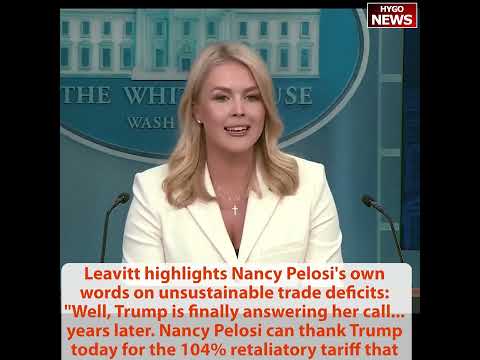
Leavitt Uses Pelosi’s 1996 Words Against Her: “How Many Jobs Lost?” — “Trump Is Finally Answering Her Call”; 104% China Tariff
Press Secretary Karoline Leavitt delivered a devastating briefing in April 2025 by reading Nancy Pelosi’s own 1996 House floor speech demanding action on the China trade deficit: “How big a trade deficit? How many jobs have to be lost for the American workers? How much dangerous proliferation has to exist before members of this House will say, I will not endorse the status quo?” Leavitt concluded: “President Trump is finally answering her call, 27 years later. Nancy Pelosi can thank President Trump today for the 104% retaliatory tariff that will be going into effect on China.” She also cited Chuck Schumer’s 2007 warnings and Sherrod Brown’s 2012 alarms about the China deficit.
”Everybody Knows This President Is Right”
Leavitt opened with the assertion that the tariff debate was not genuinely partisan.
“Everybody in Washington, whether they want to admit it or not, knows that this president is right when it comes to tariffs and when it comes to trade,” she said.
She identified the contradiction: “In fact, Democrats have long said that the United States of America has been ripped off by the countries around the world. They just don’t want to admit it now because it’s President Trump who is saying that.”
The argument was that the substance of Trump’s trade policy was something Democrats had advocated for decades. The only thing that had changed was the name on the policy. When Pelosi, Schumer, and Brown had demanded action on trade deficits, they had been praised for defending workers. When Trump actually took the action they had demanded, they opposed it — not because the policy was wrong but because the president implementing it was a Republican.
Pelosi, 1996: “How Many Jobs?”
Leavitt read from Pelosi’s June 1996 House floor speech with the precision of a prosecutor presenting evidence.
“In June of 1996, Nancy Pelosi spoke on the House floor,” Leavitt said. “She urged her colleagues at the time to fight against the status quo trade policies that had contributed to America’s trade deficit with China.”
Then the direct quotes: “Nancy Pelosi said: ‘How far does China have to go? How much more repression? How big a trade deficit? How many jobs have to be lost for the American workers? How much dangerous proliferation has to exist before members of this House of Representatives will say, I will not endorse the status quo?’”
Leavitt delivered the punchline: “Those are the words of Nancy Pelosi in 1996. President Trump is finally answering her call, 27 years later. Nancy Pelosi can thank President Trump today for the 104% retaliatory tariff that will be going into effect on China.”
The 1996 Pelosi speech was the most effective piece of opposition research the White House had deployed on the tariff issue. Every word of Pelosi’s argument — the trade deficit, the job losses, the refusal to challenge the status quo — applied with even greater force in 2025 than it had in 1996. The deficit had grown from billions to hundreds of billions. The job losses had accelerated from thousands to millions. The “status quo” that Pelosi had urged her colleagues to reject had metastasized over three decades of inaction.
The 1996 Numbers vs. 2025
Leavitt then presented the specific trade data from Pelosi’s era that showed how much worse the situation had become.
“In terms of tariffs, I think it’s interesting to note that the average US MFN tariff on Chinese goods coming into the United States is 2 percent,” Leavitt said. “Whereas the average Chinese MFN tariff on US goods going into China is 35 percent. Is that reciprocal?”
She cited the market access disparity: “On exports, China only allows certain industries into China, and therefore only 2% of US exports are allowed into China. On the other hand, the US allows China to flood our markets with a third of their exports — and that will probably go over 40%.”
The job impact: “China benefits with at least 10 million jobs from US-China trade.”
These numbers — a 2% vs. 35% tariff asymmetry, 2% of U.S. exports allowed into China vs. 40% of Chinese exports flooding U.S. markets, 10 million Chinese jobs created by the trade relationship — had been the reality in 1996. Every metric had worsened in the three decades since. The politicians who had identified the problem in the 1990s had done nothing to solve it — and in many cases had actively made it worse through trade agreements that deepened the asymmetry.
Pelosi’s 1996 Call to Action
The most damning portion of Pelosi’s speech was her direct appeal to her colleagues.
“On this day, your member of Congress could have drawn the line to say to the President of the United States, do something about this US-China trade relationship that is a job loser for the United States,” Pelosi had said in 1996.
The irony was complete. Pelosi had called on members of Congress to demand presidential action on the China trade deficit. Twenty-seven years later, a president was taking exactly that action — and Pelosi was opposing it. She had demanded that someone “do something.” Trump was doing something. And Pelosi was now arguing he should stop.
Schumer, 2007: “Take Action Now”
Leavitt extended the Democratic hypocrisy catalog to include Senate leadership.
“In 2007, Chuck Schumer spoke of our nation’s crippling trade deficit, saying: ‘These are the kinds of records the American people don’t want us to be breaking,’” Leavitt said.
Schumer had called for immediate action: “‘The administration needs to move beyond words, take action now to reverse a trend that threatens our prospects for future economic growth.’ And Chuck Schumer said that in 2007.”
Leavitt connected the 2007 warning to the 2025 action: “Finally, in 2025, President Trump is taking action.”
The Schumer quote was particularly effective because it used the phrase “take action now” — exactly what Trump was doing. Schumer had demanded urgency in 2007. Eighteen years later, the action had finally arrived, and Schumer was opposing it.
Sherrod Brown, 2012: “Millions of Jobs”
Leavitt added a third Democratic voice to the record.
“Recently defeated Democrat Sherrod Brown said on deficits in 2012 that our deficit with China had reached an all-time high,” she said. “And it was on pace to exceed last year’s record. The trade deficit had cost American workers millions of jobs at the time.”
Leavitt summarized: “These are the words of Democrats years ago. It is about time America finally has a president who is taking action to restore those millions of jobs back to the United States of America, to boost our manufacturing industry.”
She concluded: “He’s doing what’s right for the American people. It will take a lot of labor. It will take a lot of effort. That’s exactly what the American people elected this president to do.”
The three-speaker catalog — Pelosi (1996), Schumer (2007), Brown (2012) — demonstrated that the Democratic Party had spent decades identifying the China trade deficit as a crisis while doing nothing to address it. The party’s three most prominent voices on trade had all demanded action. When action finally came from a Republican president, the same party declared the action illegitimate.
Key Takeaways
- Leavitt read Pelosi’s 1996 House floor speech demanding China trade action: “How many jobs lost? How big a trade deficit? I will not endorse the status quo.”
- She concluded: “Trump is finally answering her call. Pelosi can thank him for the 104% retaliatory tariff on China.”
- 1996 data cited: U.S. tariff on Chinese goods 2% vs. China’s 35% tariff on U.S. goods; only 2% of U.S. exports allowed into China.
- Schumer (2007): “Take action now to reverse a trend that threatens economic growth.” Brown (2012): “The trade deficit has cost millions of jobs.”
- Leavitt: “Democrats have long said America was ripped off. They just don’t want to admit it now because it’s President Trump who is saying that.”