 HYGO News
 Leavitt: '$2 Billion to Harvard With a $50 Billion Endowment -- Why Are Taxpayers Subsidizing Them?'; Title VI or No Funding
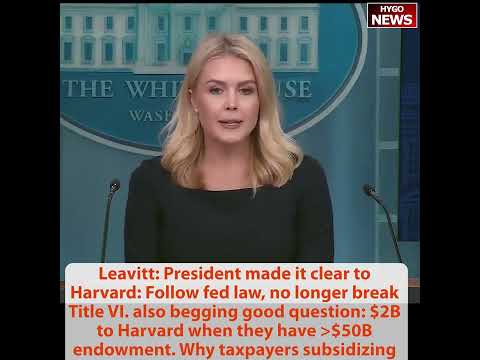
Leavitt: “$2 Billion to Harvard With a $50 Billion Endowment — Why Are Taxpayers Subsidizing Them?”; Title VI or No Funding
Press Secretary Karoline Leavitt laid out the administration’s case against Harvard in an April 2025 briefing, framing it as both a civil rights issue and a fiscal one. “The president made it clear to Harvard: follow federal law, no longer break Title VI, and you will receive federal funding,” Leavitt said. “Unfortunately, Harvard has not taken the president’s demands seriously.” She then posed the fiscal question: “More than $2 billion out the door to Harvard when they have a more than $50 billion endowment. Why are American taxpayers subsidizing a university that has billions of dollars in the bank already?” She noted that former President Obama had sided with Harvard against the administration.
”Grounded in Common Sense”
Leavitt framed the Harvard dispute as a simple matter of law enforcement.
“When it comes to Harvard, the president’s position on this is grounded in common sense,” she said. “In the basic principle that Jewish American students — or students of any faith — should not be illegally harassed and targeted on our nation’s college campuses.”
She cited the evidence: “We unfortunately saw that illegal discrimination take place on the campus of Harvard. There are countless examples to prove it, particularly with the stunning confession by then-Harvard President Claudine Gay, who said that bullying and harassment ‘depended on the context.’”
Leavitt recalled Trump’s response: “The president at that time made it clear to the American public he was not going to tolerate illegal harassment and anti-Semitism taking place in violations of federal law.”
The Claudine Gay reference anchored the dispute in a specific, nationally televised moment. During a December 2023 congressional hearing, Gay had been asked whether calling for the genocide of Jews violated Harvard’s code of conduct. Her answer — that it “depends on the context” — had generated national outrage and ultimately led to her resignation. The incident had crystallized the perception that elite universities had become institutions where anti-Semitism was tolerated or even encouraged.
”Follow Federal Law”
Leavitt stated the administration’s demand in its simplest terms.
“The president made it clear to Harvard: follow federal law,” she said. “No longer break Title VI, which was passed by Congress to ensure no student can be discriminated against on the basis of race. And you will receive federal funding.”
She reported Harvard’s response: “Unfortunately, Harvard has not taken the president or the administration’s demands seriously.”
She restated the principle: “All the president is asking — don’t break federal law, and then you can have your federal funding.”
Title VI of the Civil Rights Act of 1964 prohibited discrimination on the basis of race, color, or national origin in any program or activity receiving federal financial assistance. The administration’s argument was straightforward: Harvard received federal money; federal money came with conditions; one of those conditions was compliance with Title VI; Harvard was violating Title VI by tolerating anti-Semitic harassment; therefore, federal funding should be suspended until compliance was restored.
The simplicity of the argument was its strength. The administration was not creating new legal requirements or inventing novel theories. It was applying a 60-year-old civil rights law to a specific, documented pattern of discrimination.
”$2 Billion and $50 Billion”
Leavitt then introduced the fiscal dimension that broadened the argument beyond civil rights.
“I think the president is also raising a good question,” she said. “More than $2 billion out the door to Harvard when they have a more than $50 billion endowment. Why are American taxpayers subsidizing a university that has billions of dollars in the bank already?”
She expanded the critique: “And we certainly should not be funding a place where such grave anti-Semitism exists.”
The $2 billion versus $50 billion comparison was the number that made the Harvard funding indefensible on fiscal grounds alone, regardless of the anti-Semitism issue. Harvard’s endowment was larger than the GDP of most countries. It generated billions in investment returns annually. The notion that American taxpayers — many of whom could not afford to send their own children to college — were subsidizing an institution with $50 billion in the bank was absurd on its face.
The question “why are taxpayers subsidizing a university that has billions in the bank” applied not just to Harvard but to every wealthy university receiving federal funds. If the administration’s position prevailed, it could trigger a broader reevaluation of federal funding for institutions with massive endowments.
”Why Do Ivy League Schools Get So Much?”
A reporter pressed the broader question.
“Why do Ivy League schools get so much federal funding?” the reporter asked.
Leavitt acknowledged the scope: “It’s a very good question. And it’s a question the president has obviously raised in his discussions and negotiations with not just Harvard, but also Columbia and many other Ivy League institutions.”
She described the institutional response: “We have the anti-Semitism task force, which the president promised and delivered on. The anti-Semitism task force is across the government — representatives from various federal agencies who meet on a weekly basis to discuss the question that you just raised.”
Leavitt connected the funding to public sentiment: “And I think a lot of Americans are wondering why their tax dollars are going to these universities when they are not only indoctrinating our nation’s students, but also allowing such egregious, illegal behavior to occur.”
Obama Sides With Harvard
A reporter from the Washington Reporter provided the additional context.
“We saw the Trump administration today announce it’s cutting around $2 billion — or freezing $2 billion in funds to Harvard because the campus has serious problems with violence and with anti-Semitism,” Matt Foldi said. “We saw President Obama — former President Obama — side with Harvard, which rejected the Trump administration’s demands.”
He asked: “Where does the administration see this going with Harvard and with other colleges and universities in America that are refusing to reform in wake of the sort of craziness that we’ve seen take over some of them?”
Obama’s decision to side with Harvard against the Trump administration’s anti-Semitism enforcement added a political dimension to the dispute. The former president was effectively arguing that Harvard should receive $2 billion in taxpayer money despite documented Title VI violations — a position that placed him on the side of an institution that had tolerated anti-Semitic harassment against a president who was trying to stop it.
The alignment between Obama and Harvard — both representing the elite establishment that Trump’s base viewed with suspicion — reinforced the administration’s narrative that the dispute was not about education funding but about whether powerful institutions were above the law.
Key Takeaways
- Leavitt stated the demand: “Follow Title VI, stop breaking federal law, and you get your funding. Harvard has not taken the president’s demands seriously.”
- The fiscal argument: “$2 billion to Harvard with a $50 billion endowment. Why are taxpayers subsidizing a university with billions in the bank?”
- She cited Claudine Gay’s testimony that anti-Semitic harassment “depends on the context” as evidence of the problem.
- Former President Obama sided with Harvard against the funding freeze — placing himself against anti-Semitism enforcement.
- Leavitt: “A lot of Americans are wondering why their tax dollars go to universities that are indoctrinating students and allowing egregious, illegal behavior.”