 HYGO News
 Lashes Out @ElonMusk, Calls Twitter's Censorship of NY Post Hunter Laptop "Old News, Distraction"
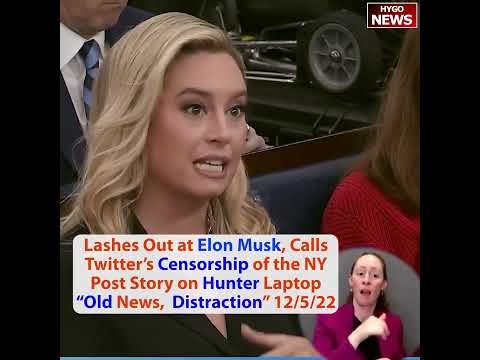
KJP Dismisses Twitter Files Revelations as “Distraction” and “Old News” — Calls Elon Musk’s Release “Interesting Coincidence” That “Won’t Help a Single American”
On 12/5/2022, a reporter pressed White House Press Secretary Karine Jean-Pierre for the administration’s view on the “Twitter Files” — the Elon Musk-authorized release of internal Twitter documents showing how the platform had suppressed the October 2020 New York Post story about Hunter Biden’s laptop. “My question was, is it the White House view that these decisions were made appropriately in light of what has come out?” the reporter asked. KJP refused to address the substantive question and instead attacked the release itself: “We see this as an interesting or a coincidence, if I may, that he would so haphazardly, Twitter would so haphazardly push this distraction. That is a full of old news.” KJP called the revelations “a distraction” and claimed “it won’t do anything to help a single American improve their lives” — dismissing what many viewed as evidence of coordinated pre-election suppression of a story that directly affected the Biden family.
The Twitter Files Context
The exchange occurred just days after Elon Musk — who had acquired Twitter in late October 2022 — released internal Twitter documents to journalist Matt Taibbi, who published them as “The Twitter Files.” The first installment revealed the internal decision-making that had led Twitter to suppress the New York Post’s October 14, 2020 story about Hunter Biden’s laptop.
The laptop story had been one of the most controversial media events of the 2020 campaign. The New York Post had published reporting based on emails and other content from a laptop abandoned at a Delaware repair shop. The contents appeared to document Hunter Biden’s foreign business dealings and suggested potential involvement by then-candidate Joe Biden.
Twitter’s response had been unprecedented. The platform had:
- Blocked sharing of the NY Post article via direct message and posting
- Locked the NY Post’s Twitter account for weeks
- Applied its “hacked materials” policy despite no evidence of hacking
- Suppressed distribution of the story more broadly
The Twitter Files revealed that these decisions had been made under significant internal debate, with some Twitter executives expressing doubt about whether the suppression was justified. The files also revealed communications between Twitter and various government and campaign entities regarding content moderation.
The Reporter’s Direct Question
The reporter’s question was specific. “My question was, is it the White House view that these decisions were made appropriately in light of what has come out?” the reporter asked.
The question had several features that made it pointed:
“The White House view” — Asked for an official administration position, not personal opinion.
“These decisions” — Referenced specific Twitter decisions to suppress the laptop story.
“Appropriately” — Asked for a normative judgment about whether the actions were justified.
“In light of what has come out” — Framed the question around the new Twitter Files information, not the original 2020 decisions.
The reporter was asking whether the administration thought Twitter’s suppression of a story damaging to Joe Biden — during the final weeks of the 2020 campaign — had been appropriate conduct. This was a yes-or-no question that admitted of substantive answers.
The Clarification Dodge
KJP’s first response was a clarification-seeking dodge. “Which decisions? By whom?” KJP asked.
The “which decisions?” question was disingenuous. The reporter had been asking about Twitter Files issues, and any follower of news would have understood the context. The clarification-seeking was a delay tactic — forcing the reporter to restate the question while KJP composed her response.
The reporter clarified. “By Twitter,” the reporter said.
KJP acknowledged: “By Twitter on, okay.”
The clarification pattern was common in KJP briefings. When faced with unfavorable questions, KJP would often force restatements that gave her time to think and that sometimes allowed her to shift the question’s framing in subtle ways.
”Interesting Coincidence”
KJP’s substantive response was attacking the release rather than answering the question. “So look, we see this as an interesting or a coincidence, if I may, that he would so haphazardly, Twitter would so haphazardly push this distraction,” KJP said.
The “interesting coincidence” framing was politically pointed. KJP was suggesting that Musk’s release of the Twitter Files was suspiciously timed — though she didn’t specify what the coincidence was supposedly relative to. The implication was that the release was politically motivated rather than journalistically legitimate.
The “haphazardly” characterization was odd. Musk had released the documents through Matt Taibbi, an experienced investigative journalist with a Substack publication. The release had been methodical, not haphazard — organized as a series of threaded posts with specific documentary evidence. Calling the release “haphazard” appeared to be rhetorical dismissal rather than accurate description.
The “full of old news” criticism was also questionable. The New York Post story was from October 2020, but the Twitter Files revealing how the story was suppressed were newly released in December 2022. The internal Twitter communications, policy debates, and decision-making processes documented in the files were genuinely new information, not old news rehashed.
”Not Healthy”
KJP’s characterization escalated. “What is happening? It’s not, it’s frankly, it’s not healthy. It won’t do anything to help a single American improve their lives,” KJP said.
The “not healthy” framing was a significant administration statement. KJP was characterizing journalism exposing social media censorship as “not healthy” for democratic discourse. This was a striking position for a White House spokesperson:
Implied that the censorship was acceptable — Because exposing it was “not healthy.”
Characterized transparency as harmful — Exposure of prior suppression was presented as damaging rather than clarifying.
Prioritized the administration’s political narrative — The “not healthy” standard seemed to align with what was inconvenient for the administration.
Reversed traditional free-speech framing — Usually, suppression was “not healthy” and transparency about suppression was healthy.
The “won’t help a single American improve their lives” framing was also politically telling. It suggested that only narrowly economic concerns mattered — that revelations about media manipulation around a presidential election didn’t affect Americans’ lives. This was a reductive view of what matters to citizens. Questions about how information was managed around elections go to the heart of democratic self-governance.
”Distraction”
KJP returned to the “distraction” framing. “And so look, this is, we see this as an interesting, you know, coincidence and, you know, it’s a distraction,” KJP said.
The repetition of “distraction” was the key political message. By characterizing the Twitter Files as a distraction, KJP was:
Urging reporters to move on — Implying they shouldn’t cover it.
Denying substantive importance — Dismissing it as not worth serious engagement.
Signaling administration preference — Making clear what the administration wanted news coverage to look like.
Avoiding engagement on merits — Not having to address specific revelations.
The “distraction” framing was a standard technique for handling politically damaging news. By characterizing a story as a distraction, spokespeople could decline to address its substance while appearing to dismiss rather than deny.
What KJP Didn’t Address
Notably absent from KJP’s response was any substantive engagement with the actual revelations. The reporter had asked specifically whether the suppression decisions had been “appropriate” — a direct substantive question. KJP hadn’t:
- Defended the suppression as appropriate
- Criticized the suppression as inappropriate
- Said the administration was reviewing the matter
- Distanced the current administration from the 2020 decisions
- Addressed any specific document revealed in the Twitter Files
- Acknowledged the existence of specific Twitter Files revelations
The silence on substance was itself revealing. If the administration thought the suppression had been appropriate, it could have said so. If the administration thought the suppression had been inappropriate, it could have condemned it. The inability to say either suggested that the administration’s preferred answer — which it couldn’t state publicly — was that the suppression had served useful political purposes that the administration didn’t want to explicitly endorse.
The Biden Family Implications
The Twitter Files specifically documented how a story damaging to Joe Biden’s family had been suppressed during the closing weeks of his presidential campaign. This was not an abstract censorship question — it was a concrete case where the Biden family had benefited directly from Twitter’s suppression decision.
Any substantive engagement with the “appropriateness” question required the administration to take a position on whether suppression of a damaging story about the president’s family had been appropriate. This was politically impossible to answer. Admitting the suppression was inappropriate would be admitting Biden had benefited from improper conduct. Defending the suppression as appropriate would be defending media suppression of stories damaging to political allies.
KJP’s escape from this bind was to refuse to engage with the substance at all. The “distraction” framing wasn’t just rhetorical preference — it was political necessity.
The Elon Musk Target
KJP’s reference to “he would so haphazardly” made clear that the framing was attacking Musk personally. “He” clearly referred to Musk, who had authorized the Twitter Files release. The characterization of Musk as “haphazardly” pushing distractions was part of a broader Democratic Party narrative that had emerged after Musk’s Twitter acquisition.
That narrative characterized Musk as an irresponsible actor using Twitter to amplify right-wing content and attack Democratic positions. The “haphazardly” framing fit this narrative — presenting Musk as someone making decisions without proper consideration or professional judgment.
The Biden administration’s relationship with Musk had deteriorated significantly during 2022. Biden had repeatedly declined to acknowledge Tesla’s leadership in electric vehicles, instead crediting GM with supposed EV leadership. Musk had increasingly criticized administration policies. The Twitter Files release deepened this antagonism.
Key Takeaways
- A reporter asked KJP whether the White House viewed Twitter’s suppression of the 2020 NY Post Hunter Biden laptop story as “appropriate” in light of Twitter Files revelations.
- KJP refused to address the substantive question and instead attacked the release itself.
- She called the Twitter Files release “an interesting coincidence” and characterized it as something Musk was “haphazardly” pushing.
- KJP dismissed the revelations as “old news” and “a distraction” that “won’t do anything to help a single American improve their lives.”
- The White House notably never defended or condemned the 2020 Twitter decisions on the merits — only attacked the disclosure of those decisions.
Transcript Highlights
The following is transcribed from the video audio (unverified — AI-generated from audio).
- My question was, is it the White House view that these decisions were made appropriately in light of what has come out?
- Which decisions? By whom? — By Twitter.
- We see this as an interesting or a coincidence, if I may, that he would so haphazardly, Twitter would so haphazardly push this distraction.
- That is a full of old news, if you think about it.
- It’s frankly, it’s not healthy. It won’t do anything to help a single American improve their lives.
- We see this as an interesting, you know, coincidence and, you know, it’s a distraction.
Full transcript: 112 words transcribed via Whisper AI.