 HYGO News
 KJP Won't Say Why Biden Has Not Campaigned In Georgia For Raphael Warnock
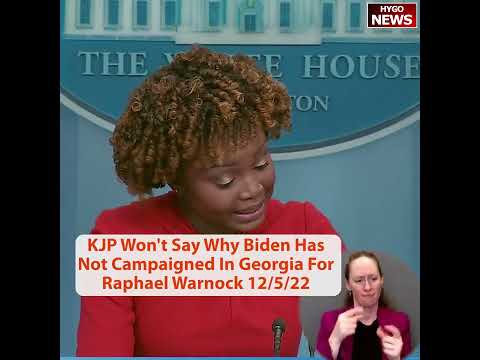
KJP Dodges on Why Biden Skipped Georgia Runoff — Hides Behind “Hatch Act” and Pivots to “Economic Policy Successes”
On 12/7/2022, a reporter asked Press Secretary Karine Jean-Pierre why President Biden hadn’t campaigned in Georgia for Senator Raphael Warnock during the 2022 campaign or the December 6 runoff election. “The president, he didn’t end up going to Georgia during the campaign to campaign for Raphael Warnock. He hasn’t been during the runoff election. Why is that?” the reporter asked. KJP responded with a Hatch Act caveat, then pivoted to a generic defense of Biden’s political activity: “I need to be careful, Hatch Act. Podium that the president will do anything that he can do for Senator Warnock to be helpful to him.” She then shifted to touting fundraising, phone banks, union events, and administration accomplishments — a lengthy pivot that avoided the direct question about why Biden hadn’t appeared in Georgia with Warnock.
The Direct Question
The reporter’s question was specific and factual. “The president, he didn’t end up going to Georgia during the campaign to campaign for Raphael Warnock. He hasn’t been during the runoff election. Why is that?” the reporter asked.
The factual premise was uncontested. Biden had not campaigned in Georgia during either the November 2022 general election or the December 2022 runoff. The absence was conspicuous because:
Georgia was critical to Democratic Senate control — Warnock’s seat was one of the most contested races of the 2022 cycle.
The runoff was a national focus — Even after Democrats secured Senate control on November 8, the Georgia runoff attracted national attention and resources.
Other prominent Democrats did campaign in Georgia — Barack Obama, Stacey Abrams, and many other Democratic figures had appeared for Warnock.
Biden was the sitting Democratic president — Presidential appearances typically provided significant boosts to Senate candidates.
The reporter’s question asked for the explanation for Biden’s absence. It was a reasonable journalism question deserving a direct answer.
The Hatch Act Caveat
KJP’s opening response was a procedural dodge. “So look, I need to be careful, Hatch Act,” KJP said.
The Hatch Act is a federal law that restricts certain political activities by federal employees, including White House staff and press secretaries speaking from the podium. KJP invoking the Hatch Act was a standard technique for avoiding substantive answers to political questions during official briefings.
The Hatch Act invocation had limited legitimacy in this context. While KJP couldn’t use the White House briefing to directly advocate for Warnock, she could explain the President’s scheduling decisions and travel choices. Explaining why the president hadn’t visited Georgia wasn’t partisan advocacy — it was simply reporting on the administration’s activities.
More importantly, the Hatch Act caveat was inconsistent with KJP’s subsequent lengthy pivot to administration accomplishments. If the Hatch Act constrained her from answering the specific Warnock question, why didn’t it constrain her from touting Biden’s “economic policy successes” in a political context? The selective invocation suggested that the Hatch Act was being used as a convenient excuse rather than as a genuine legal constraint.
”From the Podium”
KJP’s statement continued with a broken phrase. “Podium that the president will do anything that he can do for Senator Warnock to be helpful to him,” KJP said.
The sentence structure was incomplete — likely “from the podium” was the intended preamble, but the full construction was garbled. The substance KJP was attempting to convey was that Biden was willing to do whatever he could to help Warnock, while being constrained by Hatch Act rules about political advocacy from the official White House podium.
This framing didn’t actually answer the question. The reporter wasn’t asking whether Biden was generically willing to help Warnock. The reporter was asking specifically why Biden hadn’t campaigned in Georgia. Saying Biden would “do anything he can do” to help didn’t address the factual question of why one specific and conspicuously absent campaign activity — an in-person Georgia visit — hadn’t happened.
The Political Reality
The unstated but obvious political reality was that Warnock’s campaign had likely not invited Biden to campaign in Georgia. Throughout 2022, Democratic candidates in competitive states had maintained strategic distance from Biden whose approval ratings were low. Warnock, running in a purple-trending-blue state like Georgia, had calculated that a Biden appearance would cost more votes than it gained.
This was not unusual in mid-term cycles when a president had low approval. Republicans had kept distance from Trump in 2018 under similar conditions. Democrats had kept distance from Obama in 2014. The pattern was well-established. But acknowledging it required the White House to acknowledge that Biden’s unpopularity was a campaign liability — which the administration wasn’t willing to do publicly.
KJP’s inability to answer the question directly reflected this bind. The honest answer — “Warnock’s campaign didn’t want Biden to appear with him because Biden’s presence would hurt” — was politically impossible to state from the White House podium. But the honest answer also couldn’t be directly contradicted by a claim that Biden had been welcome but chose not to go. The impossibility of giving any truthful answer drove the Hatch Act dodge.
”High Volume of Fundraising”
KJP pivoted to discussing Biden’s political activity elsewhere. “As you all have seen on the president’s schedule recently, he’s done a high volume of fundraising, attended several political events including phone banks and unions and much and with unions and much more,” KJP said.
The pivot served multiple purposes:
Changed the subject — Away from Georgia to other political activity.
Showed Biden was politically active — Countering any impression that he wasn’t engaged in helping Democrats.
Avoided the Georgia specificity — Fundraising and phone banks happened nationally, not in Georgia.
Filled time with content — The verbal volume crowded out further Georgia-specific questions.
The phrase “phone banks and unions and much and with unions and much more” was grammatically broken. KJP was clearly working from talking points without a coherent script, producing repetitive phrasing that suggested her real-time composition was struggling. The doubled “unions” and “much” reflected her mental stalling.
The pivot also didn’t actually answer the question. The reporter hadn’t asked whether Biden was doing other political work. The reporter had asked why Biden wasn’t in Georgia. Listing other activities didn’t explain the specific Georgia absence.
”Economic Policy Successes”
KJP continued the pivot into policy. “And let’s not forget the successes that we have seen, his economic policy successes as we talk about the bipartisan infrastructure legislation, the inflation reduction act, those are the things that the president was able to get done,” KJP said.
The policy pivot moved even further from the Georgia question. Now KJP was reciting administration accomplishments — the Bipartisan Infrastructure Law, the Inflation Reduction Act — that had no obvious connection to why Biden hadn’t campaigned in Georgia.
The accomplishment recitation was a standard technique for filling answer time while ignoring the specific question. Administration accomplishments could be mentioned in response to almost any question, providing a reliable reservoir of on-message content.
The strategic retreat — from Georgia specifics to general political activity to administration accomplishments — was typical of KJP’s difficulty navigating questions that had no administration-friendly direct answer. Rather than give a problematic direct answer, KJP rolled away from the question into safer territory.
The Warnock Victory
Warnock had won the December 6, 2022 runoff, defeating Republican challenger Herschel Walker. Biden’s absence from the campaign hadn’t prevented the victory. This fact could be read two ways:
Biden’s absence didn’t matter — Warnock’s victory suggested that Biden’s campaigning wasn’t needed.
Biden’s absence helped — Warnock’s victory suggested that keeping Biden away was the right strategy.
The reporter asking the question on December 7 knew Warnock had won the previous day. The question wasn’t asking whether Biden’s absence had been a strategic error — Warnock’s victory had resolved that question. The question was asking the White House to acknowledge and explain the absence, which required admitting that the absence had been by the Warnock campaign’s preference rather than by accident.
KJP’s refusal to give this explanation meant that the White House couldn’t even accept post-victory credit for staying out of the way. Biden appeared neither as an engaged campaigner nor as a strategically-deferential ally. He appeared simply absent, which was the worst of both worlds narratively.
The Broader Pattern
Biden’s absence from Georgia was part of a pattern throughout the 2022 cycle. Democratic candidates in competitive races had largely kept Biden at arms length. Fundraising was acceptable because it happened privately. Phone banks and union events were acceptable because they didn’t attach Biden’s name directly to individual candidates. But actual campaign appearances alongside individual candidates had been rare.
This pattern suggested that Biden’s political value to individual candidates was limited in ways the administration wasn’t willing to discuss publicly. The “high volume of fundraising” that KJP mentioned was what Biden could still do — raise money from supporters who were committed to Democrats regardless of Biden’s popularity. What he couldn’t do was win over swing voters in competitive districts or states, where his presence was a net negative.
The 2024 implications were concerning for the administration. If Biden couldn’t effectively campaign for candidates in 2022, his own 2024 reelection campaign would face similar limitations. The White House’s refusal to acknowledge the problem — instead deflecting with Hatch Act caveats and accomplishment lists — meant the problem couldn’t be addressed strategically.
Key Takeaways
- A reporter asked KJP why Biden hadn’t campaigned in Georgia for Senator Raphael Warnock during either the general election or the December runoff.
- KJP invoked the Hatch Act as a reason for being cautious about answering, then pivoted away from the specific question.
- KJP claimed Biden would “do anything that he can do for Senator Warnock to be helpful to him” but didn’t address the Georgia absence.
- She pivoted to discussing Biden’s “high volume of fundraising,” phone banks, and union events — political activity that wasn’t specific to Georgia.
- The pivot continued into touting “economic policy successes” like the Bipartisan Infrastructure Law and Inflation Reduction Act, further avoiding the Georgia question.
Transcript Highlights
The following is transcribed from the video audio (unverified — AI-generated from audio).
- The president, he didn’t end up going to Georgia during the campaign to campaign for Raphael Warnock. He hasn’t been during the runoff election. Why is that?
- So look, I need to be careful, Hatch Act.
- The president will do anything that he can do for Senator Warnock to be helpful to him.
- As you all have seen on the president’s schedule recently, he’s done a high volume of fundraising, attended several political events including phone banks and unions.
- Let’s not forget the successes that we have seen, his economic policy successes.
- The bipartisan infrastructure legislation, the inflation reduction act, those are the things that the president was able to get done.
Full transcript: 127 words transcribed via Whisper AI.