 HYGO News
 KJP Won't Say If Biden Thinks Americans Should Use Chinese App TikTok
By HYGO News
Published
· Updated
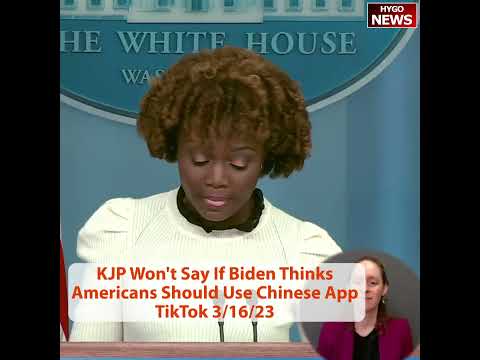
KJP Won’t Say If Biden Thinks Americans Should Use Chinese App TikTok
White House Press Secretary Karine Jean-Pierre declined to say whether President Joe Biden believes Americans should use TikTok during a March 2023 briefing, deflecting twice when a reporter pressed her to respond to an NSA director’s characterization of the Chinese-owned app as a “loaded gun.” The exchange highlighted the White House’s careful positioning as the Committee on Foreign Investment in the United States (CFIUS) weighed a potential forced sale or ban of the platform used by roughly 150 million Americans.
The “Loaded Gun” Characterization
- NSA framing: National Security Agency Director Gen. Paul Nakasone had described TikTok as a “loaded gun” in a public appearance days before the briefing.
- Reliance scope: The characterization cited roughly 150 million American users and growing use of the platform as a primary news source.
- National security frame: Intelligence officials framed the potential for Chinese government influence over content as an acute security concern.
- Algorithmic risk: Officials warned that TikTok’s recommendation algorithm could be weaponized to shape American political views during elections.
- Data exposure: The underlying concern centered on Chinese law potentially compelling ByteDance to share U.S. user data with Beijing.
KJP’s Twofold Deflection
- First question: Asked whether the administration agreed with the “loaded gun” assessment, Jean-Pierre refused to “get ahead of any comments” on TikTok.
- CFIUS reference: The press secretary pointed to an ongoing Committee on Foreign Investment in the United States review as reason to withhold comment.
- Second attempt: A reporter reframed the question as whether Biden thought Americans “should be on TikTok” — still no answer.
- Privacy pivot: Jean-Pierre pivoted to what Biden “believes he needs to do” regarding safety and privacy rather than user behavior.
- No-advice posture: She explicitly said she would not speak to “actions that the American people should take or not take.”
The CFIUS Review Process
- Committee composition: CFIUS reviews include Treasury, Defense, State, Commerce, Justice, and other agencies for national security implications.
- TikTok stakes: The committee had been negotiating with ByteDance for years over potential structural or operational remedies.
- Project Texas: TikTok had proposed “Project Texas” — housing U.S. user data with Oracle under monitored access — as an alternative to divestiture.
- Divestiture pressure: By March 2023, reports indicated the administration was pushing for ByteDance to divest TikTok or face a potential ban.
- Secrecy norms: CFIUS deliberations are statutorily confidential, providing cover for White House non-engagement with specific TikTok questions.
The Government Device Ban
- Executive branch ban: Biden had signed legislation requiring federal agencies to remove TikTok from government devices within 30 days.
- State-level action: More than half of U.S. states had imposed TikTok bans on state government devices by March 2023.
- University campuses: Public universities in Texas, Florida, and other states were blocking TikTok on campus Wi-Fi networks.
- Military: The Department of Defense had prohibited TikTok on military devices since 2020.
- Congressional devices: Both the House and Senate had banned TikTok from congressional staff devices.
The Political Tightrope
- Youth voter reach: Democrats had used TikTok extensively to reach young voters in the 2022 midterms.
- Cabinet members: Several Cabinet members and administration officials maintained active TikTok accounts for public communication.
- Biden campaign: The 2024 campaign was reportedly weighing whether to build a TikTok presence despite security concerns.
- Bipartisan pressure: Both Sen. Mark Warner and Sen. Marco Rubio had publicly criticized TikTok and urged administration action.
- Democratic splits: Rep. Jamaal Bowman and other progressive Democrats defended TikTok as a platform for marginalized voices.
TikTok’s U.S. Response
- CEO testimony: TikTok CEO Shou Zi Chew was scheduled to testify before House Energy and Commerce in March 2023.
- Independence claims: The company consistently argued ByteDance had no access to U.S. user data and could resist Chinese government demands.
- Creator pushback: TikTok flew prominent creators to Washington to lobby against a ban, emphasizing economic impact on small businesses.
- Legal preparation: The company retained prominent First Amendment lawyers in preparation for potential legal challenges to any ban.
- Alternative proposals: Beyond Project Texas, TikTok offered enhanced algorithmic transparency and independent auditing.
The Safety and Privacy Pivot
- KJP’s substitute topic: Rather than address TikTok directly, Jean-Pierre emphasized Biden’s commitment to Americans’ safety and privacy.
- Framework absence: No comprehensive federal privacy legislation existed to backstop the administration’s claims.
- Kids Online Safety: Congressional proposals focused on protecting minors online remained stalled in committee.
- Section 230 review: Broader platform accountability discussions continued to sprawl without legislative traction.
- FTC enforcement: The Federal Trade Commission had limited authority to act against foreign-owned platforms on national security grounds.
The China Strategy Context
- Semiconductor restrictions: Biden had imposed sweeping chip export controls targeting China in October 2022.
- Balloon incident: A Chinese surveillance balloon crossing the U.S. in February 2023 had heightened public concern about Chinese surveillance.
- IRA tensions: The Inflation Reduction Act’s electric vehicle credits excluded Chinese-linked supply chains, creating trade friction.
- Taiwan: Speaker Kevin McCarthy’s anticipated meeting with Taiwan’s president threatened to further escalate tensions.
- Economic statecraft: TikTok fit into a broader pattern of economic tools being used for national security purposes against China.
Key Takeaways
- Jean-Pierre refused twice to say whether Biden believes Americans should use TikTok, citing ongoing CFIUS review.
- The NSA director’s “loaded gun” characterization raised the stakes for administration messaging on the app.
- KJP pivoted from user-behavior questions to abstract commitments about safety and privacy.
- The administration was simultaneously weighing forced divestiture pressure on ByteDance and reviewing “Project Texas” alternatives.
- Federal and state device bans had multiplied in the months before the briefing, creating political momentum for broader action.
- Democrats faced a contradiction between using TikTok to reach young voters and labeling it a national security threat.
Transcript Highlights
The following quotations are drawn from an AI-generated Whisper transcript of the briefing and should be considered unverified pending official transcript release.
- “I’m just not going to get ahead of any comments that’s been made on TikTok at this time.” — Karine Jean-Pierre
- “I’m not going to speak to actions that the American people should take or not take.” — Karine Jean-Pierre
- “Does the President think that Americans should be on TikTok?” — Reporter follow-up
- “NSA Director General has called TikTok a loaded gun because so many Americans rely on it.” — Reporter framing
- “What I can speak to is what the President believes that he needs to do, which is making sure that the safety and privacy of Americans are protected.” — Karine Jean-Pierre
- “Cepheus is looking at, is doing a review. We’re going to let them do their review.” — Karine Jean-Pierre
Full transcript: 160 words transcribed via Whisper AI.