 HYGO News
 KJP Won't Say If Biden Consulted With Governors Before New National Monument Designations
By HYGO News
Published
· Updated
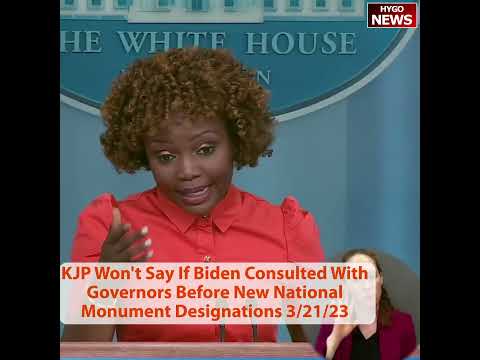
KJP Won’t Say If Biden Consulted With Governors Before New National Monument Designations
White House Press Secretary Karine Jean-Pierre declined to say whether President Joe Biden consulted Nevada Gov. Joe Lombardo before designating the Avi Kwa Ame site as a national monument in March 2023, deflecting when asked directly about Lombardo’s public statement objecting to the designation. Jean-Pierre pointed to the Office of Intergovernmental Affairs’ “constant communications” with governors generally but would not provide a specific readout on the Avi Kwa Ame consultation process.
The National Monument Designation
- Avi Kwa Ame designation: Biden designated roughly 506,000 acres in southern Nevada as the Avi Kwa Ame National Monument.
- Antiquities Act: The designation used the 1906 Antiquities Act, which grants presidents unilateral authority to protect federal lands.
- Tribal significance: The site holds sacred significance for the Mojave and other Yuman-speaking tribes of the Colorado River basin.
- Biodiversity value: The area encompasses critical desert ecosystem habitat including bighorn sheep and desert tortoise populations.
- Administration’s third designation: The Avi Kwa Ame site represented one of Biden’s third national monument designations.
Governor Lombardo’s Objection
- Public statement: Newly elected Republican Gov. Joe Lombardo issued a statement saying his office was not consulted.
- Opposition framing: Lombardo said he opposed the national monument designation publicly.
- Jurisdictional concerns: Governors often object to federal designations that limit state control over lands within their borders.
- Consultation expectations: Historical precedent has varied but typically includes governor consultation before monument designations.
- Political fallout: The public spat added to existing tensions between the Biden administration and Republican governors.
Jean-Pierre’s Non-Answer
- No meetings readout: The press secretary said she had no “meetings to work to talk through or conversations” to share.
- Climate pivot: Jean-Pierre pivoted to Biden’s climate crisis priorities rather than addressing consultation.
- Office of Intergovernmental Affairs: She pointed to the OIA’s “constant communications” with governors as generic answer.
- No specific readout: The press secretary declined to provide specifics on Avi Kwa Ame consultation.
- Standard deflection: The response followed a pattern of deflecting specific questions to generic processes.
The Antiquities Act Context
- Presidential authority: Since 1906, presidents from both parties have used the Antiquities Act to protect federal lands.
- Trump modifications: The first Trump administration dramatically shrank Bears Ears and Grand Staircase-Escalante monuments.
- Biden restoration: Biden restored the original boundaries of those monuments upon taking office.
- Legal challenges: The extent of presidential power to modify or abolish prior designations remains legally contested.
- Conservation legacy: Presidents often use the Antiquities Act late in terms to establish conservation legacies.
Governor Consultation Precedent
- Variable history: Different administrations have shown varying commitments to pre-designation consultation.
- Legal requirement absent: The Antiquities Act does not require consultation with state officials.
- Political best practice: Modern administrations typically notify affected governors regardless of legal requirements.
- Grand Staircase precedent: Bill Clinton’s 1996 Grand Staircase designation famously bypassed Utah’s Republican governor.
- Biden commitments: The administration publicly emphasized commitment to collaborative federal-state-tribal partnerships.
Avi Kwa Ame’s Tribal Significance
- Spirit Mountain: The site includes Spirit Mountain (Newberry Peak), sacred to the Mojave and other Yuman tribes.
- Creation story: According to Mojave tradition, the mountain is the place of creation for their people.
- Tribal advocacy: A coalition of 12 tribes advocated for the monument designation for years.
- Congressional support: Nevada’s Democratic senators Catherine Cortez Masto and Jacky Rosen supported the designation.
- Cultural protection: The designation provides federal protection for cultural and archaeological resources.
Environmental and Economic Considerations
- Desert ecosystem: The area encompasses rare desert ecosystems with high biodiversity value.
- Mining concerns: Some mining interests opposed the designation due to restrictions on new mineral development.
- Renewable energy: The designation complicated some proposed solar and wind projects in the region.
- Grazing permits: Existing grazing permits within monument boundaries continued under new management.
- Tourism potential: Monument designation typically increases visitation and associated tourism economy.
The Biden Conservation Agenda
- 30x30 goal: The administration committed to conserving 30% of U.S. lands and waters by 2030.
- Prior designations: Earlier monument designations included Camp Hale and Castner Range in 2022.
- Executive action emphasis: With Congress divided, executive conservation actions became increasingly important.
- Interior Department: Secretary Deb Haaland has been a central figure in conservation designations.
- Tribal consultation priority: The administration prioritized tribal consultation in conservation decisions.
The Political Landscape
- Federal lands politics: Federal lands management remains contentious in western states with large federal land holdings.
- Rural-urban divide: Conservation decisions often create tension between urban environmental advocates and rural residents.
- Republican opposition: Republican governors across the West have repeatedly challenged federal land designations.
- Legal strategy: States have pursued various legal challenges to expansive federal designations.
- 2024 politics: Conservation designations may factor into rural western state dynamics in the presidential election.
Key Takeaways
- Jean-Pierre declined to say whether Biden consulted Nevada Gov. Joe Lombardo before designating the Avi Kwa Ame National Monument.
- Lombardo publicly stated he was not consulted and opposed the designation.
- The press secretary pointed to the Office of Intergovernmental Affairs’ “constant communications” with governors as a generic answer.
- Jean-Pierre pivoted to Biden’s climate crisis priorities rather than addressing specific consultation questions.
- The Antiquities Act grants presidents unilateral authority to designate national monuments without state consultation requirements.
- The site holds profound sacred significance for the Mojave and other Yuman-speaking tribes of the Colorado River basin.
Transcript Highlights
The following quotations are drawn from an AI-generated Whisper transcript of the briefing and should be considered unverified pending official transcript release.
- “I don’t have any meetings to work to talk through or conversations.” — Karine Jean-Pierre
- “I can’t speak to any conversation that has been had with the governor.” — Karine Jean-Pierre
- “The President is taking tackling the climate crisis as a priority.” — Karine Jean-Pierre
- “Nevada governor Joe Lombardo put out a statement saying that they were not consulted on the Abiquamia site and that he opposes it being designated as a national monument.” — Reporter framing
- “The president and his office of intergovernmental affairs which deals with the governors and deals with mayors and also local elected officials is in constant communications.” — Karine Jean-Pierre
- “I just don’t have a readout to give you on that.” — Karine Jean-Pierre
Full transcript: 150 words transcribed via Whisper AI.