 HYGO News
 KJP Suggests Biden Still Has NO PLANS To Visit The Southern Border
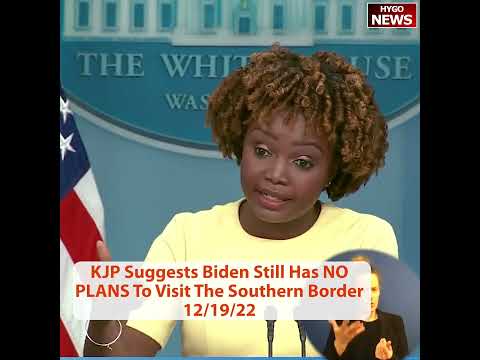
Reporter Cites Dem Rep Cuellar on Biden Border Visit: “A Leader Has to Show Images of Being Up There” — KJP Deflects Again
On 12/20/2022, a reporter cited Democratic Representative Henry Cuellar’s call for Biden to visit the border. “Representative Cuellar told Face Nation that he wants to see President Biden go to the border. He said it doesn’t have to be for a photo op, but a leader has to show images of being up there in front,” the reporter said. “So does the President have any plans to go to the borders now? A good time to go?” White House Press Secretary Karine Jean-Pierre deflected: “Look, the President’s focus right now is to come up with solutions. It’s focused on making sure that we have the resources to manage the challenges that we’re seeing at the border.” She dismissed further follow-up: “I just answered the question. I just said we’ve litigated that back and forth here for the past two weeks or so.”
The Henry Cuellar Context
Representative Henry Cuellar’s call for a Biden border visit was politically significant. Cuellar was:
Texas Democrat — Border district.
Conservative Democrat — Moderate voice.
Border advocate — Representing Laredo area.
Experienced legislator — Multi-term congressman.
Administration critic — On some issues.
Cross-partisan credibility — For border concerns.
When Cuellar called for Biden to visit the border, the administration couldn’t dismiss him as Republican grandstanding. A Democratic congressman representing a border district was publicly asking for presidential engagement.
”Not for a Photo Op”
Cuellar’s specific framing was important. The reporter quoted him: “He said it doesn’t have to be for a photo op, but a leader has to show images of being up there in front.”
The “not for a photo op” qualifier was significant:
Preempted administration objection — That visits would be performative.
Acknowledged concern — About presidential imagery.
Emphasized substantive goal — Not just publicity.
“Leader has to show images” — Visual leadership matters.
“Being up there in front” — Presidential presence.
Cuellar was addressing the administration’s apparent reason for avoiding the border. If the concern was that visits would be “political stunts” or photo ops, Cuellar was acknowledging that concern while arguing that leadership required visible presence regardless.
The framing was sophisticated political communication:
From a Democrat — Cross-partisan credibility.
With border experience — Substantive foundation.
Not performative — Focus on leadership.
Visual necessity — Imagery as substance.
Leadership expectation — Of presidential role.
The Reporter’s Follow-Up
The reporter asked directly. “So does the President have any plans to go to the borders now? A good time to go?” the reporter asked.
The question had specific components:
“Any plans” — Current administration planning.
“To go to the borders now” — Immediate action.
“A good time to go” — Strategic timing question.
Conditional framing — Given current crisis.
Cuellar’s public call, combined with the approaching Title 42 end and El Paso’s emergency, created a specific political moment. The reporter was testing whether the administration recognized this moment as requiring presidential engagement.
The Familiar Deflection
KJP’s response was familiar. “Like you said, I’ve addressed this before. Look, the President’s focus right now is to come up with solutions,” KJP said.
The “addressed this before” framing:
Claimed repetition — The question had been asked.
Implied settled answer — No new engagement needed.
Reduced follow-up pressure — By dismissing asking.
Familiar technique — Used across topics.
Terminated substantive engagement — Before it began.
But the question was genuinely new. Cuellar’s specific call was a new data point. The approaching Title 42 end was new context. The El Paso emergency was new. The reporter wasn’t asking the same question — they were asking about new circumstances.
”Focus on Solutions”
KJP framed presidential focus. “The President’s focus right now is to come up with solutions,” KJP said.
“Focus on solutions” was vague:
No specific solutions — Identified.
No geographical specifics — For focus.
No timeline — For solutions.
No measurable goals — For effort.
No personal engagement — Described.
The framing implied Biden was engaged without describing the engagement. Working on solutions without visiting the border created a specific disconnect — the solutions presumably affected the border, which Biden wouldn’t visit. This disconnect wasn’t addressed.
”Resources to Manage Challenges”
KJP pivoted to resources. “It’s focused on making sure that we have the resources to manage the challenges that we’re seeing at the border,” KJP said.
The resource framing emphasized:
Federal capacity — Rather than presidential presence.
Management — Rather than leadership.
Challenges at border — Acknowledged.
Budget request — As primary response.
Administrative focus — Rather than personal.
This framing was consistent with the administration’s approach throughout 2022. The border was treated as an operational challenge requiring resources, not as a leadership moment requiring presidential presence. This approach had been the administration’s preference despite Democratic and Republican calls for Biden to visit.
The Budget Request Reference
KJP mentioned the Congressional request. “And right now, as you know, we have a budget request in front of Congress. And again, if Congressional Republicans are serious about dealing with the challenges that we’re seeing at the border, they will assist,” KJP said.
The budget request was real but substituted for other engagement:
Requested — But not yet approved.
Congressional responsibility — Rather than executive.
Republican blame — For non-approval.
Administration engagement — Through requests.
Presidential visibility — Not through budget requests.
A budget request wasn’t a substitute for presidential presence. Congress often approved or denied requests regardless of presidential personal engagement. And presidential presence couldn’t be replaced by budget submissions.
The “Given What We’re Seeing” Interruption
The transcript captured an interruption. “But given what we’re seeing at the border,” the reporter started, apparently trying to follow up.
KJP cut off the follow-up. “I just answered the question. I just said we’ve litigated that back and forth here for the past two weeks or so,” KJP said.
The “I just answered” framing:
Claimed question was answered — Though it hadn’t been.
Appealed to repetition — “Back and forth for two weeks.”
Terminated engagement — Preventing follow-up.
Asserted control — Over briefing flow.
Deflected accountability — By claiming completion.
“Litigated back and forth” was dismissive language. Border visit questions weren’t legal matters to be “litigated.” They were legitimate questions deserving direct answers.
”Past Two Weeks or So”
KJP cited duration. “We’ve litigated that back and forth here for the past two weeks or so,” KJP said.
The “two weeks” framing suggested:
Extensive prior coverage — Making current question redundant.
Settled matter — Not requiring further engagement.
Briefing fatigue — For the topic.
Repetition claim — Though question contexts varied.
But two weeks earlier, the El Paso emergency hadn’t been declared. Cuellar hadn’t made his specific call. The Supreme Court hadn’t intervened. Circumstances had changed substantially. “Two weeks of litigation” didn’t accurately reflect the evolving situation.
The Dismissive Pattern
KJP’s dismissive response fit a broader pattern:
Legitimate questions asked — By reporters.
Administration deflection — Through various techniques.
Claims of prior coverage — To terminate engagement.
Budget request pivots — To avoid other questions.
Republican blame — As consistent fallback.
This pattern reduced briefing informational value. Reporters who pressed substantive questions were met with dismissive framings. Viewers couldn’t extract useful information about administration positions on evolving situations.
The Democratic Pressure Context
By late December 2022, Democratic pressure on Biden for border engagement was growing:
Cuellar’s public call — For visit.
Various Democratic governors — Expressing concern.
Border state Democrats — Facing local pressure.
Progressive critics — On humanitarian grounds.
Moderate Democrats — On political grounds.
The administration’s position — avoiding the border despite Democratic calls — was becoming increasingly untenable. Republicans had been calling for visits for months. Democratic calls represented new pressure. The political calculation that had supported avoidance was shifting.
The January 2023 Visit
Biden eventually visited El Paso on January 8, 2023 — about two weeks after this briefing. The visit:
Was brief — Few hours.
Was carefully managed — Limited exposure to chaos.
Came after sustained pressure — From multiple sources.
Was reactive — Not proactive.
Was limited — In substantive engagement.
The visit didn’t match Cuellar’s call for visible presidential leadership. Biden went to El Paso, had meetings with officials, and left. There was no substantive engagement with conditions that would have justified the call for visual leadership.
But the visit happened, ending the specific “Biden has never visited the border” narrative. Administration messaging after the visit could note Biden’s El Paso trip as evidence of engagement.
The Cuellar Role
Henry Cuellar continued being a moderate Democratic voice on border issues throughout 2023 and beyond. His specific role:
Border district representation — Direct experience.
Cross-partisan positioning — Moderate Democrat.
Media engagement — Frequent.
Administration criticism — When warranted.
Party balance — Between wings.
Cuellar’s December 2022 call for Biden to visit was one of many occasions he publicly pressed the administration. His willingness to criticize his own party made him particularly effective at communicating border concerns to audiences beyond Republican critics.
The Communications Cost
The administration’s handling of border visit questions had communication costs:
Perceived detachment — From border realities.
Elitism framing — For Republicans to exploit.
Democratic frustration — With administration.
Media coverage pattern — Focused on avoidance.
Campaign vulnerability — For 2024.
Each briefing where KJP deflected border visit questions added to the cumulative record. The record would inform 2024 campaign messaging, with Republicans likely to cite the pattern of avoidance.
Key Takeaways
- A reporter cited Democratic Representative Henry Cuellar’s call for Biden to visit the border: “A leader has to show images of being up there in front.”
- Cuellar specifically said the visit “doesn’t have to be for a photo op” — preempting administration deflection.
- KJP didn’t commit to a visit: “The President’s focus right now is to come up with solutions.”
- She cited the budget request and Republican blame framing.
- When the reporter tried to follow up, KJP cut off: “I just answered the question. I just said we’ve litigated that back and forth here for the past two weeks or so.”
- Biden eventually visited El Paso in January 2023, about two weeks after this briefing — a visit that was brief, carefully managed, and came after sustained pressure.
Transcript Highlights
The following is transcribed from the video audio (unverified — AI-generated from audio).
- Representative Cuellar told Face Nation that he wants to see President Biden go to the border.
- He said it doesn’t have to be for a photo op, but a leader has to show images of being up there in front.
- So does the President have any plans to go to the borders now? A good time to go.
- The President’s focus right now is to come up with solutions. It’s focused on making sure that we have the resources to manage the challenges that we’re seeing at the border.
- If Congressional Republicans are serious about dealing with the challenges that we’re seeing at the border, they will assist.
- I just answered the question. I just said we’ve litigated that back and forth here for the past two weeks or so.
Full transcript: 167 words transcribed via Whisper AI.