 HYGO News
 KJP Says Biden "Inherited A Mess" At Southern Border, Says "Republicans Made it Worse"
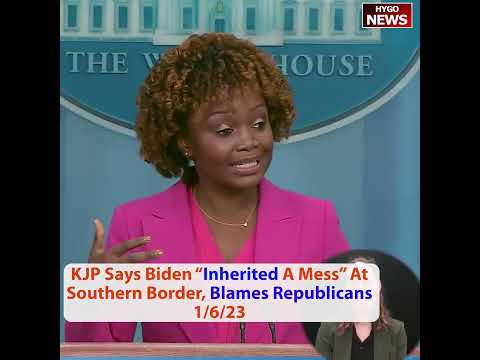
KJP: “President Inherited a Mess” From Trump, “Republicans Made It Worse” By Blocking Immigration Reform
On 1/5/2023, a reporter asked White House Press Secretary Karine Jean-Pierre about Biden’s strategy for comprehensive immigration reform with the new Congress. “In terms of comprehensive immigration reform, which obviously the president has called on Congress to enact over and over again, what is his sort of theory of the case right now for getting that done?” the reporter asked. KJP responded with the familiar “inherited a mess” framing: “The president put forth a comprehensive immigration reform on day one. And look, I also want to just put this in a broader context here. The president inherited a mess because of what the last administration did. They herited, we herited a mess. And you know, Republicans in Congress made it worse by blocking comprehensive immigration reform.”
The Reform Question
The reporter asked substantively. “What is his sort of theory of the case right now for getting that done? Will he be taking in his own actions to do outreach to members? Does he basically consider that a top priority going into the new Congress?” the reporter asked.
The question had dimensions:
Strategy question — Theory of the case.
Personal engagement — Outreach to members.
Priority assessment — Top priority status.
New Congress context — Republican House.
Substantive inquiry — About legislative work.
The “theory of the case”:
Legal phrase — For strategic approach.
Implying planning — Was needed.
Requires specificity — For real strategy.
Professional framing — Of policy work.
Serious inquiry — Not political.
”It Is a Type Priority”
KJP confirmed priority. “So first of all, it is a type priority,” KJP said.
The “type priority”:
Transcription error — Likely for “top priority.”
Affirmation — Of importance.
Standard framing — For administration priorities.
Political positioning — As engaged.
Response pattern — Routine.
“Top priority” characterizations:
Were routine — For various issues.
Diluted by overuse — Somewhat.
Political signaling — Primary function.
Not commitment — To specific action.
Standard practice — Across administrations.
”Day One” Framing Yet Again
KJP invoked “day one.” “The president put forth a comprehensive immigration reform on day one,” KJP said.
The “day one” framing:
Reference to January 20, 2021 — Bill sent to Congress.
Administration claim — For engagement.
Legislative attempt — That went nowhere.
Repeated invocation — Over two years.
Standard talking point — By 2023.
The bill:
U.S. Citizenship Act — Original name.
Comprehensive scope — Multi-faceted.
Never moved — In Congress.
Dormant — By late 2022.
Symbolic reference — Only by 2023.
Using “day one” framing two years later:
Showed administration priorities — Allegedly.
Avoided current actions — Specifically.
Maintained narrative — Of engagement.
Deflected present questions — To past proposals.
Limited informational value — Despite repetition.
”Broader Context”
KJP pivoted to context. “I also want to just put this in a broader context here,” KJP said.
The “broader context” framing:
Standard pivot — Before blame-shifting.
Signaled direction — Of response.
Context often meant blame — In administration usage.
Avoiding specifics — Of current situation.
Extended framing — For political purposes.
”Inherited a Mess”
KJP used the familiar inheritance framing. “The president inherited a mess because of what the last administration did,” KJP said.
The “inherited a mess” framing:
Blame previous administration — Trump.
Avoid current responsibility — Biden.
Standard political — Defense.
Two-year-old framing — Still used.
Deflection technique — Routine.
The “mess” characterization:
Problematic description — Of border conditions.
Characterization rather than facts — Political.
Specific issues — Not detailed.
Inheritance claim — For responsibility.
Continuing use — Despite time.
By early 2023:
Biden administration — Two years in.
Border conditions — Affected by Biden policies.
Trump era — Receding as explanation.
Administration choices — Mattering more.
Blame-shifting — Less credible.
”They Herited, We Herited”
KJP’s verbal stumble was notable. “They herited, we herited a mess,” KJP said.
The “herited” (inherited) stumbles:
Verbal pattern — KJP characteristic.
Quick correction — Without acknowledgment.
Not “inherited” — Twice.
Moving on — Without pause.
Typical delivery — Under pressure.
The “they herited, we herited”:
Confused pronoun — Who inherited.
Starting with “they” — Wrong.
Correcting to “we” — Right.
Real-time stumble — Not prepared.
Standard pattern — For KJP.
”Republicans Made It Worse”
KJP added Republican blame. “Republicans in Congress made it worse by blocking comprehensive immigration reform,” KJP said.
The Republican-blame framing:
Standard administration line — On immigration.
Blocking reform — Specific claim.
Making conditions worse — Attributed.
Bipartisan blame — Extended.
Political deflection — Continued.
But “Republicans blocking reform”:
Was partly accurate — For comprehensive bills.
Was partly misleading — Democrats had priorities.
Simplified complex politics — For messaging.
Avoided administration choices — On executive action.
Standard rhetoric — From both sides.
The reality:
Comprehensive reform — Had bipartisan opposition.
Different priorities — Across parties.
Various Democratic positions — Also.
Biden administration — Hadn’t fully engaged.
Complex situation — Beyond simple blame.
”He’s Acting”
KJP pivoted to action. “What you’re seeing from this president is he’s acting. He’s acting to protect, to continue to protect the border, secure the border, and also deal with irregular migration,” KJP said.
The “acting” framing:
Present tense engagement — Claimed.
Three objectives — Listed.
Border protection — Priority.
Border security — Related.
Irregular migration — Addressed.
Specific administration actions included:
CBP One app — For asylum appointments.
Humanitarian parole — For specific populations.
Regional processing — Centers.
Venezuela policy — Specific.
Other policy tools — Various.
Whether these actions:
Were sufficient — Debatable.
Addressed concerns — Mixed.
Protected borders — Disputed.
Secured operations — Partial.
Solved problems — No.
The “acting” framing:
Claimed engagement — Without detailed effectiveness.
Listed multiple objectives — For comprehensive framing.
Political positioning — Rather than analysis.
Deflected specifics — To general activity.
Standard administration — Response.
The Three Objectives
KJP listed three objectives:
Protect the border — Physical.
Secure the border — Operational.
Deal with irregular migration — Flows.
These three:
Somewhat redundant — Overlap.
Comprehensive — Ostensibly.
Political framing — For messaging.
Not prioritized — Among objectives.
Rhetorical rather than operational — Framework.
Operational reality:
Trade-offs existed — Between objectives.
Resource constraints — Real.
Policy tensions — Natural.
Specific programs — Necessary.
Measurable outcomes — Needed.
The administration’s approach had:
Mixed priorities — Across objectives.
Various policies — Sometimes conflicting.
Political considerations — Driving decisions.
Operational challenges — Limiting options.
Limited comprehensive coherence — In practice.
The “Theory of the Case”
The reporter’s specific question about “theory of the case” wasn’t answered:
What was the strategy — For reform?
Timeline for action — Beyond requests?
Specific provisions — Being negotiated?
Republican engagement — Planned?
Democratic coalition — Building?
KJP’s response:
Didn’t detail strategy — Specifically.
Didn’t address outreach — Personally.
Didn’t describe priority work — Substantively.
Used familiar framing — Instead.
Avoided specifics — Throughout.
For substantive reform, the administration needed:
Specific legislative strategy — Not just “day one.”
Republican engagement — Genuinely.
Compromise framework — Pragmatically.
Coalition building — Beyond party.
Measurable goals — Achievable.
None of this was:
Detailed in response — To question.
Apparently pursued — Systematically.
Yielding results — Visibly.
Prioritized — By administration.
Time-bounded — With milestones.
The Republican House Context
The new Congress had:
Republican House control — Starting January 2023.
Democratic Senate — Continuing.
Divided government — Established.
McCarthy speakership — Troubled.
Various priorities — Competing.
For immigration reform:
Republican priorities — Enforcement.
Democratic priorities — Legalization.
Fundamental disagreement — On approach.
Limited overlap — On specifics.
Unlikely comprehensive deal — Without compromise.
The administration’s:
“Comprehensive reform” — Maintained as goal.
Actual negotiation — Limited.
Compromise willingness — Unclear.
Specific proposals — Not emphasized.
Rhetorical engagement — Continued.
The Pattern of Blame
The administration’s pattern:
Trump blame — For inheritance.
Republican blame — For obstruction.
Executive action — When convenient.
Congressional inaction — Blamed.
Administration claim — Of engagement.
This pattern:
Served political purposes — Consistently.
Deflected accountability — From specifics.
Maintained narrative — Of victimhood.
Avoided compromises — That might antagonize base.
Continued regardless — Of outcomes.
By early 2023:
Two years into term — Blaming predecessors.
Growing accountability expectations — From voters.
Diminishing returns — From blame-shifting.
Political vulnerabilities — Accumulating.
2024 considerations — Emerging.
The Substantive Gap
The reporter’s substantive question revealed gap:
Strategy not articulated — In response.
Priorities not demonstrated — Specifically.
Engagement not detailed — Operationally.
Results not claimed — Measurably.
Prospects not assessed — Realistically.
This gap:
Showed lack of substantive approach — Perhaps.
Reflected communication choices — Definitely.
Frustrated reporters — Routinely.
Limited public understanding — Of efforts.
Enabled administration flexibility — Politically.
The Biden Personal Engagement
The reporter asked specifically about Biden. “Will he be taking in his own actions to do outreach to members?” the reporter asked.
Biden’s personal engagement:
Limited on immigration — Historically.
Outreach unknown — Specifically.
Priority unclear — Personally.
Public engagement — Minimal.
Delegation pattern — Observable.
The question went:
Unanswered specifically — By KJP.
Deflected to administration — Generally.
Lost in broader framing — Of context.
Not addressed — Substantively.
Pattern of avoidance — Continued.
Key Takeaways
- A reporter asked KJP about Biden’s strategy for comprehensive immigration reform with the new Congress.
- KJP confirmed it was a “top priority” and referenced Biden’s “day one” comprehensive immigration reform bill.
- She invoked the “inherited a mess” framing: “The president inherited a mess because of what the last administration did.”
- KJP stumbled verbally: “They herited, we herited a mess.”
- She blamed Republicans: “Republicans in Congress made it worse by blocking comprehensive immigration reform.”
- The “he’s acting” framing listed three objectives: protecting, securing, and dealing with irregular migration.
- The specific question about “theory of the case” and Biden’s personal outreach went unanswered substantively.
Transcript Highlights
The following is transcribed from the video audio (unverified — AI-generated from audio).
- What is his sort of theory of the case right now for getting that done?
- The president put forth a comprehensive immigration reform on day one.
- The president inherited a mess because of what the last administration did.
- They herited, we herited a mess.
- Republicans in Congress made it worse by blocking comprehensive immigration reform.
- He’s acting to protect, to continue to protect the border, secure the border, and also deal with irregular migration.
Full transcript: 159 words transcribed via Whisper AI.