 HYGO News
 KJP Refuses To Say If Biden Was 'Sloppy' In His Handling Of Classified Materials
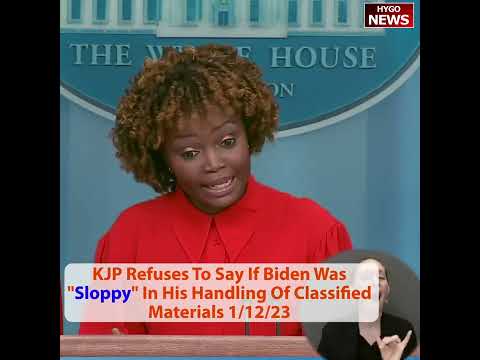
Reporter: Was Biden “Sloppy” With Classified Documents? — KJP Refuses to Answer, Defers to Lawyer Statement
On 1/12/2023, a reporter asked White House Press Secretary Karine Jean-Pierre a pointed question about Biden’s handling of classified materials. “This is the kind of thing that can cause government employees to lose their security clearance. This is a serious matter, as the White House has said. Was the President sloppy to handle the classified material after multiple locations where classified documents are being found?” the reporter asked. KJP refused to characterize Biden’s handling: “I said this in my, I said it in the statement. It’s in the statement of, from his lawyer, Richard Sauber. And at the end, he said, we are confident that they are thorough review. We’ll show that these documents were inadvertently misplaced.” She deflected: “I’m going to leave it there. That’s what his lawyer said.”
The Security Clearance Context
The reporter established context. “This is the kind of thing that can cause government employees to lose their security clearance. This is a serious matter, as the White House has said,” the reporter said.
The security clearance context:
Government employees — Face consequences.
Security clearance loss — For mishandling.
Career-ending — Typically.
Legal implications — Possible.
Standard treatment — For rank-and-file.
The “serious matter” framing:
White House’s own language — Used.
Administration admission — Of seriousness.
Accountability expectation — Established.
Comparison to employees — Implicit.
Two-tier justice question — Implied.
The “Sloppy” Characterization
The reporter used the specific word. “Was the President sloppy to handle the classified material after multiple locations where classified documents are being found?” the reporter asked.
“Sloppy”:
Descriptive characterization — Of handling.
Not criminal — Accusation.
Behavioral description — Neutral legally.
Media-friendly term — For coverage.
Accountability framing — Reasonable.
The reporter’s logic:
Multiple locations — Documents found.
Pattern of mishandling — Evident.
Standard characterization — Appropriate.
Not extreme accusation — Just descriptive.
Legitimate question — For administration.
The Multiple Locations
The classified documents had been found:
Penn Biden Center — Think tank office.
Wilmington garage — Next to Corvette.
Personal library — In home.
Multiple file cabinets — Various.
Rolling discoveries — Continuing.
Multiple locations:
Pattern of mishandling — Clear.
Not isolated incident — Systemic.
Post-VP period — Concerning.
Various locations — Unsecured.
“Sloppy” fit — Reasonably.
”I Said This in My Statement”
KJP’s first deflection. “Look, I said this in my, I said it in the statement,” KJP said.
The “in the statement” reference:
Prepared statements — Released earlier.
Lawyer statements — Specifically.
Formal communications — Not briefing answers.
Deflection to documents — Written.
Standard technique — For hard questions.
Administrative responses:
Written first — For control.
Repeated in briefings — Without variation.
Limited discussion — Beyond prepared.
Standard messaging — Discipline.
Substantive avoidance — Through formality.
The Richard Sauber Reference
KJP cited Biden’s lawyer. “It’s in the statement of, from his lawyer, Richard Sauber,” KJP said.
Richard Sauber:
Biden special counsel — At White House.
Documents coordinator — For administration.
Statements author — Various.
Public spokesperson — On documents.
Legal strategist — Primary.
The statements:
Carefully crafted — Legally.
Protective of Biden — Politically.
Standard legal language — Throughout.
Limited admissions — Strategic.
Coordinated messaging — With WH.
”Inadvertently Misplaced”
The key phrase. “We are confident that they are thorough review. We’ll show that these documents were inadvertently misplaced,” KJP quoted.
“Inadvertently misplaced”:
Key legal framing — Of conduct.
“Inadvertently” — Not intentional.
“Misplaced” — Not deliberate storage.
Passive voice — Deflecting responsibility.
Legal protection language — Throughout.
The framing:
Minimized intent — Legally important.
Distinguished from Trump — Who allegedly obstructed.
Protected from charges — Potentially.
Political framing — As innocent mistake.
Standard defense — For such matters.
But “inadvertently misplaced”:
Still mishandling — Technically.
Still security violation — Substantively.
Still “sloppy” — Descriptively.
Didn’t answer question — Directly.
Avoided characterization — Tactically.
”Promptly Upon Discovery”
The lawyer statement emphasized prompt action. “The President and his lawyers acted promptly upon discovery of this mistake,” the statement said.
“Promptly upon discovery”:
Timing of response — Emphasized.
After discovery — Qualifier.
Discovery was delayed — Years.
“Mistake” — Minimizing characterization.
Standard legal framing — Of conduct.
“Prompt” action:
After discovery — In November 2022.
But documents — Had been there for years.
Discovery was reactive — Not proactive.
Action following — Legal requirement.
Not admirable — Just compliant.
”I’m Going to Leave It There”
KJP terminated the engagement. “I’m going to leave it there. That’s what his lawyer said,” KJP said.
The “leave it there”:
End of engagement — On specific topic.
Procedural termination — Of questioning.
Substantive avoidance — Maintained.
Deflection to lawyer — As sufficient.
Standard technique — For hard topics.
The closure:
Didn’t answer — “Sloppy” question.
Referenced statement — Instead of responding.
Controlled briefing flow — Administratively.
Frustrated reporter — Predictably.
Moved to next topic — Eventually.
”Takes This Very Seriously”
KJP repeated standard framing. “But again, this is something that the President takes very seriously. And we have been coordinating. They have been coordinating,” KJP said.
The “takes this very seriously”:
Standard administration response — To all concerns.
Unfalsifiable claim — By design.
Political positioning — As responsible.
Accountability substitute — For actual engagement.
Ritual incantation — Essentially.
The phrase appeared:
Across topics — Consistently.
Under pressure — Particularly.
Without specifics — Always.
Diminished by repetition — Gradually.
Standard deflection — Recognized.
”We Have Been Coordinating”
KJP’s “coordinating” framing. “They have been coordinating,” KJP said.
“Coordinating”:
With DOJ — On investigation.
Legal procedures — Followed.
Administrative cooperation — Claimed.
Process over substance — Emphasis.
Avoidance of characterization — Through process.
The coordination language:
Emphasized compliance — Legal.
Avoided accountability — Political.
Process-focused — Rather than substance.
Standard legal response — To investigations.
Political shield — From questions.
The Sloppy Question’s Significance
The “sloppy” question had political importance:
Simple characterization — Of handling.
Media-ready term — For coverage.
Not extreme — Or accusatory.
Reasonable question — About conduct.
Refused answer — Revealing.
KJP’s refusal:
Implied the answer — Yes, sloppy.
But politically unspeakable — From WH.
Revealed the tension — In defense.
Legal vs. political — Framing.
Standard non-answer — Technique.
The Legal vs. Political Framing
The administration’s framing had tensions:
Legal framing — Minimizes intent.
Political framing — Emphasizes responsibility.
Competing priorities — For White House.
Shield from charges — Legal.
Political accountability — Required.
The “inadvertently misplaced” framing:
Served legal protection — Effectively.
Undermined political accountability — Somewhat.
Made “sloppy” accurate — Technically.
But politically damaging — To admit.
Required deflection — From question.
The Multiple Discoveries Problem
The multiple locations represented:
Systematic failure — Not isolated.
Pattern of mishandling — Clear.
Multiple years — Of exposure.
Various sites — Unsecured.
Rolling disclosures — Problematic.
This pattern:
Supported “sloppy” — Characterization.
Undermined “inadvertent” — Framing.
Multiple mistakes — Harder to dismiss.
Systematic issue — Suggested.
Political problem — Significant.
The Two-Tier Justice Concern
The reporter’s security clearance reference:
Regular employees — Face consequences.
President protected — Apparently.
Different standards — Applied.
Accountability gap — Exposed.
Legitimate concern — For many.
Security clearance processes:
Strict for regular employees — Typically.
Revocation common — For violations.
Career impact — Severe.
Different from presidential — Entirely.
Political protection — De facto.
The gap concerned:
Rank-and-file — In security roles.
Former employees — Who lost clearances.
Public — About equal justice.
Oversight bodies — Watching.
Political opponents — For attack.
The Biden Defense Strategy
The Biden legal defense:
“Inadvertent” — Keystone.
“Cooperation” — Emphasized.
Lawyer statements — Controlled.
Political/legal separation — Attempted.
Trump contrast — Exploited.
The strategy had:
Legal effectiveness — Potentially.
Political limitations — Real.
Media recognition — Of pattern.
Public skepticism — Growing.
Long-term damage — Accumulating.
The Special Counsel Implications
After January 12:
Special Counsel Robert Hur — Appointed.
Formal investigation — Year-long.
Evidence gathering — Comprehensive.
Final report — February 2024.
Political impact — Significant.
The Hur report would:
Confirm mishandling — Occurred.
Not recommend charges — Technically favorable.
Describe Biden as — “Elderly man with poor memory.”
Damage politically — Significantly.
Affect 2024 — Substantially.
The Pattern of Non-Response
KJP’s pattern across classified documents briefings:
Refuse characterization — Of handling.
Defer to lawyer — Statements.
Emphasize cooperation — Standard.
Deflect to process — Legal.
Avoid substantive — Political engagement.
This pattern:
Protected Biden — Short-term.
Frustrated media — Consistently.
Damaged credibility — Gradually.
Built negative narrative — Over time.
Standard approach — Despite costs.
The Media Dynamic
Media response:
Conservative outlets — Extensive coverage.
Liberal outlets — Cautious coverage.
Mainstream media — Gradually increasing.
Social media — Extensive discussion.
Political implications — Growing.
The “sloppy” question:
Fox News style — Characterization.
Would have been — Politically devastating if answered yes.
Politically impossible — To answer no given facts.
Deflection required — For administration.
Typical refusal — To characterize.
The Transparency Erosion
Each briefing eroded transparency credibility:
Promise of transparency — Undermined.
Specific deflections — Accumulated.
Pattern recognition — By observers.
Credibility damage — Systematic.
2024 implications — Real.
The administration’s:
Transparency credibility — Significantly damaged.
Trump contrast — Weakened.
Political positioning — Complicated.
Base support — Maintained through deflection.
General public — Increasingly skeptical.
Key Takeaways
- A reporter asked KJP if President Biden was “sloppy” in handling classified documents given multiple locations.
- The reporter noted security clearances are lost by government employees for such handling.
- KJP refused to characterize Biden’s handling, deferring to lawyer Richard Sauber’s statement.
- The key framing from the lawyer: documents were “inadvertently misplaced.”
- KJP emphasized Biden “acted promptly upon discovery of this mistake.”
- She terminated engagement: “I’m going to leave it there. That’s what his lawyer said.”
- The standard “takes this very seriously” framing was repeated.
- The exchange exemplified the tension between legal framing (minimizing intent) and political accountability (requiring characterization).
Transcript Highlights
The following is transcribed from the video audio (unverified — AI-generated from audio).
- This is the kind of thing that can cause government employees to lose their security clearance. This is a serious matter, as the White House has said.
- Was the President sloppy to handle the classified material after multiple locations where classified documents are being found?
- It’s in the statement of, from his lawyer, Richard Sauber.
- We are confident that they are thorough review. We’ll show that these documents were inadvertently misplaced.
- The President and his lawyers acted promptly upon discovery of this mistake.
- I’m going to leave it there. That’s what his lawyer said.
Full transcript: 139 words transcribed via Whisper AI.