 HYGO News
 KJP Refuses To Say If Biden Accepts Responsibility For His Afghanistan Disaster
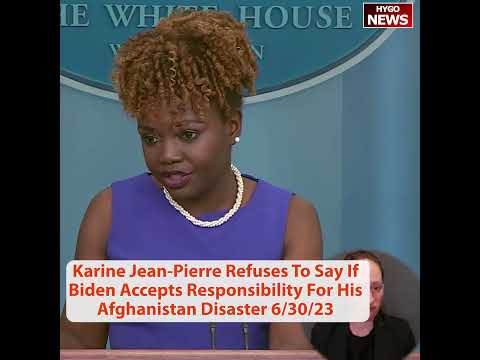
KJP Refuses to Say If Biden Accepts Responsibility for His Afghanistan Disaster
On June 30, 2023, a reporter confronted White House Press Secretary Karine Jean-Pierre with the specific findings of the State Department’s after-action review on the Afghanistan withdrawal, reading directly from the report that “senior administration officials were to blame for the chaotic exit” and asking whether the administration accepted responsibility. Jean-Pierre refused to answer, instead saying she would “let it speak for itself” and declining to comment further. She then cut off another reporter who tried to follow up by repeating “go ahead, go ahead” — moving to the next question without engaging with the substance of the review’s findings.
The Reporter’s Direct Question
The reporter laid out the findings of the State Department review with precision: “The report specifically says that senior administration officials were to blame for the chaotic exit; for failing to decide which Afghans should be eligible for evacuation; and for issuing changing guidance. Do you agree with the report? Do you accept responsibility for this chaos?”
The question was remarkable for its specificity. Rather than asking a general question about the withdrawal, the reporter quoted the report’s own findings, enumerating three concrete failures that the State Department review had attributed to senior officials within the Biden administration:
First, senior officials were blamed for the chaotic nature of the exit itself. The withdrawal had devolved into pandemonium at Hamid Karzai International Airport, with thousands of desperate Afghans overwhelming the perimeter, clinging to departing aircraft, and in some cases dying in the crush of crowds trying to reach the gates.
Second, the administration had failed to decide which Afghans should be eligible for evacuation. This was one of the most consequential failures, as it meant that personnel on the ground were making life-or-death decisions about who could enter the airport without clear criteria or consistent guidance from Washington. Afghan allies who had served alongside U.S. forces, interpreters who had risked their lives, and others who had been promised protection were left without a clear path to evacuation.
Third, the administration had issued changing guidance, creating confusion among the military personnel, State Department officials, and aid workers who were executing the evacuation. Shifting rules about documentation, eligibility, and processing procedures meant that individuals who were cleared for evacuation one day might be turned away the next, adding to the chaos at a time when every hour mattered.
Jean-Pierre’s Refusal to Accept Responsibility
Jean-Pierre’s response was a study in bureaucratic deflection: “Look, what I am — the report came from the State Department. It’s an action — after-action report. I will just let it speak for itself. I’m just not going to comment further. This is a State Department report. Clearly, it is part of the administration. If that’s what it lays out, that’s what it lays out.”
Several elements of her response were notable. First, she repeatedly emphasized that the report came from the State Department, as though distancing the White House from its findings. The phrase “this is a State Department report” was stated as a fact, but in context it functioned as a deflection — implying that the White House was not obligated to respond to or accept the findings of a report produced by another agency.
Second, her statement “if that’s what it lays out, that’s what it lays out” was a carefully constructed non-answer. On its surface, it appeared to acknowledge the report’s conclusions. But by framing it as a conditional — “if that’s what it lays out” — she avoided directly agreeing with the findings and certainly did not accept responsibility for them.
Third, the phrase “I will just let it speak for itself” was the most telling deflection. When a report directly blames your administration’s senior officials for specific, enumerated failures, letting it “speak for itself” is not neutrality. It is a refusal to engage. The reporter had asked two direct questions: “Do you agree with the report?” and “Do you accept responsibility?” Jean-Pierre answered neither.
Cutting Off the Follow-Up
After delivering her non-answer, Jean-Pierre moved to shut down further questioning on the topic. When another reporter attempted to follow up — “Can you explain why — what he means by —” — Jean-Pierre interrupted with “Go ahead. Go ahead,” moving to a different reporter and a different topic.
The pattern was consistent with Jean-Pierre’s handling of Afghanistan questions throughout the briefing. Each time a reporter pressed for specifics about Biden’s claims or the administration’s accountability, Jean-Pierre either deflected to general talking points, claimed she had already answered the question, or simply moved on.
The State Department Review
The after-action review that prompted the exchange was the Biden administration’s most comprehensive internal examination of the August 2021 withdrawal from Afghanistan. Released on June 30, 2023, the review found that the State Department had failed to do enough planning before the collapse of the U.S.-backed government.
The review repeatedly blamed the administrations of both former President Trump and President Biden for their efforts before and after the August 2021 departure of U.S. forces from Kabul. However, the failures attributed to the Biden administration were particularly damaging because they involved decisions made in the critical weeks when the Afghan government was collapsing and the evacuation was underway.
The administration released only 24 of the report’s 87 pages, and it was published on a Friday afternoon before a holiday weekend. Critics, including House Oversight Committee Chairman Michael Comer, accused the administration of deliberately trying to minimize coverage of the report’s damaging findings. The decision to withhold nearly three-quarters of the report further fueled accusations that the administration was hiding the full extent of its culpability.
Biden’s Defiance Earlier That Day
Jean-Pierre’s refusal to accept responsibility was all the more striking given Biden’s own comments earlier the same day. When asked if he admitted failure in Afghanistan, Biden had declared: “Remember what I said about Afghanistan? I said Al-Qaeda would not be there. I said it wouldn’t be there. I said we’d get help from the Taliban. What’s happening now? What’s going on? Read your press. I was right.”
Biden’s defiance and Jean-Pierre’s deflection presented a unified front of non-accountability. The President claimed the withdrawal was vindicated by subsequent events — a claim contradicted by the continued presence of Al-Qaeda in Afghanistan and the Taliban’s authoritarian rule. The press secretary refused to engage with the specific findings of the administration’s own review. Neither would accept responsibility for what the State Department itself had identified as failures by senior administration officials.
The Human Stakes
The failures documented in the report had real human consequences. The chaotic evacuation had resulted in the deaths of 13 U.S. service members in a suicide bombing at Abbey Gate on August 26, 2021. An estimated 170 Afghan civilians were also killed in the attack. The U.S. evacuated approximately 124,000 Afghans, but an unknown number of Americans and Afghan allies who had been promised evacuation were left behind.
The failure to decide which Afghans were eligible for evacuation — one of the specific findings Jean-Pierre refused to address — meant that some of those who had risked their lives to assist U.S. forces were abandoned to Taliban reprisals. The changing guidance she declined to discuss had created life-or-death confusion at the airport gates. And the chaotic exit she would not accept responsibility for had cost American lives.
Key Takeaways
- A reporter quoted the State Department review’s finding that “senior administration officials were to blame” for the chaotic exit and asked directly whether the White House accepted responsibility. Jean-Pierre refused to answer.
- Jean-Pierre said she would “let it speak for itself” and would not “comment further,” treating the State Department as a separate entity despite it being part of the Biden administration.
- Her phrasing “if that’s what it lays out, that’s what it lays out” was a non-answer that neither accepted nor rejected the report’s findings that officials failed to decide evacuation eligibility and issued changing guidance.
- The exchange occurred on the same day Biden declared “I was right” about Afghanistan, creating a unified front of non-accountability across the White House.
- The review found failures in planning and execution that contributed to the deaths of 13 U.S. service members and the abandonment of American citizens and Afghan allies.