 HYGO News
 KJP refuses to explain why deficit doubling: 'Talk to an economist' 'From year to year volatile'
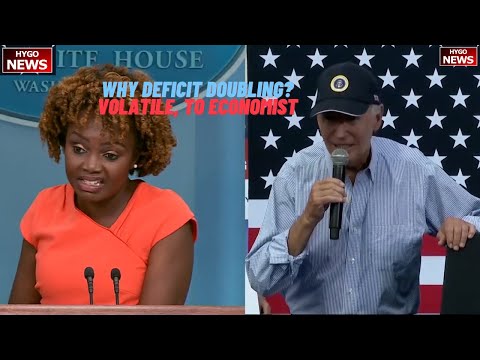
KJP Refuses to Explain Why Deficit Is Doubling: “Talk to an Economist” “From Year to Year Volatile”
On September 5, 2023, White House Press Secretary Karine Jean-Pierre was asked a straightforward question during her regular briefing: why was the federal deficit doubling? Her response was to dismiss the question entirely, telling the reporter to “talk to an economist” and claiming that deficits are “from year to year volatile.” The exchange illustrated a recurring pattern in Jean-Pierre’s briefings — when confronted with facts that contradicted the White House’s messaging, she would deflect, repeat talking points, and refuse to engage with the substance of the question.
The Briefing Exchange
A Time magazine reporter asked Jean-Pierre about the federal deficit, which projections showed was on track to roughly double from the prior fiscal year. Rather than address the data directly, Jean-Pierre leaned on her standard framing.
“Deficits from year to year can be volatile, and so that’s kind of how we have tracked that, but the reality is the president has a real plan, as we have laid out multiple times, to reduce the deficit,” Jean-Pierre claimed.
The reporter pressed: “What is the reason it’s going up, though? Why is the deficit increasing?”
Jean-Pierre’s answer was circular: “I just said, it can be year to year — it can be very volatile.”
When another reporter simply interjected “Why?” Jean-Pierre shot back dismissively: “Talk to an economist, and they can tell you specifically.”
The response was remarkable for its bluntness. The White House press secretary — whose entire job is to explain and defend the administration’s policies — was telling the press corps that she could not explain why the deficit was increasing and that they should seek answers elsewhere. It was an admission of either ignorance or unwillingness to engage with unfavorable data, neither of which inspired confidence in the administration’s fiscal messaging.
The Deficit Numbers
The numbers Jean-Pierre was attempting to deflect from were significant. The nonpartisan Committee for a Responsible Federal Budget had projected that the federal deficit for fiscal year 2023, which would end on September 30, was on track to hit approximately $2 trillion. This represented a near-doubling from the $1.4 trillion deficit recorded in fiscal year 2022.
This trajectory directly contradicted one of President Biden’s most frequently repeated claims: that he had reduced the deficit. Biden regularly cited the decline in the deficit from its pandemic-era peak of $3.1 trillion in fiscal year 2020 to lower levels in subsequent years. However, as multiple fact-checkers noted, much of that decline was attributable to the natural expiration of emergency pandemic spending programs — not to any fiscal discipline imposed by the Biden administration.
The deficit was increasing in fiscal year 2023 for identifiable reasons, including elevated federal spending, rising interest costs on the national debt driven by the Federal Reserve’s rate hikes to combat inflation, and the cost of student loan forgiveness programs. These were not mysterious or “volatile” factors — they were specific policy choices and economic conditions that a competent press secretary could have acknowledged and contextualized.
Jean-Pierre’s Talking Points
After dismissing the deficit question, Jean-Pierre pivoted to her prepared talking points, reciting them largely verbatim from her briefing book.
“The deficit has fallen more than $1 trillion under this president, and he has signed legislation to cut the deficit by another $1 trillion — so the president’s budget would reduce the deficit by a further $2.5 trillion by cutting wasteful spending on wasteful special interests and making big corporations and the rich pay their fair share,” she contended.
She then shifted to attacking Republicans: “By contrast, what you’re seeing from our Republican colleagues on the other side is that, you know — especially what President Trump and congressional Republicans, what they did during his administration is that they added $2 trillion to the deficit with a tax cut that obviously skewed obviously to the wealthy and large corporations.”
Jean-Pierre continued: “The president believes in moving forward with his economic plan in a fiscally responsible way, and so that’s what we’re going to continue to do here. What we know for sure is that trickle-down economy does not work, you hear us talk about all the time when we talk about Bidenomics is building an economy from the bottom up, middle out — that’s the president’s plan, that’s what he’s going to continue to do. And that’s what he’s going to do in a fiscally responsible way.”
She concluded: “What I can speak to is what the president has done over the last two years — is we the deficit go down $1 trillion. He spent — he signed another piece of legislation where the deficit is going to go down another $1 trillion. That is the president’s focus, that is why we believe Bidenomics is so important.”
The response was notable for several reasons. First, the claim that Biden had reduced the deficit by $1 trillion relied on comparing post-pandemic years to the peak pandemic spending year — a comparison that fact-checkers had repeatedly flagged as misleading. Second, Jean-Pierre’s pivot to attacking Trump-era tax cuts did not address the reporter’s question about why the deficit was currently increasing. Third, her mention of Bidenomics — a branding effort the White House had recently launched — seemed disconnected from a conversation about a ballooning deficit.
The “Fiscally Responsible” Disconnect
The core tension in the exchange was between the White House’s insistence that Biden was “fiscally responsible” and the observable reality that the deficit was nearly doubling on his watch. Jean-Pierre’s inability to reconcile these two facts — or even to attempt a reconciliation — left reporters visibly unsatisfied.
A press secretary in that situation had several options. She could have acknowledged the deficit increase and explained the specific factors driving it while arguing that the administration’s long-term fiscal plan would eventually reduce deficits. She could have pointed to specific legislative achievements that would reduce future spending. She could have provided context about interest rate costs and their relationship to inflation-fighting measures.
Instead, Jean-Pierre chose the least informative path: deny, deflect, and dismiss. The deficit was “volatile.” The president had a “real plan.” Talk to an economist.
The Pattern
This briefing was not an isolated incident. Jean-Pierre’s tenure as press secretary was defined by a reliance on scripted talking points that she would recite regardless of the question being asked. When reporters pressed for specifics that fell outside her prepared material, she would either redirect them to other agencies, claim she had not seen the report in question, or — as in this case — suggest they consult outside experts.
The “talk to an economist” line was particularly striking because it implied that explaining economic policy was beyond the scope of the White House press secretary’s responsibilities. The press secretary speaks for the President of the United States. If the administration had a coherent explanation for why the deficit was increasing, Jean-Pierre should have been prepared to deliver it.
Key Takeaways
- On September 5, 2023, KJP dismissed questions about the federal deficit nearly doubling by calling deficits “volatile” and telling a reporter to “talk to an economist.”
- The nonpartisan Committee for a Responsible Federal Budget projected the fiscal 2023 deficit would hit approximately $2 trillion, nearly double the prior year’s $1.4 trillion.
- Jean-Pierre repeated the claim that Biden had reduced the deficit by $1 trillion, a figure fact-checkers flagged as misleading because it compared post-pandemic spending to peak pandemic levels.
- Rather than addressing the specific drivers of the deficit increase — elevated spending, rising interest costs, and student loan programs — Jean-Pierre pivoted to attacking Trump-era tax cuts and promoting Bidenomics.
- The exchange exemplified Jean-Pierre’s pattern of reciting prepared talking points without engaging with the substance of reporters’ questions.