 HYGO News
 KJP Refuses To Call Chinese App TikTok A 'National Security Risk'
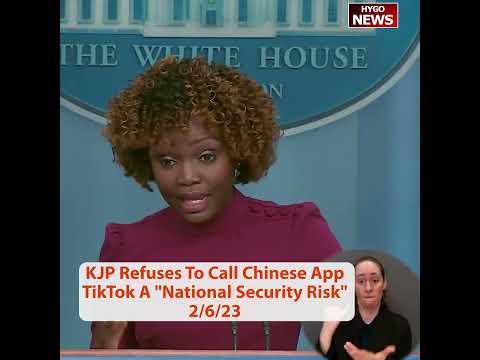
KJP Won’t Label TikTok a National Security Risk — Only “Unacceptable” Concerns About Chinese Data Leveraging
In February 2023, a reporter asked White House Press Secretary Karine Jean-Pierre whether TikTok posed a national security threat, invoking both Congressional criticism and Senate calls for app store removal. “Congressman Ken Buck saying if you think of if you see the CCP surveillance balloon scares you, wait until you hear about TikTok. Senator Michael Bennett had recently called on the CEOs of Apple and Google to remove TikTok from their Google Play stores and Apple Play Store. Does the administration believe that TikTok is a national security threat and doesn’t believe that those apps should be removed?” the reporter asked. KJP noted restrictions but avoided direct labeling: “The Biden administration more broadly has never allowed TikTok on the White House devices. Other federal agencies have similar restriction. We have been clear about our concerns on apps like TikTok.” Then she framed the concern abstractly: “We are focused on the challenges of certain countries including China seeking to leverage digital technologies in Americans data in ways that present unacceptable national security risk. I’m just not going to get ahead of it as we know there’s a review currently happening.”
The Ken Buck Framing Invoked
Ken Buck framing:
“Balloon scares you” — Current crisis.
“Wait until TikTok” — Comparison.
Surveillance parallel — Drawn.
Republican framing — Sharp.
National security angle — Emphasized.
Congressman Ken Buck’s framing comparing TikTok to the balloon crisis was sharp rhetorical comparison. If Americans were alarmed about physical Chinese surveillance, they should be more alarmed about daily data surveillance through TikTok. This was effective political framing.
The Michael Bennet Senate Action
Bennet action:
Senate Democrat — From Colorado.
Apple and Google — Targeted.
App store removal — Demanded.
Bipartisan pressure — Indicated.
Substantive request — Made.
Senator Michael Bennet’s request to Apple and Google to remove TikTok from app stores was substantive Democratic action. This wasn’t just Republican criticism but bipartisan concern about TikTok’s security implications.
”Never Allowed TikTok on White House Devices”
KJP’s initial admission:
Restriction exists — Internal.
White House devices — Protected.
Federal agencies — Similar.
Practice — Established.
Implicit concern — Revealed.
KJP’s acknowledgment that TikTok was banned on White House devices was implicit admission of security concerns. If TikTok weren’t a threat, why ban it on government devices? The practice contradicted any benign characterization.
The Federal Agency Pattern
Federal restrictions:
Multiple agencies — Banning TikTok.
Defense Department — Leading.
State Department — Following.
Various others — Joining.
Pattern — Clear.
The federal agency pattern of banning TikTok from government devices was widespread and growing. These weren’t partisan decisions — they were professional security assessments by career officials across multiple administrations.
”Clear About Our Concerns”
KJP noted concerns:
“We have been clear” — Claimed.
“Our concerns” — Acknowledged.
“Apps like TikTok” — Specified.
Specific company — Named implicitly.
Pattern continuing — Consistent.
While KJP said the administration had been “clear about our concerns,” that wasn’t entirely accurate. The concerns had been suggested more than stated plainly. The “clear” framing was somewhat generous.
”Certain Countries Including China”
Abstract framing:
“Certain countries” — Plural.
“Including China” — Specific.
Not exclusive — China alone.
Framing softening — Somewhat.
Political caution — Evident.
The “certain countries including China” framing was softer than simply naming China. It suggested China was one of several, reducing the directness of the attack on Chinese tech. This was diplomatic hedging.
”Leverage Digital Technologies in Americans Data”
The concern:
Digital technologies — Broad scope.
Americans data — Subject.
“Leverage” — Concerning word.
Intentional use — Implied.
Hostile intent — Suggested.
The framing of China “leveraging digital technologies in Americans data” was substantive concern. This wasn’t about ownership or control per se but about active use of American user data by Chinese entities. This was real security concern.
”Unacceptable National Security Risk”
The strong phrase:
“Unacceptable” — Strong.
“National security risk” — Direct.
Categorical framing — Used.
Near explicit — Admission.
Still qualified — Technically.
The phrase “unacceptable national security risk” was near-explicit acknowledgment that TikTok posed threat. KJP came close to directly labeling TikTok but maintained some linguistic distance through the “certain countries” framing.
”Not Going to Get Ahead”
The deflection:
“Not going to get ahead” — Deflection.
“Review happening” — Citation.
Specifics avoided — Future policy.
Process respect — Claimed.
Engagement limited — Maintained.
KJP’s “not going to get ahead of” framing was standard deflection. The ongoing review provided cover for not making specific policy commitments. This allowed strategic ambiguity about TikTok’s future.
The CFIUS Review
Ongoing review:
CFIUS — Committee on Foreign Investment.
ByteDance — Parent company.
Investigation — Multi-year.
National security — Focus.
Ultimate outcome — Uncertain.
The CFIUS review of ByteDance’s ownership of TikTok was the ongoing process KJP referenced. This multi-year investigation would eventually produce national security assessment. Whether it would result in divestiture, ban, or approval was unclear.
The Verbal Patterns
KJP verbal patterns:
“CCCCC surveillance balloon” — Stumble.
“White House of Vices” — Stumble.
“More more broadly” — Repetition.
“Other faith at federal” — Stumble.
Under pressure — Consistent.
KJP had multiple verbal issues in this response — “CCCCC” for CCP, “of Vices” for devices, double “more,” and other slips. These were her characteristic under-pressure verbal difficulties. Clip-worthy moments for critics.
The Political Delicate Dance
Political dance:
TikTok ban — Controversial.
Young voters — TikTok users.
2024 concern — Real.
Security concerns — Legitimate.
Balance needed — Difficult.
The administration’s caution on TikTok reflected political reality. TikTok was used by many young voters who would be crucial in 2024. Banning it could have political cost. Administration had to balance security and political considerations.
The National Security Concerns Real
Real concerns:
Data access — By Chinese government.
Algorithm control — Beijing influence.
Content moderation — Political.
Youth influence — Substantial.
Long-term — Strategic.
National security concerns about TikTok were substantive not manufactured. Chinese government legal authority to access ByteDance data, algorithm control, and youth influence at scale were all real issues. The concerns had bipartisan support.
The Bipartisan Pressure Growing
Bipartisan pressure:
Republicans leading — Aggressively.
Democrats joining — Bennet, Warner.
Intelligence community — Warning.
FBI — Concerns.
Administration — Catching up.
Pressure on TikTok was bipartisan and growing. Republicans were leading aggressively, Democrats were joining, intelligence community was warning, FBI was concerned. Administration caution appeared increasingly out of step.
The State Action Context
State bans:
Multiple states — Acting.
Government devices — Banned.
University systems — Following.
Momentum — Building.
Federal lagging — Somewhat.
Multiple states had banned TikTok on government devices. University systems were following. The state momentum was building faster than federal action. This created pressure on federal government to match state action.
The Corporate Response
ByteDance response:
Denials — Continuing.
“Project Texas” — Proposed.
Data localization — Offered.
Compromise — Attempted.
Controversy — Continuing.
ByteDance’s proposed solutions — Project Texas with U.S. data storage and various guarantees — were attempts to address concerns. Whether they adequately addressed security risks was debated. The debate continued.
The Children’s Safety Dimension
Children concerns:
Algorithm — Exploitative.
Mental health — Affected.
Content — Problematic.
Parental concern — Growing.
Regulatory — Consideration.
Beyond national security, TikTok’s impact on children’s mental health was separate concern. Algorithm optimization for engagement had documented negative effects. This was parallel regulatory consideration.
The First Amendment Questions
First Amendment issues:
Speech platform — TikTok is.
Government ban — Constitutional questions.
Narrow tailoring — Required.
Compelling interest — National security.
Legal challenge — Expected.
Banning TikTok raised First Amendment questions. The platform was used for protected speech by millions of Americans. Any government ban would face legal challenge and need to be narrowly tailored to compelling interest.
The Technology Competition Dimension
Technology competition:
U.S.-China rivalry — Broader.
Technology sector — Central.
Data sovereignty — Concept.
Supply chain — Considerations.
Strategic competition — Frame.
TikTok debate was part of broader U.S.-China technology competition. Data sovereignty, supply chain security, strategic technology were all in play. TikTok was one piece of larger strategic puzzle.
The Administrative Strategic Silence
Strategic silence:
Policy not announced — Intentional.
Options preserved — Flexibility.
Political sensitivity — Managed.
Review citation — Cover.
Engagement limited — Deliberately.
The administration’s strategic silence on TikTok specifics preserved options and managed political sensitivity. The ongoing review provided cover for not committing to specific outcomes. This was deliberate strategic positioning.
The Consumer Alternatives
Alternatives:
Instagram Reels — Direct competitor.
YouTube Shorts — Parallel.
Various platforms — Emerging.
User migration — Difficult.
Network effects — Strong.
If TikTok were banned, alternatives existed but user migration would be difficult. Network effects kept users on TikTok. Replacement wouldn’t be automatic. This complicated simple policy solutions.
The Geopolitical Messaging
Messaging:
China — Characterized.
Concerns — Specific.
Competition — Acknowledged.
Policy — Uncertain.
Strategic — Deliberate.
The geopolitical messaging about China through TikTok discussion was careful. China was named but “certain countries including” framing softened. Concerns were specified but not fully operationalized in policy.
The Reporter’s Professional Work
Reporter:
Specific citations — Of officials.
Pointed question — Security threat.
App store removal — Included.
Administrative accountability — Sought.
Quality journalism — Displayed.
The reporter’s question was well-constructed. Citing both Republican Congressman Ken Buck and Democratic Senator Michael Bennet made clear this was bipartisan concern. The specific policy ask about app store removal was concrete.
The Pattern of Not Calling It
Pattern:
Direct labeling — Avoided.
Specific designation — Refused.
Near-admission — Made.
Abstract framing — Used.
Strategic ambiguity — Maintained.
KJP’s pattern of near-admission while avoiding direct labeling was characteristic. “Unacceptable national security risk” from “certain countries including China” came very close to calling TikTok threat without actually doing so. Strategic ambiguity maintained.
The Future Policy Uncertainty
Future uncertainty:
Ban possible — But difficult.
Divestiture required — Maybe.
Status quo — Continuation.
Political pressure — Growing.
Resolution — Uncertain.
The future of TikTok policy remained uncertain through 2023 and beyond. Ban, divestiture, or continued operation all remained possibilities. Political pressure was growing but resolution was slow and uncertain.
The 2024 Presidential Campaign
Campaign dimension:
Trump TikTok record — Mixed.
Biden TikTok — Caution.
Youth vote — Factor.
Security concerns — Bipartisan.
Campaign messaging — Complex.
TikTok would feature in 2024 presidential campaign. Both Trump (who had tried to ban it) and Biden had complex records. Youth voters who used TikTok were politically important. Security concerns were bipartisan. Campaign messaging would be complex.
The Democratic Caucus Concerns
Democratic concerns:
Bennet leading — Senate.
Warner engaged — Intelligence.
Various members — Supporting.
White House — Restrained.
Gap visible — Between.
Gap between restrained White House position and growing Democratic Caucus concerns was visible. Senators Bennet and Warner were pushing harder than administration. This created pressure from administration’s own party.
The Intelligence Community Warnings
Intelligence warnings:
FBI Director — Public.
CIA concerns — Reported.
Intelligence reports — Classified.
Threat assessment — Serious.
Administration response — Measured.
Intelligence community had publicly warned about TikTok through FBI Director testimony and other statements. Classified threat assessments existed. Administration response appeared measured given intelligence community concerns.
The Long-Term National Security Dimension
Long-term:
Chinese surveillance — Multi-year concern.
Data accumulation — Growing.
Influence operations — Potential.
Strategic implications — Long.
Policy needed — Eventually.
The long-term national security dimension required eventual policy response. China’s ability to access American data through TikTok and potentially conduct influence operations was serious strategic concern. Policy couldn’t be indefinitely deferred.
Key Takeaways
- A reporter invoked Congressman Ken Buck’s comparison between Chinese balloons and TikTok, plus Senator Michael Bennet’s call for app store removal.
- KJP noted White House device ban: “The Biden administration more broadly has never allowed TikTok on the White House devices. Other federal agencies have similar restriction.”
- She acknowledged concerns: “We have been clear about our concerns on apps like TikTok.”
- She framed abstractly: “We are focused on the challenges of certain countries including China seeking to leverage digital technologies in Americans data in ways that present unacceptable national security risk.”
- She deflected on policy specifics: “I’m just not going to get ahead of it as we know there’s a review currently happening.”
- KJP came close to directly labeling TikTok as national security threat but maintained linguistic distance through “certain countries” framing.
Transcript Highlights
The following is transcribed from the video audio (unverified — AI-generated from audio).
- Congressman Ken Buck saying if you think of if you see the CCP surveillance balloon scares you wait until you hear about TikTok.
- Senator Michael Bennet had recently called on the CEOs of Apple and Google to remove TikTok from their Google Play stores and Apple Play Store.
- The Biden administration more more broadly has never allowed TikTok on the White House devices. Other federal agencies have similar restriction.
- We have been clear about our concerns on apps like TikTok.
- We are focused on the challenges of certain countries including China seeking to leverage digital technologies in Americans data in ways that present unacceptable national security risk.
- I’m just not going to get ahead of it as we know there’s a review currently happening.
Full transcript: 161 words transcribed via Whisper AI.