 HYGO News
 KJP Refuses To Address House GOP Request For Unredacted Records From Then VP Biden
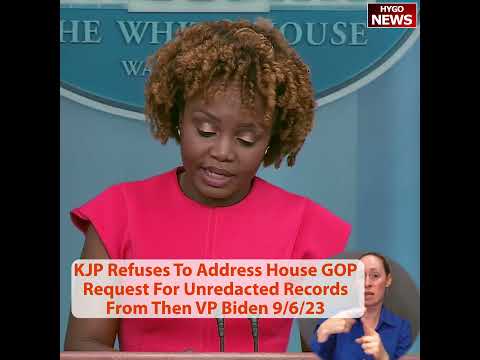
KJP Refuses to Address House GOP Request for Unredacted Records From Then-VP Biden
On September 5, 2023, a reporter asked White House Press Secretary Karine Jean-Pierre about a letter House Republicans had just sent to the National Archives requesting unredacted records from the office of then-Vice President Joe Biden. The reporter’s question was direct: did the White House support transparency on these records? Jean-Pierre immediately deflected, saying she would “let the White House Counsel’s Office” handle it and that she had nothing more to share. The brief exchange encapsulated the Biden administration’s consistent strategy of routing all questions about the president’s family business dealings through legal counsel rather than addressing them from the podium.
KJP Deflects to White House Counsel
The reporter laid out the request plainly: “House Republicans have just sent a letter to National Archives requesting unredacted records from the office of then-Vice President Biden. Does the White House support the transparency on these records?”
Jean-Pierre’s answer was a study in practiced avoidance: “So, look, I’m just going to let — I know the White House — my — my team at the White House Counsel’s Office has responded to this. I’m just going to let them deal with that — that information. I just don’t have more — more to share.”
The response was notable for its layers of deflection. Jean-Pierre did not say the White House supported transparency. She did not say it opposed the request. She did not characterize the records or explain why they might be redacted. She simply routed the question to the counsel’s office, a referral that effectively killed the line of inquiry since the counsel’s office does not hold public briefings or take follow-up questions from the press corps.
The National Archives Records Request
The letter from House Republicans to the National Archives and Records Administration was part of the House Oversight Committee’s investigation into the Biden family’s financial dealings. The committee, chaired by Representative James Comer of Kentucky, had been seeking documents related to Joe Biden’s time as vice president under Barack Obama, particularly records that might reveal interactions between Biden’s official office and his son Hunter Biden’s foreign business associates.
The specific records in question involved communications from the Office of the Vice President during the Obama administration. House Republicans argued that redactions applied to previously released documents obscured potentially significant details about the relationship between Biden’s official duties and his family’s business activities. The request for unredacted versions was an escalation in the committee’s investigative efforts.
The National Archives had become a central battleground in the investigation because it housed the official records of Biden’s vice presidency. Under the Presidential Records Act, these documents were the property of the federal government and subject to potential disclosure, though various exemptions and redaction protocols could limit what was made public.
The White House Counsel Firewall
Jean-Pierre’s referral to the White House Counsel’s Office was consistent with a strategy the Biden administration had employed since the earliest days of the Hunter Biden controversy. By designating the counsel’s office as the sole point of contact for all questions related to the Biden family’s business dealings and any associated investigations, the White House created a firewall between the press secretary and the most politically damaging line of inquiry facing the administration.
The strategy had several advantages for the White House. First, it prevented Jean-Pierre from making statements at the podium that could later be used in legal proceedings or contradicted by emerging evidence. Second, it allowed the administration to avoid creating news by declining to engage with specifics. Third, it frustrated reporters who could not get answers during the daily briefing, the most visible and widely covered forum for White House communications.
The disadvantage was that it created a recurring spectacle of the press secretary visibly refusing to address a major story. Each deflection to the counsel’s office reinforced the impression that the White House had something to hide, even if the referral was legally prudent. Reporters noted that Jean-Pierre was willing to discuss virtually any other topic from the podium but consistently declined to engage with questions about the Biden family’s finances.
The Broader Investigation Context
The records request came during a period of intensifying congressional scrutiny of the Biden family’s business dealings. By September 2023, the House Oversight Committee had issued multiple subpoenas, obtained bank records, and interviewed witnesses as part of its investigation into what Republicans characterized as an influence-peddling operation centered on the Biden family name.
Key developments that preceded this exchange included Devon Archer’s testimony before the committee in late July 2023, in which Hunter Biden’s former business partner described how they leveraged the “Biden brand” in their dealings with foreign companies and governments. Archer testified that Hunter Biden had placed his father on speakerphone during business meetings with foreign associates, a detail that contradicted Joe Biden’s repeated assertion that he had never discussed business with his son.
The committee had also obtained bank records showing a complex web of shell companies through which funds from foreign entities flowed to various Biden family members. Republicans argued that the pattern of payments, the use of multiple LLCs, and the involvement of Biden family members who had no apparent expertise in the relevant industries pointed to an influence operation rather than legitimate business activity.
House Speaker Kevin McCarthy had announced a formal impeachment inquiry into President Biden just days after this briefing, on September 12, 2023, further escalating the political stakes surrounding the investigation.
The Transparency Question
The reporter’s question about whether the White House “supported transparency” on the records was particularly pointed because the Biden administration had entered office promising to be the most transparent administration in history. Biden had explicitly contrasted his approach with what he characterized as the secrecy of the Trump years.
The refusal to even address the question of transparency on vice presidential records undercut that promise. A White House that supported transparency could have said so without prejudging the content of the records. A simple “The president believes in transparency and the National Archives will process the request through normal channels” would have been a standard, non-committal response that at least acknowledged the principle.
Instead, Jean-Pierre’s flat refusal to engage suggested that the White House was not confident that the unredacted records would support the administration’s narrative that there was no connection between Biden’s official actions and his family’s business dealings.
A Recurring Pattern
The September 5 exchange was one of hundreds of similar moments throughout Jean-Pierre’s tenure in which she declined to address questions about Hunter Biden’s business activities, the president’s knowledge of or involvement in those activities, or the various investigations examining the Biden family’s finances.
The pattern was so consistent that reporters began to frame their questions in ways designed to make the deflection itself the story. By asking whether the White House “supported transparency,” the reporter forced Jean-Pierre to choose between endorsing openness, which might have been used to pressure the administration to release the records, and declining to engage, which highlighted the administration’s resistance to scrutiny.
Jean-Pierre consistently chose the latter, creating a body of footage in which the White House press secretary repeatedly refused to discuss one of the most significant investigations of the Biden presidency. Critics argued that the cumulative effect was more damaging than any single answer could have been, as it painted a picture of an administration that was systematically stonewalling legitimate oversight.
Key Takeaways
- On September 5, 2023, a reporter asked KJP whether the White House supported transparency on House Republicans’ request for unredacted National Archives records from Biden’s vice presidential office.
- Jean-Pierre immediately deflected to the White House Counsel’s Office, saying “I’m just going to let them deal with that information” and declining to state any position on the transparency question.
- The records request was part of the House Oversight Committee’s investigation into Biden family business dealings, which had intensified following Devon Archer’s testimony about the “Biden brand.”
- The White House’s strategy of routing all Biden family questions through legal counsel prevented the press secretary from creating news but reinforced the impression of an administration resisting scrutiny.
- The refusal to endorse transparency on vice presidential records contradicted the administration’s promise to be the most transparent in history.