 HYGO News
 KJP Reads Prepared Script From Binder In Response To El Paso Declaring State Of Emergency, $3.5B
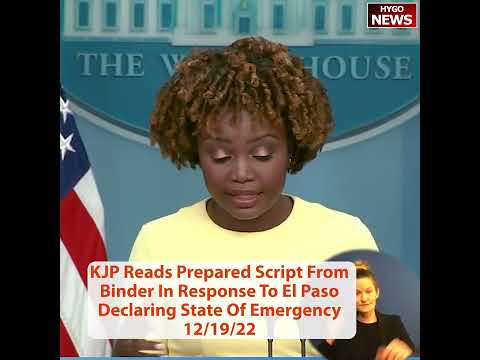
KJP Reads Scripted Response on El Paso State of Emergency — “In Constant Communication” and “$3.5 Billion Additional Funding Request”
On 12/19/2022, a reporter asked White House Press Secretary Karine Jean-Pierre about El Paso’s Democratic mayor declaring a state of emergency ahead of Title 42’s anticipated end. The mayor had said he would only declare emergency “when he felt he could no longer keep his community or the asylum seekers safe” — and he felt that time had come. KJP read a prepared response from her binder: “From day one President Biden has taken steps to reduce disorderly migration while expanding legal pathways for orderly migration. We are in constant communication with the mayor of El Paso. We’re surging resources to the border. We’re going to continue to do the work that is needed. We’re going to ask for the additional funding, the 3.5 billion additional funding requests from Congress.” The scripted nature of the response was notable for a question about an unfolding crisis in a specific city.
The El Paso State of Emergency
The El Paso situation was serious. Mayor Oscar Leeser had declared a state of emergency based on:
Migrant volumes — Significantly exceeding city capacity.
Shelter strain — Local facilities overwhelmed.
Street populations — Migrants sleeping outside in winter cold.
Anticipated Title 42 end — Expected further volume increase.
Resource needs — Beyond local capacity.
Public safety concerns — For both migrants and residents.
Leeser was a Democrat. His declaration wasn’t Republican political theater — it was a Democratic mayor’s assessment that federal response was inadequate. The declaration created specific political pressure on the Biden administration.
The Democratic Mayor Context
Mayor Leeser’s Democratic affiliation was politically important:
Not a partisan attack — From administration perspective.
Could not be dismissed — As “political stunt.”
Reflected genuine concern — From administration ally.
Required serious response — Rather than deflection.
Cross-party credibility — For his assessment.
When Democratic mayors declared emergencies, the White House couldn’t use Republican-blame framing. The administration had to engage with Democratic officials’ concerns substantively. This was different from situations where Republican governors made similar declarations.
”Could No Longer Keep His Community Safe”
The reporter’s framing quoted the mayor’s explicit concern. “He said that he would only do that when he felt he could no longer keep his community or the asylum seekers safe,” the reporter said.
The “safe” framing was significant:
Not about politics — About actual safety.
Community and migrants — Both concerns.
Reasoned standard — For emergency declaration.
Implied federal failure — To maintain safety.
Municipal responsibility — Limits reached.
The mayor had set a specific threshold — when safety could no longer be maintained. When he declared emergency, it meant that threshold had been crossed. This wasn’t routine politics; it was a specific safety judgment by a municipal leader.
The Scripted Response
KJP’s response had characteristics of scripted reading:
Polished phrasing — “Reduce disorderly migration while expanding legal pathways.”
Specific numbers — “$3.5 billion additional funding.”
Structured content — Multiple talking points.
Minimal hedging — For sensitive topic.
Consistent messaging — With prior administration statements.
The reading from a binder was characteristic of KJP’s briefing style. On sensitive topics, she would read prepared talking points rather than extemporizing. This ensured message discipline but also removed responsiveness to specific questions.
”Day One” Framing Again
The “day one” framing appeared predictably. “From day one President Biden has taken steps to reduce disorderly migration while expanding legal pathways for orderly migration,” KJP said.
The framing components:
“Day one” — Familiar administration framing.
“Reduce disorderly migration” — Claim of effective action.
“Expand legal pathways” — Claim of constructive policy.
Balance framing — Both enforcement and generosity.
The “reduce disorderly migration” claim was questionable. Border encounters had been at record levels throughout Biden’s presidency. Whether administration policies had “reduced” disorderly migration was debated — many observers thought administration policies had increased such migration.
”In Constant Communication”
KJP claimed communication. “We are in constant communication with the mayor of El Paso,” KJP said.
The “constant communication” claim was:
Rhetorically strong — Suggesting close engagement.
Empirically testable — Mayor could confirm or deny.
Politically important — Showing administration engagement.
But unverified — In the briefing itself.
The claim suggested that the administration and Mayor Leeser were in close dialogue. If true, why had the mayor declared emergency? Either the administration wasn’t addressing his concerns or the administration hadn’t actually been in “constant communication.”
The mayor’s own public statements sometimes suggested limited federal engagement. The disconnect between administration claims of communication and local officials’ experiences was common throughout 2022-2023.
”Surging Resources”
KJP claimed resource deployment. “We’re surging resources to the border,” KJP said.
“Surging resources” was a standard administration phrase:
Vague scale — How much?
Unclear composition — Of what?
Timing unclear — When?
Destination unclear — Where specifically?
Effect unclear — On what problems?
The phrase implied action without detail. Surge could mean:
Personnel deployment — Additional staff.
Equipment transfer — Vehicles, supplies.
Financial resources — To localities.
Coordination efforts — Interagency work.
Information sharing — Communications.
Without specifics, “surging resources” was essentially a reassurance rather than a substantive engagement with El Paso’s specific needs.
”Continue to Do the Work”
KJP offered continued engagement. “We’re going to continue to do the work that is needed,” KJP said.
“Continue to do the work” was meaningless beyond claiming engagement. It:
Committed to continuation — Of undefined work.
Claimed adequacy — “What is needed.”
Avoided specifics — About what work.
Preserved flexibility — For future definition.
These empty phrases filled time in briefings without conveying actual information. Reporters could quote the phrase but couldn’t derive substantive understanding from it.
The $3.5 Billion Request
KJP cited specific funding. “We’re going to ask for the additional funding, the 3.5 billion additional funding requests from Congress,” KJP said.
The $3.5 billion figure was different from the $3 billion referenced in earlier briefings. This variation in cited amounts — sometimes $3B, sometimes $3.5B — suggested either:
Request had increased — As needs grew.
Different components cited — Depending on context.
Administration talking points — Used different numbers.
Staff variations — In preparation.
Whatever the explanation, the specific dollar amount was administration messaging rather than committed action. Congress would ultimately decide what to fund, not the administration.
The Funding Request Reality
The administration’s supplemental funding requests for border operations faced specific obstacles:
Congressional dynamics — Republican concerns about spending.
Democratic priorities — Competing priorities for appropriations.
Process requirements — Supplemental vs. regular budget.
Ongoing negotiations — With changing requirements.
Political timing — Near end of Congressional session.
The $3.5 billion was an ask, not an achievement. Administration talking points treated it as evidence of engagement, but the funding might not be approved. If Congress didn’t approve it, the administration could blame Congress. If approved, the administration could claim credit.
The Binder-Reading Pattern
The binder-reading pattern had implications:
Message discipline — Ensuring consistent framing.
Reduced spontaneity — Less off-script moments.
Preparation reliance — On written materials.
Limited responsiveness — To specific questions.
Verbal difficulty — Possible if reading compensated for stumbling.
KJP’s tendency to read from prepared materials had been noted throughout her tenure. While some reading was appropriate for specific briefings, the pattern of reading rather than speaking extemporaneously suggested either:
Strategic preference — For message control.
Verbal uncertainty — Needing written preparation.
Substantive limitation — Not having deep grasp of issues.
Administrative preference — For scripted responses.
The pattern didn’t necessarily reflect negatively on KJP — many press secretaries used prepared materials extensively. But the degree of reliance on scripted reading was notable.
The El Paso Response Gap
The response to El Paso’s emergency declaration was illustrative:
Local emergency declared — By Democratic mayor.
Federal response — Generic scripted talking points.
Administration engagement — Claimed but not detailed.
Funding request — As primary tangible response.
No specific actions — For El Paso situation.
El Paso’s specific needs — shelter, processing, transportation, medical care — weren’t addressed directly in the response. The administration’s response was about general policies, general communication, and general funding requests. Specific operational engagement with El Paso’s situation wasn’t articulated.
The Sanctuary City Complication
The El Paso situation was complicated by the broader sanctuary city debate:
Texas Republican governor — Busing migrants to Democratic cities.
Sanctuary city policies — Declared by many Democratic-led cities.
Federal-local tensions — Over migration management.
Resource strain — On destination cities.
Political positioning — By various actors.
El Paso wasn’t receiving bused migrants — it was at the origin point. But the broader sanctuary city debate affected how the federal administration engaged with Democratic-led municipalities. Democratic mayors expected federal support; federal officials expected local accommodation of federal policies.
The Approaching Deadline
The El Paso emergency came days before the anticipated Title 42 end (December 21). The city’s preparations would be tested imminently. If El Paso was already overwhelmed under Title 42, what would happen when Title 42 ended?
This was the urgent question KJP’s scripted response didn’t address. Generic talking points couldn’t substitute for specific preparation announcements. El Paso and other border cities needed to know:
What federal resources — Would arrive when.
What policies — Would be implemented.
What coordination — Would occur.
What contingencies — Were planned.
What communication — Would happen.
These operational details weren’t in the scripted response. KJP read about funding requests and day-one engagement while El Paso wondered what specific federal help was coming.
Key Takeaways
- A reporter asked KJP about El Paso’s Democratic mayor declaring a state of emergency ahead of Title 42’s anticipated end.
- Mayor Oscar Leeser had said he would only declare emergency when he could no longer keep his community or asylum seekers safe.
- KJP read a prepared response from her binder covering administration talking points.
- She claimed “constant communication with the mayor of El Paso” and “surging resources to the border.”
- KJP cited a $3.5 billion additional funding request from Congress as evidence of administration engagement.
- The scripted response didn’t address El Paso’s specific needs or detail what operational response would occur.
- The response exemplified KJP’s pattern of reading prepared talking points rather than engaging substantively with specific local situations.
Transcript Highlights
The following is transcribed from the video audio (unverified — AI-generated from audio).
- El Paso’s Democratic mayor has declared a state of emergency and he said that he would only do that when he felt he could no longer keep his community or the asylum seekers safe.
- He’s saying that that time is now ahead of Title 42 expiring. What is the White House response to that?
- From day one President Biden has taken steps to reduce disorderly migration while expanding legal pathways for orderly migration.
- We are in constant communication with the mayor of El Paso.
- We’re surging resources to the border. We’re going to continue to do the work that is needed.
- We’re going to ask for the additional funding, the 3.5 billion additional funding requests from Congress.
Full transcript: 140 words transcribed via Whisper AI.